


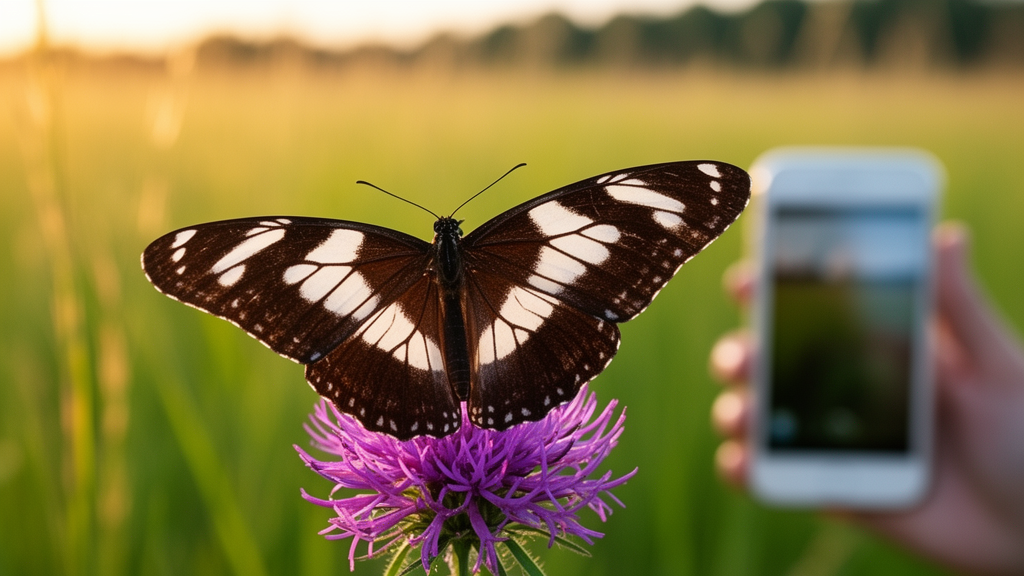
The Republic of Georgia has a new butterfly. Hipparchia parisatis, a large, pale-banded satyrine known in English as the White-edged Rockbrown, has been formally recorded in the country for the first time, based on five photographic records of five specimens from four localities, all within the Vashlovani Protected Areas in southeastern Georgia. The finding, published in the journal Caucasus, closes a conspicuous gap in the mapped distribution of a species whose confirmed range otherwise sweeps from Turkey and Iran eastward to Iraq, Oman, and Central Asia, and whose nearest documented populations lie in Armenia and Azerbaijan, hundreds of kilometres to the south and east.
Hipparchia parisatis is not a species one could easily misidentify. On the upper side of the hindwing, both sexes carry a striking white marginal band, the feature that gives the species its vernacular name, and a narrower version of the same band appears along the forewing. Only one other member of the genus, Hipparchia alcyone, shares anything like this pattern, but it lacks the row of prominent eyespots on the underside of the hindwing that is diagnostic for parisatis. The combination of a white hindwing margin and a strongly spotted underside separates the Georgian specimens from every other satyrine known from the Caucasus, which is why the authors of the new report were able to confirm the identification from field photographs alone, without collecting or dissecting a single specimen.
The story of the discovery is as much about how modern biodiversity data are gathered as it is about the butterfly itself. During fieldwork in Vashlovani Nature Reserve, supported by a grant from the Rufford Foundation, researcher János Novák photographed a single individual in its rocky habitat in August 2023. He posted the image to the citizen science platform iNaturalist, where it was tentatively identified by another contributor. Only then did the team realise what they had: not a stray vagrant but a species apparently established in Georgia, with older records already sitting unnoticed in online databases. A targeted search of iNaturalist and the observation platform Observation.org turned up four additional photographic records made between 2018 and 2022 by observers including Noé Terorde, Siebe Roffel, and Guido Reijnen, several of them from the same reserve.
All five records come from an area of barely a few square kilometres in and around Vashlovani Nature Reserve, a strictly protected zone established in 1935 that forms the core of the wider Vashlovani Protected Areas. The reserve sits in the extreme southeast of Georgia, where the country meets Azerbaijan, and protects a mosaic of arid grassland, steppe, and open woodland at elevations between roughly 300 and 800 metres above sea level. The Georgian records fall between 370 and 800 metres, consistent with the altitudinal preferences the species shows elsewhere in its range. Four of the five observations were made in September, and one in August, a seasonal pattern that matches the species’ phenology in neighbouring Iran, where adults fly in a single generation with a summer aestivation pause.
That phenology is one of the more curious aspects of the species’ biology. Across West and Central Asia, Hipparchia parisatis emerges in May or June, but the adults then disappear for the hottest weeks of summer, a dormancy strategy known as aestivation, before reappearing in August and September to complete their flight period. The Georgian observations, clustered in late summer, fit this rhythm precisely and suggest the species is not merely present but following the same life cycle in the Caucasus that it exhibits in its Asian strongholds. The authors note that the butterfly’s food plants, grasses typical of arid habitats, are abundant in the reserve, providing the resources needed for a resident population.
The zoogeographic implications are considerable. Vashlovani is already celebrated as one of the richest butterfly localities in Georgia, and the new report adds parisatis to a growing list of species there that are otherwise associated with the subtropical and tropical faunas of the East Mediterranean and West Asia. The authors describe the reserve as a refugium where relict populations of thermophilic species survive at the northern edge of their ranges, and the presence of parisatis strengthens the case that Vashlovani preserves a fragment of a once more widespread arid-subtropical biotope. The finding also underscores how incomplete the faunistic knowledge of the South Caucasus remains, with a conspicuous species going unrecorded in a well-studied country until citizen science platforms made the evidence visible.
The report is careful about what the photographs can and cannot establish. Because no specimens were collected, the authors cannot rule out entirely that the Georgian population belongs to a different subspecies from those found in Iran and Central Asia, and they note that the taxonomic status of parisatis populations in the Caucasus region, including those in Armenia and Azerbaijan, remains unresolved. What the images do establish, beyond reasonable doubt, is the presence of the species in Georgia, and the authors argue that the reserve’s protected status means the population is likely to persist. They recommend that future surveys combine targeted fieldwork with continued monitoring of citizen science platforms, an approach they say is proving essential for detecting new country records in a region where professional entomological coverage is thin.
For the authors, the discovery is a demonstration of the model they advocate: professional biologists and citizen observers working through shared online infrastructure. The initial photograph was taken by a professional researcher, but the identification was confirmed through iNaturalist’s community, and the additional records were found by searching the same platforms rather than by new fieldwork. The authors suggest that this workflow, in which observations are documented photographically, identified collaboratively, and then verified and published by specialists, is the most efficient way to advance faunistic knowledge in the South Caucasus, and they hope the Georgian record of Hipparchia parisatis will be the first of many such additions to the country’s butterfly fauna.
Subject of Research: On the presence of Hipparchia parisatis (Kollar, 1849) in the Republic of Georgia (Lepidoptera, Nymphalidae, Satyrinae)
Article Title: On the presence of Hipparchia parisatis (Kollar, 1849) in the Republic of Georgia ( Lepidoptera , Nymphalidae , Satyrinae )
Article References: Kolev, Z., Novák, J., & Seropian, A. (2024). On the presence of Hipparchia parisatis (Kollar, 1849) in the Republic of Georgia (Lepidoptera, Nymphalidae, Satyrinae). Caucasiana, 3, 263-271. https://doi.org/10.3897/caucasiana.3.140259
Image Credits: AI Generated
DOI: 10.3897/caucasiana.3.140259
Keywords: butterflies, citizen science, Georgia, Vashlovani, biodiversity, biogeography, presence, Hipparchia, parisatis, Kollar, Republic, Lepidoptera
Cite Scienmag News
Margaret Porter. (October 17, 2026). White-edged butterfly from Asia turns up in Georgia after citizen sleuths spot it online. Scienmag. https://scienmag.com/white-edged-butterfly-from-asia-turns-up-in-georgia-after-citizen-sleuths-spot-it-online/
Margaret Porter. "White-edged butterfly from Asia turns up in Georgia after citizen sleuths spot it online." Scienmag, 17 October 2026, https://scienmag.com/white-edged-butterfly-from-asia-turns-up-in-georgia-after-citizen-sleuths-spot-it-online/. Accessed 17 October 2026.
Margaret Porter. "White-edged butterfly from Asia turns up in Georgia after citizen sleuths spot it online." Scienmag. October 17, 2026. https://scienmag.com/white-edged-butterfly-from-asia-turns-up-in-georgia-after-citizen-sleuths-spot-it-online/


