


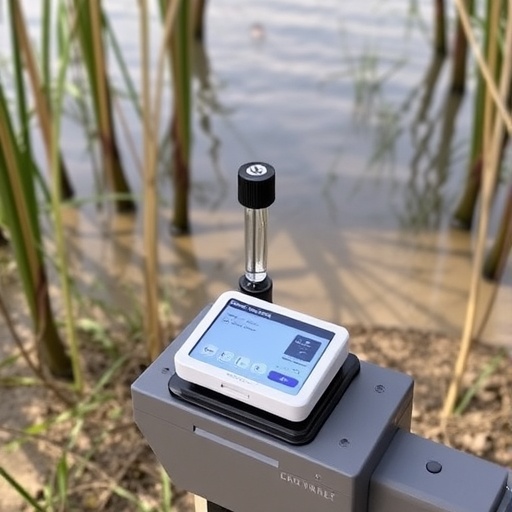
Beneath the placid surfaces of lakes and coastal waters lies a dynamic, unseen frontier—sediment layers that play a pivotal role in regulating aquatic ecosystem health. These sediments engage in a process known as benthic flux, where vital nutrients such as nitrogen and phosphorus are exchanged between the sediment and the overlying water. The release of these dissolved nutrients, while essential to nutrient cycling, can inadvertently trigger harmful algal blooms (HABs), which compromise water quality, disrupt aquatic life, and lead to negative socio-economic consequences including diminished recreational opportunities and lower property values.
Historically, gathering accurate and continuous data on benthic fluxes has been a formidable challenge for oceanographers and limnologists. Conventional methods typically demand the coordination of two separate boat trips to deploy and later retrieve heavy equipment, yielding only a single snapshot in time per deployment. This approach restricts our comprehension of the temporal complexities inherent in nutrient exchanges and limits our ability to understand how these processes fluctuate with environmental changes. Emerging autonomous systems offer some relief but remain underutilized in revealing the intricate sediment-water interactions that underlie nutrient dynamics and HAB proliferation.
Researchers at Florida Atlantic University’s Harbor Branch Oceanographic Institute have pioneered a breakthrough with a novel instrument called the Chamber ARray for Observing Sediment Exchanges Long-term, or CAROSEL. This advanced, intelligent underwater system revolutionizes benthic flux monitoring by automating high-frequency measurements of nutrient exchanges directly at the sediment-water interface. CAROSEL enables real-time data collection on ammonium (NH₄⁺) fluxes and other variables multiple times a day over extended periods, a feat previously unattainable with conventional tools.
CAROSEL operates autonomously on the lake or ocean bed, bypassing the need for repeated physical deployments. It harnesses an array of underwater sensors capable of capturing a suite of chemical parameters, thus providing comprehensive insight into how sediments influence nutrient cycling and overall water chemistry. This methodology stands in stark contrast to traditional benthic flux measurement approaches, opening new avenues for detailed, long-term ecological studies.
The FAU team deployed the CAROSEL system in a shallow freshwater retention pond situated on their Harbor Branch campus in Fort Pierce, Florida. This location provided an ideal natural laboratory to observe diel nutrient and oxygen flux patterns under variable environmental conditions. Their focus centered on dissecting how nutrients like ammonium and oxygen move between sediment and water across daily and multiday cycles, and how such exchanges respond to weather phenomena such as rainfall. The retention pond, typical of Best Management Practice (BMP) systems widespread across Florida, serves to mitigate nutrient loading before waters reach coastal estuaries—a critical environmental objective with evolving regulatory importance.
Results from this deployment, published in the journal Limnology & Oceanography, underscored intricate diel rhythms in benthic and water column chemistry. Oxygen fluxes in the water manifested a clear daily pattern, surging during daylight hours due to photosynthesis and declining at night as respiration dominates. In contrast, sediment layers consistently consumed oxygen, reflecting ongoing microbial metabolism. Intriguingly, sediments stubbornly released ammonium throughout the monitoring period, while the overlying water showed daytime nitrogen incorporation and nocturnal breakdown—counterintuitive to expectations that photosynthesis would elevate nutrient uptake by daytime.
Abrupt weather changes, especially post-rainstorm scenarios, highlighted the extreme sensitivity of nutrient fluxes. Both ammonium and nitrate exhibited rapid shifts, revealing how environmental perturbations modulate sediment-water interactions on short timescales. Furthermore, nitrogen removal pathways—principally nitrification and denitrification—were found to be robust yet highly variable, challenging assumptions that sediment processes operate slowly or steadily. This variability points to complex biochemical feedbacks that have critical implications for water quality management and HAB mitigation.
The high-temporal-resolution data provided by CAROSEL have far-reaching implications. According to Jordon Beckler, Ph.D., associate research professor and senior study author, such detailed monitoring facilitates a granular understanding of how weather patterns and environmental fluctuations directly impact lakebed chemistry. This capability enables scientists to unravel the multifaceted chain reactions in aquatic ecosystems that were previously obscured by low-frequency, low-resolution measurements, marking an exciting paradigm shift in benthic flux science.
Sediments, covering roughly 70% of the Earth’s surface beneath water bodies, have often been overlooked as a vital environmental interface. The insights gained through CAROSEL position sediments as the next frontier akin to the growing appreciation of terrestrial soil and atmospheric health. As HAB occurrences proliferate worldwide, understanding sediment contributions to nutrient regimes becomes ever more critical for ecosystem conservation and restoration strategies.
Another compelling feature of the CAROSEL system lies in its versatility and adaptability. Mason Thackston, the study’s first author and a graduate research assistant, emphasized that the system was engineered for dual freshwater and marine applications and can integrate virtually any commercially available underwater sensor. This flexibility enables tailored deployments across varied ecosystems, from lakes and retention ponds to estuaries and coastal marine environments, accommodating diverse research and monitoring priorities.
Looking ahead, the FAU researchers plan to extend CAROSEL’s utility in new projects, including establishing nutrient flux baselines in areas slated for dredging in Florida’s Northern Indian River Lagoon and directly tracking legacy nutrient fluxes in Lake Okeechobee. These efforts are expected to deepen understanding of BMP performance in mitigating nutrient pollution and inform adaptive management practices critical for sustaining water quality in the face of anthropogenic pressures and climate variability.
CAROSEL represents a transformative technological leap in aquatic ecosystem monitoring, enabling a never-before-seen window into the temporal dynamics of sediment-water nutrient exchange. This innovation not only enhances scientific knowledge but also holds promise for impacting environmental policy, restoration efforts, and public health through improved tracking and control of nutrient-driven water quality challenges.
News Publication Date:
31-Oct-2025
Web References:
Limnology & Oceanography Journal Link
Cite Scienmag News
Violet Maxwell. (November 5, 2025). FAU’s CAROSEL Unveils Innovative Real-Time Water Quality Monitoring Technology. Scienmag. https://scienmag.com/faus-carosel-unveils-innovative-real-time-water-quality-monitoring-technology/
Violet Maxwell. "FAU’s CAROSEL Unveils Innovative Real-Time Water Quality Monitoring Technology." Scienmag, 5 November 2025, https://scienmag.com/faus-carosel-unveils-innovative-real-time-water-quality-monitoring-technology/. Accessed 5 September 2026.
Violet Maxwell. "FAU’s CAROSEL Unveils Innovative Real-Time Water Quality Monitoring Technology." Scienmag. November 5, 2025. https://scienmag.com/faus-carosel-unveils-innovative-real-time-water-quality-monitoring-technology/


