


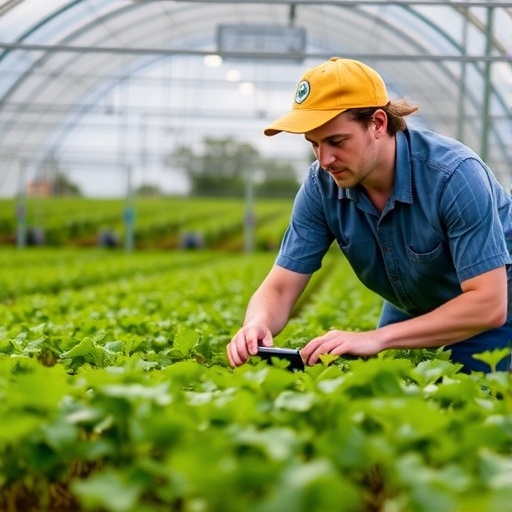
In the quest to address the mounting global challenge of feeding an ever-growing population while safeguarding natural resources, researchers at Florida Atlantic University (FAU) have embarked on a transformative journey to redefine precision agriculture. Spearheaded by Dr. Arslan Munir, associate professor in the Department of Electrical Engineering and Computer Science at FAU’s College of Engineering and Computer Science, this groundbreaking initiative harnesses cutting-edge edge and fog computing technologies to revolutionize how farmers monitor, analyze, and respond to crop needs in real time. With a substantial $827,533 grant awarded by the United States Department of Agriculture’s National Institute of Food and Agriculture, the project promises to set new benchmarks for intelligent farming systems.
This ambitious multi-institutional research collaboration, which also includes Kansas State University and Purdue University, introduces an innovative edge/fog computing-based framework named “FogAg.” Designed to operate at the intersection of computational intelligence and agricultural science, FogAg focuses on the dynamic interplay between water and nitrogen—the two critical yet often variable inputs that directly influence crop yield and health. By capturing real-time multi-layer sensing data coupled with advanced analytics, the system aims to provide actionable insights into water-nitrogen interactions that conventional smart farming tools have struggled to achieve.
Modern agriculture confronts an escalating array of stresses, ranging from environmental challenges to resource constraints, all intensified by rising global food demands. Water scarcity and inefficient nitrogen usage are pervasive problems that undermine crop productivity and exacerbate environmental degradation through runoff and pollution. Traditional precision agriculture systems often rely heavily on periodic data collection without the computational agility to interpret complex, multifactorial relationships in situ, limiting farmers’ ability to make precise, timely interventions that optimize input efficiency while maximizing output.
The FogAg framework pioneers a holistic approach by integrating distributed computing layers that span from IoT-enabled field sensors to fog nodes and cloud computing infrastructure. This three-tiered cyber-physical architecture fosters near real-time processing and analytics at the network edge, dramatically reducing latency and bandwidth bottlenecks inherent in cloud-only solutions. Central to this architecture is “Neuro-Sense,” a reconfigurable processing system engineered for energy-efficient handling of diverse signal and image workloads, adapting dynamically to the shifting computational demands typical in agricultural environments.
A distinctive feature of the project is the deployment of a sophisticated multimodal sensing platform. Incorporating an economical LED-based multispectral imaging system, a near-infrared point measurement sensor, and a novel frequency response-based dielectric soil sensor, the system captures granular data not only above and below the plant canopy but also within soil matrices. This comprehensive sensing approach enables unprecedented monitoring of physiological and environmental parameters that directly affect crop growth dynamics, offering a depth and breadth of data previously unattainable in routine field conditions.
On the computational front, FogAg harnesses state-of-the-art machine learning models, including a specialized convolutional neural network accelerator optimized for complex image and sensor data streams. These models interpret nuanced plant-soil interactions, synthesizing vast heterogeneous datasets into predictive analytics. Coupled with tree-based predictive modeling, the system generates site-specific, dynamic prescriptions for variable-rate fertilizer and irrigation applications, enabling farmers to tailor resource inputs precisely according to localized crop stress patterns and growth stages.
Such fine-grained water and nitrogen management not only holds promise for augmenting crop productivity and quality but also addresses pressing environmental concerns. By optimizing inputs, the approach reduces nutrient runoff, thus decreasing agricultural nitrogen footprints and mitigating pollution of adjacent ecosystems. The framework’s scalable design supports applications across diverse agricultural contexts, from sprawling industrial farms to urban and peri-urban farming systems, offering adaptable solutions that respond to varying geographic and operational constraints.
Beyond its immediate technological contributions, the FogAg project exemplifies the synergy between engineering innovation and agricultural science. Dr. Munir and his interdisciplinary collaborators—spanning computer science, biological and agricultural engineering, and agronomy—ensure that theoretical and technical advancements translate into practical tools aligned with real-world farming needs. This collaborative model reflects a growing trend in research that transcends disciplinary boundaries to tackle systemic challenges in food production.
The societal relevance of FogAg extends into education as well, with intentions to embed its findings into undergraduate and graduate curricula at FAU. Training the next generation of engineers and scientists in the deployment and development of smart agriculture technologies ensures a sustainable pipeline of expertise. This educational component is crucial for fostering long-term innovation, enabling continued advancements that will propel agricultural systems toward greater resilience and sustainability.
Dr. Stella Batalama, dean of FAU’s College of Engineering and Computer Science, highlights the project’s broader significance: “This research epitomizes the kind of forward-thinking, impact-driven innovation that our university champions. Integrating cutting-edge smart technologies into agriculture addresses fundamental challenges of food security and environmental stewardship. It is a testament to how engineering can drive transformative change in critical sectors.”
In sum, the FogAg initiative stands at the forefront of a new era in precision agriculture. By deftly combining sophisticated sensing modalities, edge/fog computing architectures, and machine learning analytics, the project offers a promising avenue to empower farmers with real-time, nuanced insights that enhance decision-making and resource utilization. As agriculture continues to navigate the twin imperatives of productivity and sustainability, such innovations illuminate the path forward for a smarter and more responsive food production landscape.
News Publication Date: Not specified
Web References:
- FAU College of Engineering and Computer Science: https://www.fau.edu/engineering/
- Florida Atlantic University: http://www.fau.edu
Cite Scienmag News
Alan Morgan. (September 2, 2025). FAU Engineering Secures USDA Grant to Advance Smart Farming Innovation. Scienmag. https://scienmag.com/fau-engineering-secures-usda-grant-to-advance-smart-farming-innovation/
Alan Morgan. "FAU Engineering Secures USDA Grant to Advance Smart Farming Innovation." Scienmag, 2 September 2025, https://scienmag.com/fau-engineering-secures-usda-grant-to-advance-smart-farming-innovation/. Accessed 4 September 2026.
Alan Morgan. "FAU Engineering Secures USDA Grant to Advance Smart Farming Innovation." Scienmag. September 2, 2025. https://scienmag.com/fau-engineering-secures-usda-grant-to-advance-smart-farming-innovation/


