


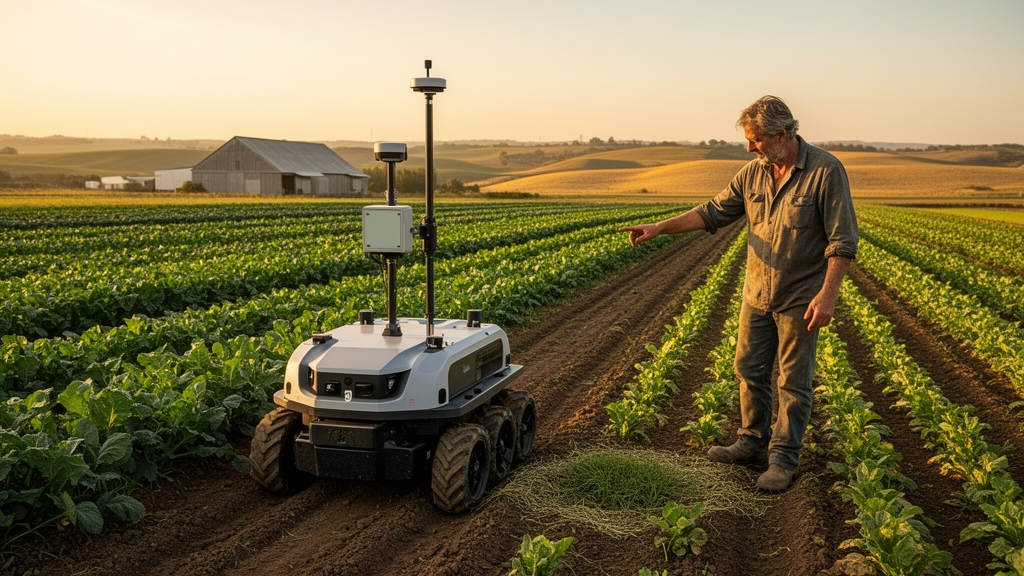
When autonomous machines and artificial intelligence arrive on a farm, the widely repeated assumption is that farm jobs will simply disappear. A three-year study from the University of California, Davis, challenges that picture. Researchers followed 16 fruit tree operations in California and Washington and conducted 165 in-depth interviews with workers and growers, examining what they call the “last mile” of agricultural automation: what happens after robotic and AI-enabled tools reach the orchard and must perform in real conditions that can change by the hour. Their conclusion, published in the journal New Technology, Work and Employment, is that automation still takes human knowledge, and that what changes is not whether people work but how the work gets done.
“Automation isn’t something that just happens to a farm or happens to a labor force,” said lead author M. Anne Visser, professor of community and regional development in the UC Davis Department of Human Ecology. “People have to actively make it happen.” Because every orchard is different, the technology has to be adapted to each one, a process that draws on human knowledge of the land, the fruit and even expected weather. No matter how capable these machines become, Visser said, they may not be able to match that embedded, place-based expertise.
The researchers documented the gap with a concrete example. A tractor or all-terrain vehicle can drive itself down orchard rows and scan trees with a digital camera that counts buds and fruit to help forecast yield, mimicking the traditional practice of a farmworker physically counting buds on every sixth or seventh tree. But the technology tended to overestimate yield and often required interpretation through historical knowledge of the field. One farm manager with more than a decade on his farm adjusted the camera’s counts down by 14 percent based on his understanding of how individual blocks had performed historically and on recent weather events. His corrected estimates turned out to be more accurate than the cameras’ own readings. Even with such tools in place, the study found, people are still needed to interpret what the technology sees, adapt it to field conditions, troubleshoot problems and bridge the gap between how a tool was designed to work and how farming actually works.
Autonomous harvesters showed similar limits. Visser said many prototypes cannot seem to match the knowledge needed to pick fruit, and even as the technology improves, many growers and workers believe it will still take a human to integrate the machines into a farm’s production system and work alongside them. “Replacing a task on a farm is not the same as replacing a job,” she said. “These tools do not simply remove jobs on farms. They often change who does what and reshape the work around technology.”
The study also explains why fresh-market specialty crops are harder to automate than row crops such as corn or soybeans: they require quality as well as yield, and orchards represent multiyear investments that growers cannot switch out in a single season. Still, as workers move into other farm roles, the technology can improve efficiency, occupational health and planning for labor shortages. Visser said that focusing only on worker displacement can obscure opportunities for policy, workforce development, worker mobility and rural job creation. “Our hope is that our research helps advance the conversation surrounding agricultural automation and its impact on the labor force in a way that’s more useful versus what it can often do, which is divide people pretty fast,” she said. The paper, co-authored by Alex Bladimir Hernandez of UC Davis, was funded by the National Science Foundation and the University of California Office of the President, and the authors declared no conflicts of interest. As an interview-based study of 16 operations in two states, its findings describe the tree-fruit industry it examined rather than agriculture as a whole, but they suggest that the future of farm automation will be written as much by the people in the orchard as by the machines entering it.
Subject of Research: Human expertise in the adoption of agricultural automation in US tree-fruit orchards
Article Title: The assumption about farm automation that may be wrong
Article References: The assumption about farm automation that may be wrong. Original publication (Bibliographic details unavailable.)
Image Credits: AI Generated
DOI: Not provided
Keywords: agricultural automation, farm robotics, artificial intelligence, tree fruit, labor, yield estimation, UC Davis, orchards, workforce, embodied expertise, assumption, farm
Cite Scienmag News
Alan Morgan. (October 23, 2026). Farm robots still rely on the people who know the land, three-year study finds. Scienmag. https://scienmag.com/farm-robots-still-rely-on-the-people-who-know-the-land-three-year-study-finds/
Alan Morgan. "Farm robots still rely on the people who know the land, three-year study finds." Scienmag, 23 October 2026, https://scienmag.com/farm-robots-still-rely-on-the-people-who-know-the-land-three-year-study-finds/. Accessed 23 October 2026.
Alan Morgan. "Farm robots still rely on the people who know the land, three-year study finds." Scienmag. October 23, 2026. https://scienmag.com/farm-robots-still-rely-on-the-people-who-know-the-land-three-year-study-finds/


