


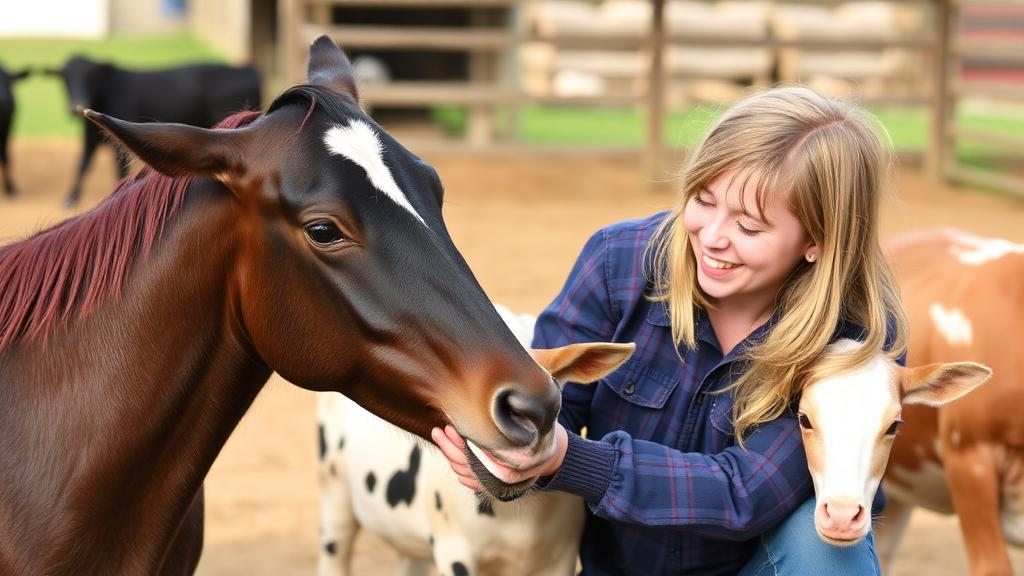
For young adults with autism who have retreated from the world, sometimes the most effective therapy is not delivered in a clinic but in a barn, surrounded by horses, sheep, hens, dogs and cats. A new one-year follow-up study from Sweden suggests that a 12-week program of animal-assisted and nature-based activities on a farm can produce benefits that persist long after the structured sessions end, helping a group of profoundly socially withdrawn young adults become measurably more active in daily life. The research, published in the Scandinavian Journal of Occupational Therapy by Sara Holmberg and A. Birgitta Gunnarsson, also takes the unusual step of framing its findings in socioeconomic terms, an approach that could reshape how policymakers think about the value of green care interventions.
The study followed ten of eleven young adults, aged 21 to 30, who had completed the original intervention on a family farm in southern Sweden. All participants had a diagnosis of autism spectrum disorder under the ICD-10 classification and had been socially withdrawn for a median of two years before the study began, with withdrawal periods ranging from one to eight years. Critically, none of them had any employment, education, or other organized occupation in the year prior to the intervention, and all were receiving social insurance benefits. These were individuals for whom conventional welfare approaches had, by and large, failed to break a cycle of isolation.
The intervention itself was grounded in occupational science and combined established principles from animal-assisted and nature-based therapy. Participants attended the farm two half-days per week for 12 weeks, working in small groups under the guidance of two female supervisors, one a physiotherapist with extensive experience of dogs and horses, the other a social worker trained in equine-assisted interventions. Each session began with coffee or tea, moved into organized activities with animals or in nature, such as grooming and groundwork with horses, feeding and caring for livestock, gardening and food preparation, and ended with a shared meal and a group conversation in which future activities were planned together.
An earlier study by the same team had already shown that the program was feasible and that attendance was remarkably high, with participants describing the farm as a comfort zone where they could safely practice being, doing, belonging and becoming, the dimensions of meaning in daily life articulated by occupational scientists Ann Wilcock and Kirk Hammell. The new follow-up asked the crucial question that most intervention studies avoid: what happens a full year later, when the supervisors, the structured routine and the weekly rhythm of farm life are no longer there to hold participants in place?
The answer was cautiously encouraging. Using summative content analysis of semi-structured telephone and written interviews, the researchers coded each participant’s occupational trajectory as improvement, partial improvement, no change or deterioration. Seven of the ten participants showed improvement of some kind. One participant was on the verge of permanent employment after a period of internship and had stopped smoking along the way. Another held an organized occupational activity outside the home two days a week. Five more reported partial improvements, including completed vocational training or internships, obtaining a truck driving licence, or taking up horseback riding as a leisure activity, even though their occupational activity at follow-up resembled pre-intervention levels. Three participants reported no change at all.
Beyond the headline numbers, the interviews revealed something important about how these young adults experienced the welfare system itself. Participants described a diffuse and fragmented landscape of supportive initiatives, but also long waiting times for decisions by the various authorities, ambiguity over which agency was responsible for them, and recurring meetings and uncertainties about care, rehabilitation and benefits that they found deeply stressful. All of their energy, several reported, was consumed by worry about administrative processes. This finding matters because it suggests that even well-designed interventions may struggle to produce lasting change when the surrounding welfare architecture is disorganized and slow.
The socioeconomic dimension of the study gives its findings unusual weight. The total direct cost of the intervention was 525,000 Swedish kronor, including taxes and social security contributions, which works out to roughly 44,000 kronor per participant for the twelve planned places. This is a modest figure when set against Swedish estimates of the lifetime cost of long-term exclusion from the labour market, calculated at around nine million kronor per young person, of which about seven million reflects lost production. And those figures exclude the substantial consequential costs that often accompany prolonged exclusion, including deteriorating health, substance abuse and criminality, which can inflate lifetime costs considerably further.
The arithmetic, the authors argue, is compelling even when success rates are modest. If only one in ten participants, as seen in this study, moves into employment or organized occupation, the intervention may still pay for itself from a societal perspective, since a single sustained exit from long-term exclusion could offset the costs of many treatment places. The findings align with a growing body of health economic evidence for nature-based and social prescribing programs, including a social return on investment analysis that found economic returns of five times the investment for a nature-based outdoor intervention, and a Swedish study showing reduced healthcare consumption among patients receiving nature-based rehabilitation. Being with animals, particularly horses, appears to add further dimensions, offering non-verbal social interaction, physical closeness and opportunities for developing life mastery that are difficult to replicate in clinical settings.
The study’s limitations are real and acknowledged by the authors. The sample was small, there was no control group, and the data relied entirely on self-report. The cost accounting reflected a research context and cannot simply be transplanted to ordinary operations. Several participants were also largely satisfied with their situation, preferring economic stability and predictability over extensive social contact, which challenges any assumption that employment is the only meaningful outcome. Nonetheless, the high retention of participants, with only one person declining the follow-up interview, is striking given that these were individuals with long histories of social isolation who typically disengage from services.
What emerges from this research is a picture of a low-threshold, community-embedded intervention that the existing welfare system can realistically implement, and that vulnerable young adults are willing to stick with. The authors point to care farming programs in the Netherlands and Norway as models of how the green rural sector can be integrated with healthcare and social work, creating interventions that benefit participants while generating new work and environmental sustainability in rural areas. Controlled trials, though methodologically challenging for such individualized programs, are needed to verify effects and cost benefits. But the message for occupational therapists and policymakers is clear: when conventional treatments fail young adults with autism, a farm, some animals and a structured routine may achieve what a waiting room cannot, and society may even come out ahead financially.
Subject of Research: Animal-assisted and nature-based farm intervention for young adults with autism and social withdrawal, assessed one year later with a socioeconomic perspective
Article Title: Animal-assisted and nature-based intervention on a farm for young adults with autism and social withdrawal – A one-year follow-up with a socioeconomic approach
Article References: Holmberg, S., & Gunnarsson, A. B. (2025). Animal-assisted and nature-based intervention on a farm for young adults with autism and social withdrawal – A one-year follow-up with a socioeconomic approach. Scandinavian Journal of Occupational Therapy, 32(1), Article 2588046. https://doi.org/10.1080/11038128.2025.2588046
Image Credits: AI Generated
DOI: 10.1080/11038128.2025.2588046
Keywords: autism spectrum disorder, animal-assisted intervention, nature-based intervention, care farming, social withdrawal, occupational therapy, young adults, health economics, social prescribing, equine-assisted therapy, Sweden, welfare services
Cite Scienmag News
Alan Morgan. (September 30, 2026). Farm Life With Animals Helps Young Adults With Autism Reconnect, One-Year Study Finds. Scienmag. https://scienmag.com/farm-life-with-animals-helps-young-adults-with-autism-reconnect-one-year-study-finds/
Alan Morgan. "Farm Life With Animals Helps Young Adults With Autism Reconnect, One-Year Study Finds." Scienmag, 30 September 2026, https://scienmag.com/farm-life-with-animals-helps-young-adults-with-autism-reconnect-one-year-study-finds/. Accessed 4 October 2026.
Alan Morgan. "Farm Life With Animals Helps Young Adults With Autism Reconnect, One-Year Study Finds." Scienmag. September 30, 2026. https://scienmag.com/farm-life-with-animals-helps-young-adults-with-autism-reconnect-one-year-study-finds/


