


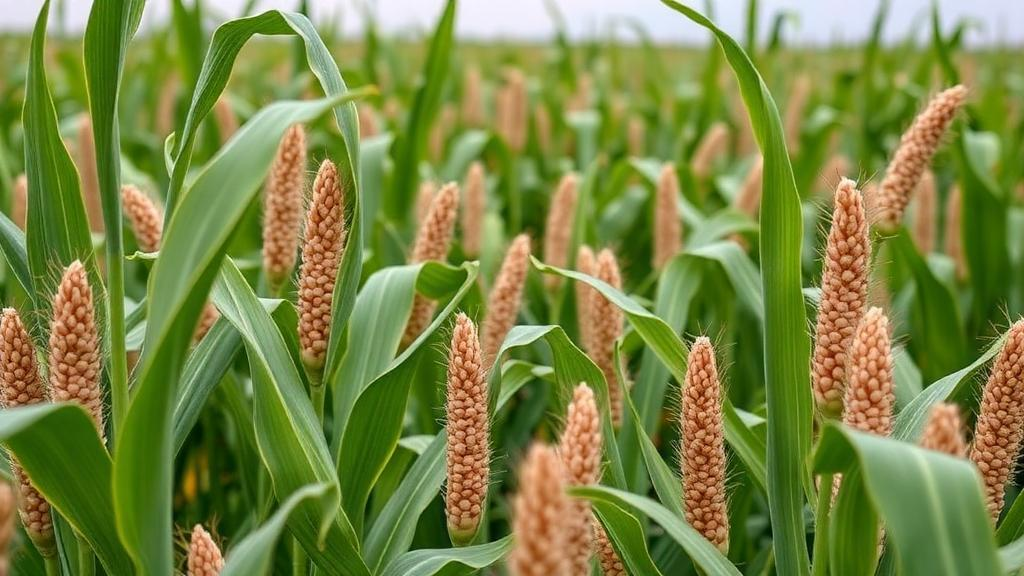
Corn feeds billions of people and underpins a vast global agricultural economy, yet the leaves of the crop tell a story that farmers have always struggled to read quickly. Rust pustules, nitrogen starvation, and the ragged feeding scars of the fall armyworm can look deceptively similar in a sun-dappled field, and by the time a human scout has walked enough rows to confirm an outbreak, the damage is often already spreading. A new study published in the journal Plant Methods presents an integrated artificial intelligence framework that promises to change that equation, combining a purpose-built field image dataset, a lightweight disease-detection network, a mobile augmented reality application, and a time-series forecasting model that projects disease and stress risks years into the future.
The research, led by Tiangang Lu, Mustafa Mhamed and colleagues at China Agricultural University and partner institutions, tackles a problem that has long frustrated computer vision researchers: images taken in real fields are messy. Unlike laboratory photographs of detached leaves on clean backgrounds, field images contain soil, weeds, shadows, overlapping leaves, and wildly variable illumination. Visual symptoms also overlap across conditions. Nitrogen deficiency produces yellowing that can resemble early disease, while the feeding damage of Spodoptera frugiperda, the notorious fall armyworm, can mimic fungal lesions. The team’s answer was to build the entire pipeline from the ground up, starting with data.
At the heart of the framework is a new benchmark called the Corn Leaf Disease Forms dataset, or CLDF, containing 2,903 images captured under genuine field conditions. Rather than lumping all abnormalities into a single disease category, the dataset distinguishes four leaf condition classes: healthy leaves, leaves infected with common rust, leaves showing nitrogen deficiency, and leaves damaged by fall armyworm. This four-way distinction matters agronomically, because each condition demands a different intervention. Rust calls for fungicide timing decisions, nitrogen deficiency points to fertilization management, and armyworm damage triggers insecticide or biological control responses. A system that merely flags a leaf as sick is far less useful than one that tells the grower what kind of sick.
Before any detection model sees the images, the researchers pass them through an advanced image processing enhancement framework, abbreviated AIPEF. This preprocessing stage performs background removal to strip away distracting field clutter, noise reduction to clean up sensor artifacts and compression noise, and image enhancement to sharpen the visual features that distinguish one condition from another. The team employed techniques including simple linear iterative clustering for segmentation of leaf regions from their surroundings. The rationale is straightforward: a detector trained on cleaner, more standardized inputs has an easier job, and the same preprocessing applied at inference time helps the model cope with the chaos of live camera feeds in the field.
The detection engine itself is an enhanced version of a state-of-the-art object detection architecture, named P-YOLOv11s-MD-SiLU. The base YOLO family of models, short for You Only Look Once, performs detection in a single forward pass through the network, which is why it has become the workhorse of real-time agricultural vision. The team’s modifications are technically pointed. They incorporated MobileNetV3, a convolutional backbone designed for mobile devices that relies on depth-wise separable convolutions and squeeze-and-excitation blocks to squeeze maximum accuracy out of minimal computation. They also introduced a modified dynamic SiLU activation function, a variation on the sigmoid linear unit that lets the network modulate its nonlinear responses more flexibly as it learns to separate visually similar symptom classes.
The performance numbers are striking. The proposed model achieved a mean average precision at an intersection-over-union threshold of 0.5, written mAP0.5, of 94.90 percent across the four leaf condition classes. Crucially, it did so while reducing computational cost relative to baseline models, a combination that matters enormously for deployment. A detector that is accurate but too heavy to run on a farmer’s phone is a laboratory curiosity. The authors report that the enhanced model outperformed the baseline configurations it was compared against, delivering the kind of accuracy-to-efficiency ratio that real-world precision agriculture demands.
Deployment was not left as a hypothetical. The trained model was integrated into a mobile augmented reality application, allowing a user to point a phone camera at a corn leaf and receive a real-time diagnosis overlaid on the live image. This is where the lightweight architecture pays off: inference happens on the device, in the field, without requiring a high-bandwidth connection to a remote server. For extension workers and smallholder farmers in regions where fall armyworm is an escalating threat, a tool that turns an ordinary smartphone into an instant plant health diagnostic could compress the gap between symptom onset and management action from days to seconds.
Perhaps the most forward-looking component of the framework is its predictive layer. Using historical environmental observations, the team applied an ARIMA time-series model, a classical statistical method for forecasting based on autoregressive and moving-average patterns in past data, to project future occurrences of each leaf condition. The forecasts are specific. The model indicates increased risks of fall armyworm damage during the 2028 to 2030 period, elevated nitrogen deficiency risk in 2027 and again in 2030, and a peak in common rust occurrence in 2026 followed by a gradual decline through 2030. These are not crystal-ball pronouncements but statistical extrapolations, and their value lies in giving agronomists and policymakers a quantitative horizon for planning seed choices, fertilizer programs, and pest surveillance campaigns.
The integration of detection and forecasting within a single framework reflects a broader shift in agricultural AI. Early deep learning studies in plant pathology focused narrowly on classification accuracy in curated datasets, and many promising models stalled when moved outdoors. The present work follows the path that the field has increasingly taken: build representative field data, engineer the preprocessing to handle environmental noise, optimize the network for the hardware it will actually run on, and then extend the system from reactive diagnosis to proactive prediction. The growth-stage awareness built into the framework acknowledges that the same leaf can present very different symptoms depending on the developmental phase of the plant, a nuance that simpler systems ignore.
The implications extend beyond corn. The architectural recipe, a curated field dataset, a modular enhancement pipeline, a compressed detection network, and a statistical forecasting layer, is portable to other crops and other stress combinations. As climate variability reshapes pest pressure and fertilizer economics tighten, tools that can both identify what is happening in a field today and estimate what is likely to happen in the seasons ahead will become central to food security. The study was supported by the Hainan Provincial Foreign Expert Project on pest monitoring of field corn and the 2115 Talent Development Program of China Agricultural University, and it is published open access, meaning the dataset design and methodology are available to researchers worldwide who want to adapt the approach to their own fields and crops.
Subject of Research: Deep learning-based corn leaf disease identification and environmental risk forecasting in precision agriculture
Article Title: An integrated AI framework for growth stage-aware corn leaf disease identification and environmental impact prediction
Article References: Lu, T., Mhamed, M., He, J., Li, M., Liu, B., Yao, F., Lv, C., & Zhang, Z. (2026). An integrated AI framework for growth stage-aware corn leaf disease identification and environmental impact prediction. Plant Methods. https://doi.org/10.1186/s13007-026-01592-9
Image Credits: AI Generated
DOI: 10.1186/s13007-026-01592-9
Keywords: corn, leaf disease, deep learning, YOLO, precision agriculture, fall armyworm, augmented reality, ARIMA forecasting, image processing, plant pathology, MobileNetV3, nitrogen deficiency
Cite Scienmag News
Alan Morgan. (September 30, 2026). AI System Spots Corn Diseases in the Field and Predicts Outbreaks Years Ahead. Scienmag. https://scienmag.com/ai-system-spots-corn-diseases-in-the-field-and-predicts-outbreaks-years-ahead/
Alan Morgan. "AI System Spots Corn Diseases in the Field and Predicts Outbreaks Years Ahead." Scienmag, 30 September 2026, https://scienmag.com/ai-system-spots-corn-diseases-in-the-field-and-predicts-outbreaks-years-ahead/. Accessed 4 October 2026.
Alan Morgan. "AI System Spots Corn Diseases in the Field and Predicts Outbreaks Years Ahead." Scienmag. September 30, 2026. https://scienmag.com/ai-system-spots-corn-diseases-in-the-field-and-predicts-outbreaks-years-ahead/


