


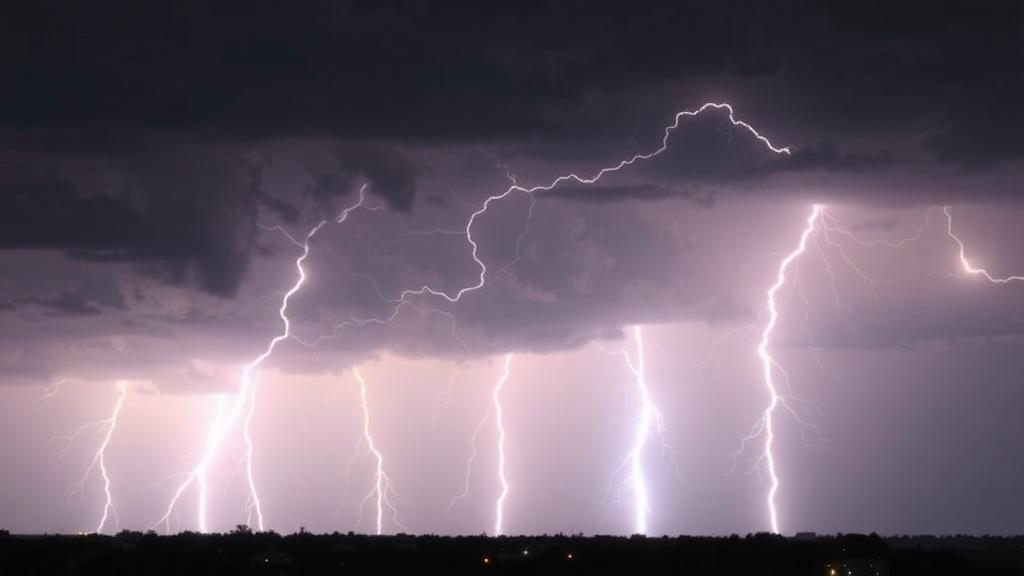
Lightning is one of nature’s most violent and photogenic phenomena, and teaching computers to recognize it automatically has become a serious scientific pursuit. Automatic lightning detection matters far beyond pretty storm photography: society’s growing dependence on the continuous availability of electrical energy and on the reliability of critical infrastructure means that a single strike can trigger industrial accidents, damage substations, and interrupt power to hospitals, data centers, and entire cities. Machine learning and deep learning models promise to spot lightning in images and video faster and more consistently than human observers, but every such model lives or dies by the quality and quantity of its training data. A new study published in Earth Science Informatics tackles that bottleneck head-on by generating synthetic lightning paths that can be used to train recognition algorithms when real photographs are scarce.
The work, carried out by Diego Orozco-Gomez of Institución Universitaria Pascual Bravo together with Elisa Rodriguez and Freddy Bolanos of Universidad Nacional de Colombia in Medellín, proposes two distinct methods for synthesizing lightning channels based on a geometric metric called tortuosity. Tortuosity, in essence, quantifies how winding and contorted a path is, and it is precisely this quality that gives lightning its characteristic jagged, branching appearance in photographs. By controlling the tortuosity of generated paths, the researchers can produce synthetic images whose channels statistically resemble real lightning, providing artificial intelligence algorithms and heuristic systems with a rich, controllable supply of training examples without waiting for the skies to cooperate.
The first of the two proposed methods relies on a hyper-heuristic algorithm. Hyper-heuristics are a class of automated decision-making approaches that, rather than applying a single fixed problem-solving procedure, select and combine lower-level heuristics dynamically as the search unfolds. In this application, the hyper-heuristic explores different strategies for building a lightning-like path segment by segment, adjusting its behavior to steer the resulting curve toward a target tortuosity. This makes the approach flexible: because the high-level controller learns which low-level heuristics work best in which situations, it can adapt to a wide range of target path shapes without being re-engineered by hand for each new case.
The second method is a more direct heuristic algorithm designed specifically for the task of drawing tortuous lightning paths. Instead of delegating decisions to an adaptive controller, this algorithm encodes domain-informed rules about how a lightning channel should grow, producing paths that match a desired tortuosity in a single, streamlined pass. The trade-off is typical of heuristic design: less generality, but far greater speed and simplicity. When the two approaches were put head-to-head, the specialized heuristic algorithm demonstrated superior performance, achieving a mean accuracy of approximately 99 percent in hitting its tortuosity targets and an average execution time of just 7 milliseconds per generated path.
That execution time deserves emphasis. Seven milliseconds per path means the algorithm can generate hundreds of synthetic lightning channels in the time it takes a photographer to capture a single storm frame, making it practical to construct large, diverse training sets on demand. For deep learning pipelines, where models such as convolutional networks and YOLO-style object detectors typically require thousands of annotated examples to generalize well, the ability to mass-produce realistic, correctly labeled synthetic images could dramatically lower the barrier to building reliable lightning recognition systems. Synthetic data also allows researchers to systematically vary properties such as path complexity, branching, and orientation, covering corners of the parameter space that real observations rarely sample.
Crucially, the team did not stop at generating plausible-looking curves; they validated their synthetic paths against reality. The paths produced by the heuristic algorithm were evaluated against 54 real lightning images, yielding an average Recall of 87.03 percent. Recall, in this context, measures how well the synthetic paths capture the features of genuine lightning channels that a recognition system would need to detect. A recall above 87 percent against real photographic evidence suggests that the synthetic images are not merely visually convincing but statistically and structurally close enough to authentic strikes to serve as meaningful training material, which is the acid test for any synthetic data pipeline.
The study builds on the authors’ earlier research into lightning image classification, including a prior model for classifying lightning images without branches based on the tortuosity metric. That lineage matters, because it grounds the new synthesis methods in a quantitative understanding of what real lightning channels look like in digital images. It also connects to a broader research landscape: recent work has applied deep learning to high-speed lightning footage for semantic segmentation, classified single versus multiple ground strike points from video, and developed knowledge distillation algorithms for lightning detection networks. Meanwhile, simulation studies of lightning discharges have explored how environmental conditions influence ionization and spark behavior, and computational models of electromagnetic fields from cloud-to-ground and cloud-to-cloud channels continue to inform lightning protection engineering.
The motivation for all of this automation is sobering. Lightning is a documented trigger of industrial accidents, including fires and explosions at facilities handling hazardous materials, and it remains a significant cause of weather-related fatalities worldwide, with national fatality studies tracking its human toll across decades. Three-dimensional direct strike models for substations, risk assessment frameworks for lightning protection systems, and damage probability models for process equipment all depend on understanding where and how strikes occur. Automatic visual detection of lightning, powered by well-trained machine learning models, adds a complementary layer of capability, one that could support early warning, infrastructure monitoring, and post-storm damage assessment in ways that ground-based sensor networks alone cannot.
What makes the Colombian team’s contribution particularly elegant is its conceptual reframing of the problem. Rather than treating lightning image generation as a pure computer graphics challenge or a pure machine learning challenge, they treat it as a path planning and optimization problem, borrowing tools from fields such as robotics and operations research. The bibliography of the paper spans classic algorithmic work such as Bresenham’s 1965 line-drawing algorithm, random walk methods rooted in the theory of Brownian motion, sampling-based path planners like RRT variants, and modern metaheuristics including differential evolution, particle swarm optimization, and simulated annealing. By channeling this diverse algorithmic arsenal toward a meteorological imaging problem, the authors demonstrate how cross-disciplinary method transfer can solve practical data scarcity problems in earth science.
The practical implications extend well beyond lightning. The same tortuosity-controlled synthesis framework could plausibly be adapted to generate training data for other crack-like, branching, or filamentary structures, from electrical treeing in insulating materials to fracture patterns in materials science. And because the researchers have made the data generated in the work publicly available through Science Data Bank, other groups can immediately build on the synthetic dataset, benchmark their own generation algorithms against the reported 99 percent accuracy and 7 millisecond generation time, and test whether models trained on these synthetic bolts transfer to real-world storm footage. As deep learning continues to penetrate atmospheric observation, studies like this one highlight an increasingly important truth: sometimes the fastest way to teach a machine about nature is to manufacture convincing imitations of it, one jagged, seven-millisecond lightning path at a time.
Subject of Research: Synthetic generation of tortuous lightning path images to train automatic lightning recognition models
Article Title: Generating synthetic lightning path images for training lightning recognition models
Article References: Orozco-Gomez, D., Rodriguez, E., & Bolanos, F. (2026). Generating synthetic lightning path images for training lightning recognition models. Earth Science Informatics, 19(12), Article 212. https://doi.org/10.1007/s12145-026-02267-8
Image Credits: AI Generated
DOI: 10.1007/s12145-026-02267-8
Keywords: lightning, synthetic images, machine learning, heuristic algorithm, hyper-heuristic, tortuosity, deep learning, path planning, training data, lightning detection, Earth Science Informatics, Colombia
Cite Scienmag News
Caitlin Barrett. (October 13, 2026). Fake Lightning, Real Training: Synthetic Bolts Teach AI to Spot the Real Thing. Scienmag. https://scienmag.com/fake-lightning-real-training-synthetic-bolts-teach-ai-to-spot-the-real-thing/
Caitlin Barrett. "Fake Lightning, Real Training: Synthetic Bolts Teach AI to Spot the Real Thing." Scienmag, 13 October 2026, https://scienmag.com/fake-lightning-real-training-synthetic-bolts-teach-ai-to-spot-the-real-thing/. Accessed 13 October 2026.
Caitlin Barrett. "Fake Lightning, Real Training: Synthetic Bolts Teach AI to Spot the Real Thing." Scienmag. October 13, 2026. https://scienmag.com/fake-lightning-real-training-synthetic-bolts-teach-ai-to-spot-the-real-thing/


