


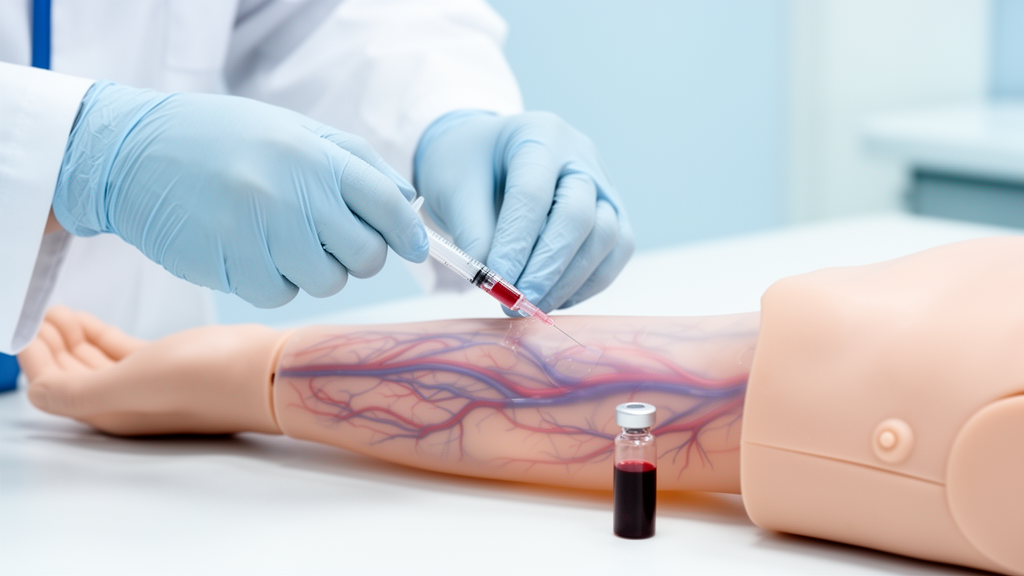
For generations of health science students, the first attempt at drawing blood from a living patient has been one of the most nerve-wracking moments in clinical education. The skill at stake, venipuncture, looks deceptively simple: locate a suitable vein, insert a hollow needle at the correct angle, and collect a sample without collapsing the vessel or missing the target. In practice, it demands a precise blend of tactile judgment, anatomical knowledge, and steady hands. Now, a team of researchers in Thailand has built a training system designed to make that first real attempt far less of a leap into the unknown, combining a latex-skinned arm simulator with a synthetic blood whose physical properties were tuned to match the real thing.
The study, published in BMC Medical Education by Suranat Phonghanpot of the Biochemistry Unit at Rangsit University’s Faculty of Sciences and Faongchat Jarintanan of the Faculty of Medical Technology, describes the development and preliminary evaluation of a novel arm simulator and synthetic blood formulation aimed at health science students. The motivation is straightforward: many students struggle to learn venipuncture because they lack realistic equipment on which to practice. Traditional phantoms and mannequins often fall short in the details that matter most to a learner’s fingertips, from the elasticity of the skin to the way a vein rolls away from an approaching needle. The researchers set out to close that gap with a system that mimics both the anatomy of the antecubital fossa and the fluid dynamics of human blood.
At the heart of the simulator is a layered construction using natural latex, chosen for its flexibility and durability, to create a skin layer that stretches and recoils much like the real integument. Beneath this latex surface, the team embedded medical rubber tubes positioned to represent the three principal veins targeted in routine blood collection: the median cubital vein, the cephalic vein, and the basilic vein. These are precisely the vessels that phlebotomists and nurses aim for in clinical practice, and their relative positions and palpability are central to teaching safe needle insertion. By reproducing this vascular geography in a durable, washable form, the simulator allows repeated needle sticks without degrading the training experience, a critical requirement for any device intended for classroom use across cohorts of students.
The system goes beyond a static phantom. It incorporates a touch-screen controlled pump that drives the synthetic blood through the artificial vasculature, simulating circulation and giving trainees the feedback of blood entering a collection tube or syringe when a needle is correctly placed. The design also prioritizes practicality: the apparatus is engineered to be easy to wash after use, an important consideration for infection control and turnaround time in busy skills laboratories. Fabrication of the arm itself was carried out with support from the Department of Anatomy at Chulalongkorn University’s Faculty of Medicine, while the College of Biomedical Engineering at Rangsit University engineered the simulated blood circulation system to the researchers’ specifications, a collaboration that underscores how much interdisciplinary work sits behind a seemingly simple teaching tool.
Perhaps the most technically intriguing part of the project is the synthetic blood itself. Getting fake blood right is not merely a matter of color. Human blood has a characteristic viscosity, density, and specific gravity, and any fluid used in a training simulator should reproduce those properties if students are to develop an accurate feel for how blood flows into vacuum tubes and how much resistance a vessel offers. The researchers began with a base color designated by the hexadecimal code #660808, then adjusted the appearance using a combination of red food coloring powder, red yeast rice powder, and instant coffee powder. That trio may sound like an unusual kitchen experiment, but each ingredient contributes to the visual depth and opacity that distinguish convincing blood from a watery red dye.
Color alone was not enough. To match the rheological behavior of real blood, the team combined the pigment mixture with xanthan gum, a common food-grade thickener, and glycerin, adjusting the proportions until the fluid’s physical measurements lined up with published values for human blood. Among the formulations tested, the best performer was formula 9, which achieved a viscosity of 4.02 centipoise, a specific gravity of 1.063, and a density of 1.056 grams per milliliter. Those numbers sit remarkably close to the values reported for human blood, meaning that when a student punctures the latex skin and enters one of the rubber veins, the fluid that flashes back into the tube behaves in a physically plausible way. The authors are careful to note that the formulation is strictly a laboratory material: it is not appropriate for intravenous, medicinal, or human use, and it is not a blood substitute.
With the hardware and fluid in hand, the researchers turned to evaluation. They tested the efficiency of the arm simulator and synthetic blood with 60 medical technology students, using an assessment instrument whose content validity was supported through item-objective congruence review. The results were striking in their consistency: the evaluation showed a very high level of reliability, with a Cronbach’s alpha of 0.946, a figure that indicates the assessment tool produced highly dependable scores across participants. For an early-stage educational device, that level of internal consistency is a strong signal that the simulator and its accompanying assessment can function coherently as a training package rather than as a novelty.
The study also provided preliminary evidence that the system can discriminate between users of different skill levels, a property that any serious assessment tool must possess. Senior students in Years 3 and 4 performed significantly better than junior students in Years 1 and 2, with a p-value below 0.05. In other words, the scores obtained with the simulator tracked with clinical experience, suggesting that the device measures something meaningful about venipuncture competence rather than rewarding luck or guesswork. Beyond the numbers, the students themselves were notably satisfied with the training set, singling out its realistic appearance for particular praise, an encouraging qualitative signal that the latex skin and lifelike synthetic blood succeeded in creating an immersive practice environment.
The research was approved by the Ethics Committee of Rangsit University under approval number RSUERB2024-058, and all methods were conducted in accordance with established research ethics guidelines, including the Declaration of Helsinki and Good Clinical Practice standards. Written informed consent was obtained from all participants, who were assured of the voluntary nature of participation and their right to withdraw at any time, and participant privacy was protected through anonymous codes and secure data storage. The work was supported by Rangsit University under grant number RRI11 2/2566, and the trial was retrospectively registered with the Thai Clinical Trials Registry under identifier TCTR20260726009.
As with any preliminary evaluation, the findings come with caveats. The sample involved students from a single institution, and the authors describe the simulator and synthetic blood set as demonstrating potential as a preliminary training tool rather than as a fully validated standard. Still, the combination of anatomically faithful vein placement, tunable fluid physics, and a reliable assessment framework points toward a future in which students can log dozens of realistic needle sticks before ever approaching a patient. For a procedure that millions of patients undergo every day, and that every new nurse, phlebotomist, and medical technologist must master, a training arm that bleeds convincingly may prove to be one of the more quietly consequential inventions in medical education.
Subject of Research: Development of an arm simulator and synthetic blood for venipuncture training in health science education
Article Title: Development and preliminary evaluation of a novel arm simulator and synthetic blood for venipuncture training among health science students
Article References: Phonghanpot, S., & Jarintanan, F. (2026). Development and preliminary evaluation of a novel arm simulator and synthetic blood for venipuncture training among health science students. BMC Medical Education. https://doi.org/10.1186/s12909-026-10570-7
Image Credits: AI Generated
DOI: 10.1186/s12909-026-10570-7
Keywords: venipuncture, arm simulator, synthetic blood, medical education, health science students, simulation training, viscosity, latex skin, phlebotomy, clinical skills, Rangsit University, Cronbach's alpha
Cite Scienmag News
Courtney Benton. (October 8, 2026). Fake Blood, Real Veins: New Training Arm Brings Venipuncture Practice Closer to Life. Scienmag. https://scienmag.com/fake-blood-real-veins-new-training-arm-brings-venipuncture-practice-closer-to-life/
Courtney Benton. "Fake Blood, Real Veins: New Training Arm Brings Venipuncture Practice Closer to Life." Scienmag, 8 October 2026, https://scienmag.com/fake-blood-real-veins-new-training-arm-brings-venipuncture-practice-closer-to-life/. Accessed 8 October 2026.
Courtney Benton. "Fake Blood, Real Veins: New Training Arm Brings Venipuncture Practice Closer to Life." Scienmag. October 8, 2026. https://scienmag.com/fake-blood-real-veins-new-training-arm-brings-venipuncture-practice-closer-to-life/


