


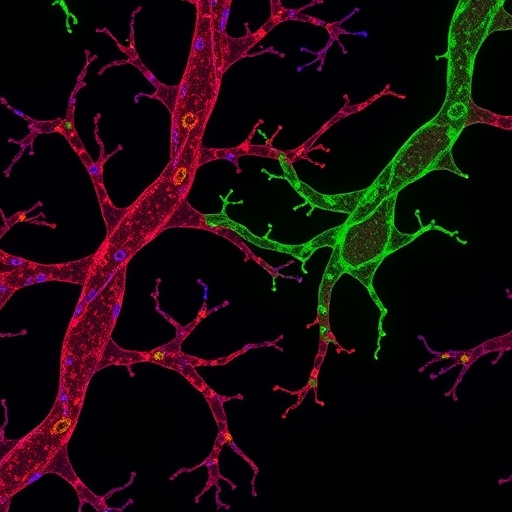
Leptin, the hormone famous for telling the brain that the body has eaten enough, has been caught moonlighting as a construction foreman for breast cancer. In a new open-access study published in the journal Medical Oncology, researchers in Mexico and the United States report that this fat-derived signaling molecule drives two parallel programs that keep tumors fed and oxygenated: it promotes the sprouting of genuine new blood vessels, and it teaches cancer cells to fabricate their own vessel-like channels, a phenomenon known as vasculogenic mimicry. Crucially, both programs appear to run through a single molecular switch — focal adhesion kinase, or FAK, an enzyme long associated with cell migration and invasion. Led by Ana K. Herrera-Vargas and the late Napoleón Navarro-Tito of the Universidad Autónoma de Guerrero, together with colleagues at the Hospital Infantil de México Federico Gómez, the Universidad Autónoma Metropolitana, and the University of Massachusetts Chan Medical School, the work provides one of the most detailed mechanistic maps to date of how an obesity-linked hormone expands the vascular plumbing of breast tumors.
The clinical backdrop is stark. Breast cancer is the most common malignancy in women, accounting for roughly 16 percent of all female cancers and standing as the leading cause of cancer-related death in this population. Like every solid tumor, a breast tumor cannot exceed a few millimeters in size without solving a supply problem: it must recruit blood vessels that deliver oxygen and nutrients and carry away waste. The canonical solution is angiogenesis, the growth of new capillaries from pre-existing vasculature, orchestrated above all by vascular endothelial growth factor (VEGF) and its receptors VEGFR1 and VEGFR2, which drive endothelial cell proliferation, migration, and survival, while the angiopoietins and their TIE receptors stabilize and mature the emerging network. In the modern formulation of cancer’s hallmarks, inducing and accessing the vasculature is a defining dimension of malignancy, and poor prognosis in breast cancer tracks closely with vascular alterations. Drugs that block the VEGF axis have transformed some areas of oncology, but in breast cancer their benefits have been modest and short-lived, largely because tumors activate vascularization strategies that the drugs never touch.
The most notorious of those strategies is vasculogenic mimicry. First described in highly aggressive melanomas and since reported across carcinomas, it describes the capacity of tumor cells to abandon their epithelial identity, drift toward an endothelial-like phenotype, and remodel the extracellular matrix into fluid-conducting channels that perfuse the tumor independently of normal blood vessels. Molecularly, the adhesion protein VE-cadherin is considered the gatekeeper: it recruits the receptor EphA2 to intercellular junctions, igniting the PI3K and ERK1/2 pathways that sustain tumor cell survival, proliferation, and migration. Matrix metalloproteinases — MMP-2 and MMP-9 in particular — carve these conduits out of the surrounding matrix. Because vasculogenic mimicry flourishes in hypoxic niches and correlates with resistance to anti-angiogenic therapy, identifying the signals that trigger it has become a central question in tumor vascular biology. The result, for patients, is a tumor that supplies itself with oxygen and nutrients while presenting drug developers with a moving target.
Leptin enters the story through the tumor’s own neighborhood. Breast tumors are enveloped in adipose tissue, and the cancer-associated adipocytes that dominate that microenvironment secrete leptin abundantly; the hormone is markedly overexpressed in the tumors of obese patients with estrogen receptor-positive disease. Building on the group’s earlier finding that leptin activates FAK in MCF-7 and MDA-MB-231 breast cancer cells — driving the secretion of MMP-2 and MMP-9, along with migration and invasion — and that the same axis triggers epithelial-to-mesenchymal transition in non-tumorigenic mammary epithelial cells, the team asked a bolder question: does leptin control tumor vascularization itself, and does FAK sit at the center of that control? They hypothesized that leptin regulates both angiogenesis and vasculogenic mimicry through a non-canonical FAK pathway, and assembled a battery of models to find out.
The anchor model was the chick chorioallantoic membrane (CAM), the densely vascularized extraembryonic membrane of fertilized chicken eggs, which allows blood vessel growth to be observed and manipulated directly. Filters soaked with leptin at 50 to 400 nanograms per milliliter were placed on the membrane with or without 5 micromolar PF-573,228, a selective FAK inhibitor, and after five days capillary sprouting, branching, and diameter were quantified morphometrically. In parallel, the researchers implanted 3 million MCF-7 or MDA-MB-231 cells in Matrigel onto the membrane to generate xenograft tumors, treated them with 500 nanograms per milliliter of leptin for 48 hours, and probed the excised tissue by confocal immunofluorescence for VEGF and N-cadherin and by histology for vessel number and caliber. A third arm grew the same cells on Matrigel, stained them with periodic acid-Schiff to expose vasculogenic mimicry structures, and used western blotting to track FAK phosphorylation at tyrosine 397 and a panel of angiogenic proteins. All experiments were performed with independent biological replicates, and only channels with clearly defined lumens were counted as mimicry structures, excluding mere cellular alignment.
On the CAM, leptin behaved as a textbook angiogenic factor, with a twist. Capillary sprouting rose measurably at 50 nanograms per milliliter and peaked at 200, reaching 13.33 sprouts against 2.67 in untreated membranes, while branching climbed dose-dependently from 10.67 to 22.67 branch points compared with a baseline of 5.67. Only the highest dose, 400 nanograms per milliliter, widened the vessels themselves, nearly doubling capillary diameter — evidence of vascular remodeling superimposed on new vessel growth. Low concentrations, in other words, elicit classical sprouting angiogenesis, whereas high concentrations appear to sculpt the existing vasculature, potentially enhancing perfusion, vascular permeability, and the escape of tumor cells into circulation. When FAK was inhibited, the entire program faltered: sprouting collapsed from 13.00 to 3.33 and branching from 18.67 to 6.00 at the 100-nanogram dose, and vessel caliber shrank at every leptin concentration tested. The kinase, the data suggest, is not a helper in leptin-driven angiogenesis but its pivot.
The xenografts revealed that the two breast cancer subtypes read the same hormone differently. Leptin raised VEGF and N-cadherin — an adhesion protein tied to invasion, therapy resistance, and metastasis to the liver, lungs, and lymph nodes — in both MCF-7 and MDA-MB-231 tumors. But the vascular architectures diverged. MCF-7 tumors, of the slower-growing luminal A subtype, responded to leptin with fewer vessels, 13.67 versus 23.50 per section, yet with vessels more than twice as wide, 128.7 versus 59.75 micrometers, a signature of structural remodeling that maintains perfusion without multiplying conduits. Triple-negative MDA-MB-231 tumors did the opposite: leptin increased both vessel density, from 17.50 to 23.33, and diameter, from 31.31 to 54.34 micrometers, in line with the intrinsically proangiogenic character previously documented for triple-negative cells. The luminal tumor rewires its existing network; the triple-negative tumor builds more of it.
Vasculogenic mimicry split along the same fault line. Grown on Matrigel, MCF-7 cells formed defined, lumen-containing tubular channels in a dose-dependent fashion, from 7.67 structures at baseline to 21.00 at the highest leptin dose, and the FAK inhibitor suppressed this tubular mimicry at every concentration tested — clear evidence of FAK dependence in the luminal model. MDA-MB-231 cells instead wove branched, matrix-type patterns into the extracellular matrix, which appeared from 50 nanograms per milliliter onward yet were wholly indifferent to FAK inhibition. Western blotting clarified the molecular underpinnings. In the triple-negative cells, leptin increased FAK phosphorylation and, in a FAK-dependent manner, raised TIE-1, MMP-9, VE-cadherin, angiopoietin-2, and VEGFR1 — a coherent pro-angiogenic, pro-mimicry portfolio — while VEGF itself rose independently of FAK, implicating alternative leptin-activated routes such as JAK2/STAT3, MAPK, NF-κB, and HIF-1α. In MCF-7 cells, the induction of MMP-9 required FAK, whereas angiopoietin-2 did not, and TIE-1 and VE-cadherin were unchanged. The researchers caution that mimicry identification rests on morphology and staining, and that future studies must confirm functional, perfusable lumens to rule out simple matrix deposition.
The translational implications are difficult to dismiss. Obesity drives leptin upward in proportion to fat mass, and hyperleptinemia is strongly associated with poor breast cancer prognosis, making the leptin–FAK axis an attractive therapeutic target, particularly in leptin-responsive tumors. The authors propose that combining FAK inhibitors with the anti-angiogenic drugs already in clinical use could yield additive or even synergistic effects by closing both escape routes simultaneously. They are equally candid about the caveats: the CAM assay, however elegant, lacks the immune and stromal complexity of human tumors; only two cell lines were examined, limiting extrapolation to other molecular subtypes; and no mammalian in vivo model was used, so systemic physiology remains untested. Orthotopic models and patient-derived xenografts, the team notes, will be essential to confirm the pathway’s role in living animals, and the variability of physiological leptin levels across metabolic states — obesity included — could reshape the magnitude of these responses in patients.
Conceptually, the study elevates leptin from metabolic bystander to active architect of tumor vascular plasticity: one hormone, two levers — angiogenesis and vasculogenic mimicry — pulled differently across two breast cancer subtypes with distinct survival strategies. It carries a poignant human footnote as well. The paper is dedicated to Dr. Napoleón Navarro-Tito, who conceived and directed the project at the Universidad Autónoma de Guerrero and died in July 2025, before seeing it published. If the leptin–FAK circuit is validated in patients, the work may come to be remembered as an early map of a vulnerability at the border between metabolism and malignancy — the exact point where the body’s energy reserves, quite literally, feed a tumor’s bloodline.
Cite Scienmag News
Nathaniel Bowman. (August 29, 2026). FAK drives leptin-triggered vessel growth and mimicry in breast cancer. Scienmag. https://scienmag.com/fak-drives-leptin-triggered-vessel-growth-and-mimicry-in-breast-cancer/
Nathaniel Bowman. "FAK drives leptin-triggered vessel growth and mimicry in breast cancer." Scienmag, 29 August 2026, https://scienmag.com/fak-drives-leptin-triggered-vessel-growth-and-mimicry-in-breast-cancer/. Accessed 3 September 2026.
Nathaniel Bowman. "FAK drives leptin-triggered vessel growth and mimicry in breast cancer." Scienmag. August 29, 2026. https://scienmag.com/fak-drives-leptin-triggered-vessel-growth-and-mimicry-in-breast-cancer/


