


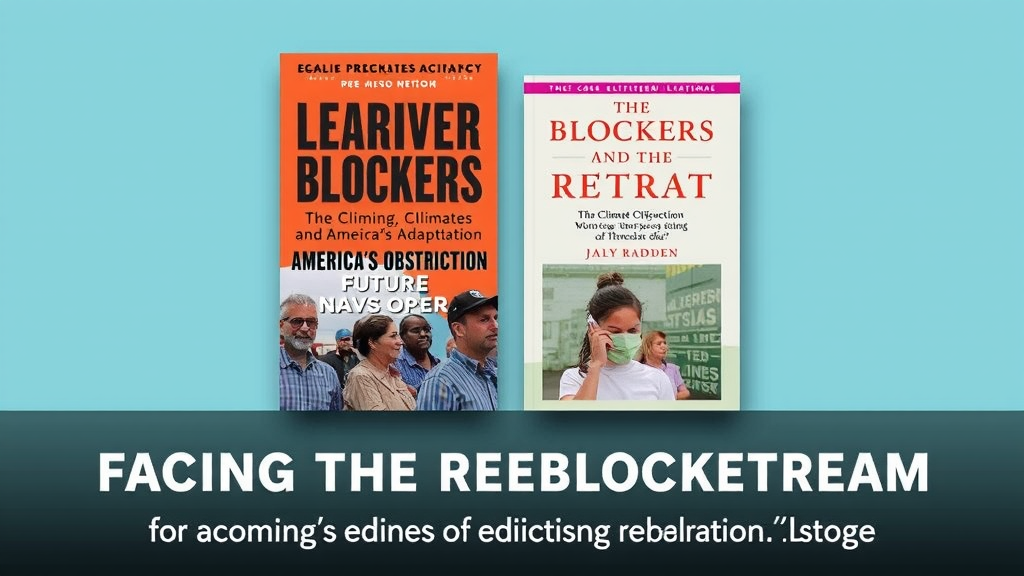
Two recently published books are drawing renewed attention to the twin forces that will define the coming decades of climate politics: the organized machinery of obstruction that has slowed global action, and the hard, practical questions of adaptation that communities must now confront regardless of how quickly emissions fall. A new review by Richard Smardon, professor emeritus in the Department of Environmental Studies at SUNY College of Environmental Science and Forestry, published in the Journal of Environmental Studies and Sciences, examines these works side by side and argues that they illuminate two halves of the same unfinished conversation about climate denial, delay, and what he frames as the post-climate future of North America.
The first of the two volumes, Climate Obstruction: How Denial, Delay and Inaction are Harming the Planet, was written by Kristian Ekberg, Bernhard Forchtner, Martin Hultman, and Kirsti Jylhä and published by Routledge in 2023. The book takes a distinctly social-scientific approach to the question of why humanity has failed to respond proportionately to decades of accumulated evidence about global warming. Rather than treating climate denial as a simple failure of information or a matter of individual psychology, the authors map a broader ecosystem of obstruction that includes organized denial, discourses of delay, and structural inaction, showing how these operate at different scales from corporate boardrooms and lobbying networks to media framing and everyday conversation.
That framing reflects an important conceptual shift that has taken place across the climate social sciences over the past decade. Early scholarship concentrated on outright denial of the scientific consensus, but researchers increasingly recognize that outright rejection of climate science is only one node in a much wider network of resistance. Delay discourses, such as appeals to economic cost, claims that technology will solve the problem on its own, deflection of responsibility onto individuals, and assertions that it is already too late to act, allow decision-makers to appear engaged while deferring substantive change. The book’s treatment of these mechanisms draws on environmental sociology, political science, and discourse studies, giving readers a multidisciplinary toolkit for recognizing obstruction wherever it appears, and for understanding why it has proven so durable even as the physical evidence of climate change has mounted.
The second volume under review takes the discussion from causes to consequences. North: The Future of Post-Climate America, by Jesse M. Keenan of Tulane University and published by Oxford University Press in 2025, examines what happens to a country when large portions of its territory become progressively harder to inhabit and invest in. Keenan’s analysis is grounded in the realities of real estate, finance, insurance, and regional planning, fields in which climate signals are no longer abstract projections but concrete line items. Rising flood risk, intensifying hurricanes, wildfire exposure, extreme heat, and water stress are already reshaping property values, insurance markets, mortgage lending, and municipal fiscal health across the United States, and the book asks where people, capital, and institutions will move as these pressures compound.
Keenan’s central provocation is the idea of a post-climate America: a future in which the geography of opportunity shifts decisively northward and inland as southern and coastal regions face escalating losses and costs. This is not a science-fiction scenario but a description of trends that are already measurable. Insurers have withdrawn from high-risk markets in California, Florida, and Louisiana. Homebuyers and lenders increasingly factor climate risk into pricing. Migration research suggests that movement within countries, driven partly by climate pressures, is already underway, even if most of it remains gradual and locally invisible. The book’s argument, as summarized in the review, is that planning for this redistribution is far preferable to stumbling into it, because unmanaged retreat tends to concentrate its harms on the households and communities with the fewest resources to relocate and rebuild.
Read together, the two books form a coherent narrative arc. The first explains how organized interests, ideological commitments, and institutional inertia combined to squander decades in which aggressive mitigation could have limited warming to less dangerous levels. The second describes the world that delay has made more likely, one in which adaptation is no longer optional and in which questions of justice, governance, and finance dominate the agenda. Smardon’s review places the volumes in the context of a rapidly growing literature on climate migration and obstruction, situating them among several other recent works that address the same terrain from complementary angles.
Among the adjacent titles the review references is Climate Obstruction: A Global Assessment, published by Oxford University Press in 2025 and authored by J. Timmons Roberts, Carlos R. S. Milani, Jacquelyn Jacquet, and Carl Downie. That volume broadens the analytical lens beyond the United States and Western Europe, documenting how obstruction operates in different political and economic systems around the world, including in emerging economies where development priorities and fossil fuel interests intersect in distinctive ways. Its appearance alongside the Ekberg and colleagues book underscores how the study of climate obstruction has matured from a niche concern of American environmental politics into a genuinely global research program with its own journals, conferences, and theoretical debates.
On the adaptation side, the review situates Keenan’s book among several recent analyses of climate-driven human mobility. Gaia Vince’s Nomad Century: How Climate Migration Will Reshape Our World, published by Macmillan in 2022, made a forceful popular case that large-scale migration is an inevitable feature of the coming century and that wealthy countries should prepare for and embrace it rather than fortify against it. Riley E. Dunlap-style empirical work on environmental attitudes finds a scholarly counterpart in Fred F. Spellman’s The Science of Climate Migration, published by CRC Press in 2023, which assembles the physical science underpinning projections of displacement, from sea-level rise and coastal erosion to drought and agricultural stress. Most recently, Robert A. McLeman, Kelly Best, and Kelsea Ober’s Migration and Displacement in a Changing Climate, published by Cambridge University Press in 2025, offers a systematic academic treatment of who moves, why, when, and with what consequences, drawing on decades of empirical migration research.
The technical substance connecting these works lies in the interaction between physical climate risk and human systems. Sea-level rise does not displace people mechanically; it does so through intermediate variables such as insurance affordability, infrastructure maintenance costs, agricultural yields, and labor demand. Similarly, obstruction does not operate through a single veto point but through the aggregation of countless small delays in legislation, permitting, investment, and public opinion. Understanding these cascades is the core technical contribution of this literature: it treats the climate crisis as a coupled system in which physics, economics, sociology, and politics continuously reshape one another, and it argues that interventions must therefore target the social and institutional linkages as deliberately as the atmospheric ones.
What emerges from the review is a sober but not hopeless message. The scholarship on obstruction is ultimately diagnostic: by naming the tactics of denial, delay, and inaction, it equips journalists, educators, policymakers, and citizens to recognize and counter them. The scholarship on adaptation and migration is ultimately prescriptive: it shows that the trajectory of a post-climate society is not fixed, and that choices made now about land use, insurance, infrastructure, social safety nets, and planned relocation will determine whether the northward redistribution of American life is orderly and just or chaotic and inequitable. For readers seeking a grounded introduction to both halves of the climate challenge, Smardon’s review suggests that these two books, read together, provide an unusually clear map of how we arrived at this impasse and where the road forward might still lead.
Subject of Research: A scholarly review of two recent books examining the social drivers of climate obstruction and the prospects for adaptation in a post-climate United States.
Article Title: Two books on climate obstruction and post climate adaption
Article References: Smardon, R. (2026). Two books on climate obstruction and post climate adaption. Journal of Environmental Studies and Sciences. https://doi.org/10.1007/s13412-026-01144-6
Image Credits: AI Generated
DOI: 10.1007/s13412-026-01144-6
Keywords: climate obstruction, climate denial, delay discourses, climate adaptation, climate migration, Jesse M. Keenan, North post-climate America, climate policy, planned retreat, environmental sociology, climate finance, Journal of Environmental Studies and Sciences
Cite Scienmag News
Sloane Callahan. (September 22, 2026). Facing the Blockers and the Retreat: Two New Books Map Climate Obstruction and America’s Adaptation Future. Scienmag. https://scienmag.com/facing-the-blockers-and-the-retreat-two-new-books-map-climate-obstruction-and-americas-adaptation-future/
Sloane Callahan. "Facing the Blockers and the Retreat: Two New Books Map Climate Obstruction and America’s Adaptation Future." Scienmag, 22 September 2026, https://scienmag.com/facing-the-blockers-and-the-retreat-two-new-books-map-climate-obstruction-and-americas-adaptation-future/. Accessed 5 October 2026.
Sloane Callahan. "Facing the Blockers and the Retreat: Two New Books Map Climate Obstruction and America’s Adaptation Future." Scienmag. September 22, 2026. https://scienmag.com/facing-the-blockers-and-the-retreat-two-new-books-map-climate-obstruction-and-americas-adaptation-future/


