

Monday, July 27, 2026
Science
No Result
View All Result
  • Login
  • HOME
  • SCIENCE NEWS
  • CONTACT US
  • HOME
  • SCIENCE NEWS
  • CONTACT US
No Result
View All Result
Scienmag
No Result
View All Result
Home Science News Chemistry

Fabric Enables Multiple Stable Shapes Using Snap-Like Structural Design

July 27, 2026
in Chemistry
Reading Time: 2 mins read
0
Fabric Enables Multiple Stable Shapes Using Snap-Like Structural Design

Fabric Enables Multiple Stable Shapes Using Snap-Like Structural Design

65
SHARES
587
VIEWS
Share on FacebookShare on Twitter
ADVERTISEMENT

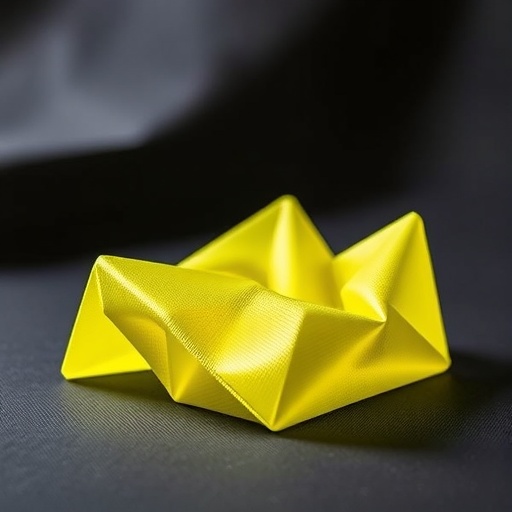
Knitting has evolved beyond comfort wear. In a new study from Harvard SEAS, researchers demonstrate how ordinary weft knitting can be engineered into shape-shifting textiles that switch between multiple stable geometries. Instead of relying on rigid polymer molding or pre-programmed stress, the team uses material choice and the knitting process itself to create “snappy” behavior driven by multistability—an underexplored mechanism in practical fabrics.

The central idea is to produce dense, thick knitted sheets from highly elastic yarns that naturally curl and reorganize into three-dimensional forms. Using a technique called plating, the researchers expose different yarns on each face of the fabric, enabling complex curvature with nothing more than yarn selection and machine parameters.

The physics of the work mirrors a familiar everyday phenomenon: a cut T-shirt curled from the bottom. Here, however, that curling tendency is expanded into a controlled system. By systematically combining horizontal and vertical stripe patterns, the team builds textiles that can snap and settle into distinct configurations, similar to an electrical light switch that reliably toggles between two states—except these fabrics can support more than two.

A key advance is mapping how geometry and material properties control snap-through behavior. The researchers identify regimes where knitted structures become multistable, and they reproduce the observed mechanics with simulations that treat the textile as a continuous material rather than tracking each yarn. This modeling strategy helps connect design knobs—stripe layouts, thickness, and elasticity—to switching performance.

To move beyond demonstrations, the group embeds fine conductive yarns within the knitted architecture. The resulting stretchable conductors turn the fabric into soft electrical switches that change state as the textile snaps back and forth, offering a pathway to programmable wearable electronics.

One prototype is a multistable knitted shell that toggles an LED as it flips between stable shapes. Another is a wearable switch placed over the knee or elbow that produces a snapping motion readable by an Arduino, enabling step counting. Finally, the researchers create a reconfigurable lamp shade containing three independent multistable switches, where stretching and flipping control different light colors.

Scalability is built into the approach: the knitting machines used resemble industrial garment equipment, suggesting future devices could be manufactured quickly and at scale. Scientifically, the work also positions textiles as a platform for nonlinear mechanical metamaterials—systems engineered to bend, buckle, and snap in useful ways.

Looking ahead, the team envisions seamless, unobtrusive fabrics that monitor movement, provide tactile feedback, and morph on demand. With multistability as a design principle, knitted materials may soon behave like programmable soft components rather than passive coverings.

Subject of Research: Advanced Functional Materials
Article Title: Knitting Multistability
News Publication Date: 15-Jun-2026
Web References: https://advanced.onlinelibrary.wiley.com/doi/10.1002/adfm.76385?af=R , https://seas.harvard.edu/news/fabric-holds-its-shape
References: NSF grant DMR-2011754; ARO MURI program W911NF-22-1-0219; ONR DURIP Award N00014-19-1-2220.
Image Credits: Kausalya Mahadevan / Harvard SEAS

Keywords

Applied physics, Materials science, Material properties, Materials engineering, Multistability, Knitting, Mechanical metamaterials, Smart textiles, Soft electronics

Tags: complex curvature in knitted sheetscontrolled fabric morphing with yarn selectiondense knitted sheets with shape-memory behaviorelastic yarns for three-dimensional formsengineering stable geometric transitions in textilesHarvard SEAS research on shape-shifting fabricsknitting techniques for programmable textilesmaterial-driven shape reconfigurationmultistability in fabric designmultistable knitted fabricsshape-shifting textilessnap-like structural design in textiles
Share26Tweet16
Previous Post

Study uncovers ultrafast gene evolution driving chicken feather color diversity

Next Post

Two Cancer Signaling Pathways Enable More Personalized Treatment for Papillary Thyroid Cancer

Related Posts

Highly chemoselective access to alkyl-sulfur compounds via N2 extrusion of alkyl hydrazines
Chemistry

Highly chemoselective access to alkyl-sulfur compounds via N2 extrusion of alkyl hydrazines

July 27, 2026
CRISPR Guides Bacteria’s Backup Defenses Like a Commanding Officer
Chemistry

CRISPR Guides Bacteria’s Backup Defenses Like a Commanding Officer

July 27, 2026
KAIST Finds Molecular Switch Activating Cell Growth Signaling for Anticancer Therapy
Chemistry

KAIST Finds Molecular Switch Activating Cell Growth Signaling for Anticancer Therapy

July 26, 2026
Can sparkling water be gentler on your teeth than other drinks?
Chemistry

Can sparkling water be gentler on your teeth than other drinks?

July 26, 2026
Versatile On-Support Phosphitylation Enables Efficient Oligonucleotide Functionalization
Chemistry

Versatile On-Support Phosphitylation Enables Efficient Oligonucleotide Functionalization

July 26, 2026
UW Chemists Develop New Approach to Improve Electron Transfer Selectivity
Chemistry

UW Chemists Develop New Approach to Improve Electron Transfer Selectivity

July 26, 2026
Next Post
Two Cancer Signaling Pathways Enable More Personalized Treatment for Papillary Thyroid Cancer

Two Cancer Signaling Pathways Enable More Personalized Treatment for Papillary Thyroid Cancer

  • Mothers who receive childcare support from maternal grandparents show more

    Mothers who receive childcare support from maternal grandparents show more parental warmth, finds NTU Singapore study

    27656 shares
    Share 11059 Tweet 6912
  • University of Seville Breaks 120-Year-Old Mystery, Revises a Key Einstein Concept

    1061 shares
    Share 424 Tweet 265
  • Bee body mass, pathogens and local climate influence heat tolerance

    682 shares
    Share 273 Tweet 171
  • Researchers record first-ever images and data of a shark experiencing a boat strike

    546 shares
    Share 218 Tweet 137
  • Groundbreaking Clinical Trial Reveals Lubiprostone Enhances Kidney Function

    531 shares
    Share 212 Tweet 133
Science

Embark on a thrilling journey of discovery with Scienmag.com—your ultimate source for cutting-edge breakthroughs. Immerse yourself in a world where curiosity knows no limits and tomorrow’s possibilities become today’s reality!

RECENT NEWS

  • New Insights Into Ionizing Radiation Exposure and Parkinson’s Disease Risk
  • Deformation-Stabilized Flexible Receive Coil Enables High-Fidelity Static and Dynamic MRI
  • Migrating birds create seasonal greenhouse gas hotspots in restored wetlands
  • Link Between Carotid Hemodynamics and Cerebral Blood Flow in Early Simulated Microgravity

Categories

  • Agriculture
  • Anthropology
  • Archaeology
  • Athmospheric
  • Biology
  • Biotechnology
  • Blog
  • Bussines
  • Cancer
  • Chemistry
  • Climate
  • Earth Science
  • Editorial Policy
  • Marine
  • Mathematics
  • Medicine
  • Pediatry
  • Policy
  • Psychology & Psychiatry
  • Science Education
  • Social Science
  • Space
  • Technology and Engineering

Subscribe to Blog via Email

Enter your email address to subscribe to this blog and receive notifications of new posts by email.

Join 5,146 other subscribers

© 2025 Scienmag - Science Magazine

Welcome Back!

Login to your account below

Forgotten Password?

Retrieve your password

Please enter your username or email address to reset your password.

Log In
No Result
View All Result
  • HOME
  • SCIENCE NEWS
  • CONTACT US

© 2025 Scienmag - Science Magazine

Discover more from Science

Subscribe now to keep reading and get access to the full archive.

Continue reading
