


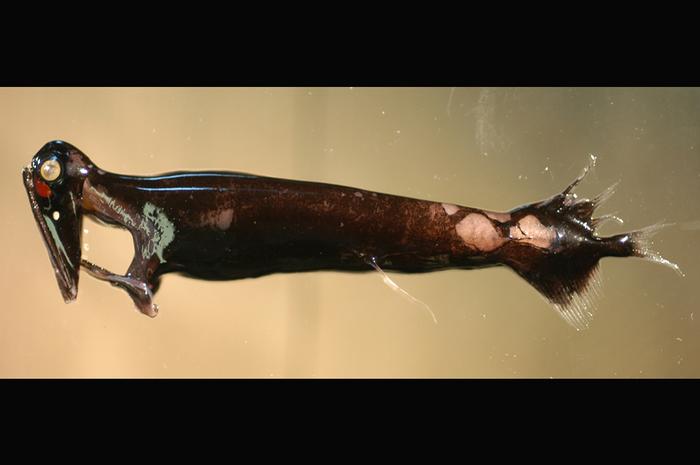
Chestnut Hill, Mass (07/24/2024) – A small but ferocious predator, the male dragonfish will apparently do anything for love. Or at least to find a mate.

Credit: Christopher Kenaley
Chestnut Hill, Mass (07/24/2024) – A small but ferocious predator, the male dragonfish will apparently do anything for love. Or at least to find a mate.
A new study by researchers at Boston College found the eyes of the male dragonfish grow larger for mate-seeking purposes, making the dragonfish an anomaly in vertebrate evolution, the team reported today in the Royal Society journal Biology Letters.
Like many creatures that inhabit the dark depths of the sea, dragonfishes survive thanks to numerous adaptations, including glowing bioluminescence. But females are not quite as bright as males, according to Boston College biologist Christopher P. Kenaley, lead author of the report “Sexually Dimorphic Eye-size in Dragonfishes, a Response to a Bioluminescent Signaling Gap”.
“We’ve found that these male dragonfishes have evolved larger eyes to find females who produce less light,” said Kenaley. “It’s rather stunning and a really important insight into how these poorly known species exist and thrive in the deep sea.”
Sexual dimorphism in the visual systems of vertebrates is extremely rare, Kenaley added. “This is perhaps the second known case in fishes, the largest group of vertebrates.”
The largest biome on Earth, the deep-sea is a dark, barren place and the distance between individuals that live there can be vast, Kenaley said. Most animals in this realm produce their own light, bioluminescence, using it to lure prey and often to find mates. Many deep-sea fishes are sexually dimorphic in this regard – males have larger photophores, the organs that produce light, than females.
That can present a problem when it comes to finding a mate, Kenaley said.
“This creates a paradox: if bioluminescence is important in sexual signaling and finding each other, this dimorphism results in a scenario in which females can detect males at shorter distances than the reverse,” he said. “In short, there’s a bioluminescent detection gap. We hypothesized that, to close this gap, males might have evolved larger eyes to capture more light.”
Kenaley and his team of Boston College undergraduates, working with Stockholm University biologist Valentina Di Santo, studied two species – Malacosteus niger and Photostomias guernei – of deep-sea dragonfishes that are sexually dimorphic in the size of their photophores. The team modeled the distance at which males and females of each species could see members of the opposite sex. This was based on the eye size and how much light a member of the opposite sex could produce.
The researchers found there is a substantial detection gap in both species ranging from just a few meters to more than 100 meters, they report in the journal. They also found that males of both species have larger eyes and that this dimorphism closes the gap by about 5 meters or so. It’s a modest improvement, they noted, but significant to the difficult task of finding a rare mate in such an open system.
In previous work, a few deep-sea biologists have asserted that a bioluminescent detection gap exists. The Boston College-led team is the first to assess the extent of this gap and, more importantly, whether these species might have evolved large male eye size.
Kenaley said future work may focus on why the bioluminescence of males is brighter than female dragonfish.
“We don’t yet know exactly why luminescent dimorphism exists in these and other deep-sea species,” said Kenaley. “Perhaps it’s a way of signalling to one another that a member of the opposite sex is nearby. Answering this question will require more studies like ours that establish a pattern of how detection distances vary with levels of dimorphism.”
Journal
Biology Letters
Method of Research
Observational study
Subject of Research
Animals
Article Title
Sexually Dimorphic Eye-size in Dragonfishes, a Response to a Bioluminescent Signaling Gap
Article Publication Date
23-Jul-2024
Cite Scienmag News
Violet Maxwell. (July 23, 2024). Eyes for Love: Searching for light and a mate in the deep, dark sea, male dragonfishes grow larger eyes than the females they seek. Scienmag. https://scienmag.com/eyes-for-love-searching-for-light-and-a-mate-in-the-deep-dark-sea-male-dragonfishes-grow-larger-eyes-than-the-females-they-seek/
Violet Maxwell. "Eyes for Love: Searching for light and a mate in the deep, dark sea, male dragonfishes grow larger eyes than the females they seek." Scienmag, 23 July 2024, https://scienmag.com/eyes-for-love-searching-for-light-and-a-mate-in-the-deep-dark-sea-male-dragonfishes-grow-larger-eyes-than-the-females-they-seek/. Accessed 4 September 2026.
Violet Maxwell. "Eyes for Love: Searching for light and a mate in the deep, dark sea, male dragonfishes grow larger eyes than the females they seek." Scienmag. July 23, 2024. https://scienmag.com/eyes-for-love-searching-for-light-and-a-mate-in-the-deep-dark-sea-male-dragonfishes-grow-larger-eyes-than-the-females-they-seek/

