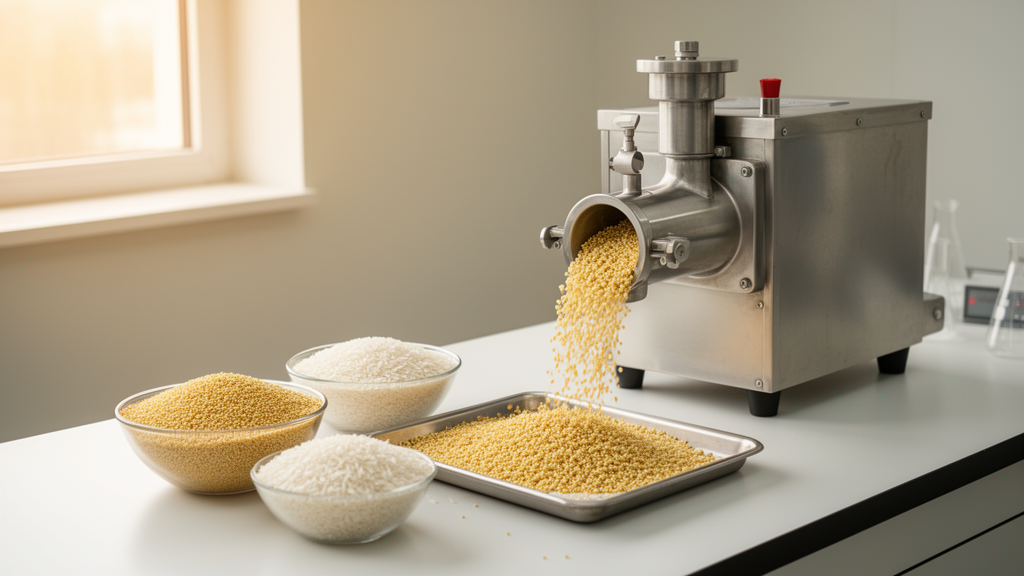
Reconstituted rice, grains rebuilt from milled flour blends through extrusion cooking, has become a promising vehicle for turning minor cereals into convenient staple foods. In a new open-access study, researchers in China systematically tested how foxtail millet (Setaria italica L.) changes every dimension of such a product, from nutrition and color to texture, microstructure and in vitro starch digestion. Using a twin-screw extruder, the team prepared reconstituted rice in which millet flour replaced rice flour at 0, 20, 40, 60, 80 and 100 percent by weight, producing six formulations labeled C-0 through C-10, and then measured a battery of indicators across all of them.
The headline outcome is that two different substitution levels emerged as winners for two different goals. The 60 percent millet formulation delivered the lowest gumminess and chewiness together with the highest overall sensory score, making it the best candidate for everyday eating. The 80 percent formulation, by contrast, achieved the highest relative crystallinity of V-type amylose-lipid complexes, a form of type 5 resistant starch, at 7.08 percent, and showed a sharply reduced content of rapidly digestible starch, pointing to stronger resistance to enzymatic breakdown. The authors conclude that millet incorporation in the 60 to 80 percent range sustains favorable nutritional and edible quality overall.
The manufacturing process itself was tightly specified. Rice and millet were milled and sieved through an 80-mesh screen, blended, and fed into a twin-screw extruder at 150 grams per minute with a feed moisture content of 36 percent and a screw speed of 150 revolutions per minute. Barrel temperatures were staged at 60 degrees Celsius in zone II, 140 in zone III, 150 in zone IV, 70 in zone V and 90 in zone VI, with a cutter speed of 1500 revolutions per minute. After extrusion cooking, the material was cut and granulated, pneumatically dried, cooled and collected as the final grain-shaped product.
Nutritionally, raising the millet share shifted the composition of the extruded grains in measurable ways. Fat content increased from 0.16 percent to 0.47 percent as millet substitution rose, a significant upward trend even though the finished products contained less fat than the raw materials, whose values were 1.35 percent for millet and 1.12 percent for rice. Protein content climbed from 6.69 percent to 10.28 percent with increasing millet, again remaining below the raw-material levels of 12.23 percent for millet and 10.50 percent for rice, a reduction the authors attribute to thermal denaturation and cross-linking of proteins with starch and lipids during extrusion. Starch content of the products ranged from 64.61 percent to 70.08 percent, generally lower than the raw materials, because gelatinization and degradation of starch chains, plus the added non-starch components from millet, diluted the relative starch fraction. Moisture content of all groups fell between 8.26 percent and 10.38 percent.
Fatty acid analysis by gas chromatography with flame ionization detection identified five fatty acids in every sample: palmitic, stearic, oleic, linoleic and linolenic, with linoleic acid dominant. Palmitic, stearic and oleic acids rose slightly without significant differences between groups, while linoleic and linolenic acids increased significantly as millet substitution grew, and the 100 percent millet sample, C-10, showed the highest concentrations of all tested fatty acids. The authors explain that high temperature and strong shear during extrusion disrupt the protein network and starch granule structure, releasing bound lipids as free fatty acids; despite some thermal oxidative loss of unsaturated fatty acids, the extra lipid substrate from millet dominated the outcome.
Those free fatty acids matter for another reason: they are the ligands for V-type starch-lipid complexes, the crystalline structures classified as type 5 resistant starch. X-ray diffraction showed characteristic V-type peaks at 13 and 20 degrees two-theta in all samples. Relative crystallinity was lowest at 3.07 percent in the 20 percent millet group, peaked at 7.08 percent at 80 percent substitution, and fell back to 5.05 percent at 100 percent millet. The authors propose that at 80 percent millet the supply of free fatty acids was moderate enough to allow orderly amylose-lipid complexation, whereas at 100 percent the excess uncomplexed fatty acids created steric hindrance that disturbed the ordered stacking of the complexes. These V-type microcrystals can shield the recognition sites of amylase and inhibit starch hydrolysis, which is why the 80 percent group showed the strongest anti-digestive behavior in the study’s tests.
Microscopy told a consistent structural story. Scanning electron micrographs of grain cross-sections revealed that the millet-free control had a flat, dense matrix with few tiny pores, while increasing millet raised both the number and diameter of pores. The 80 percent sample stood out with uniformly sized pores, fully melted starch and an ordered, compact matrix, which the authors link to an optimal blending ratio in which amylose and amylopectin chains unfolded and interpenetrated into a cross-linked, homogeneous network. The 100 percent millet sample, in contrast, was riddled with large open cavities and a loose, fragmented starch matrix, attributed to structural mismatch between millet and rice amylopectin and to rapid water-vapor expansion upon die discharge. An intact, continuous matrix acts as a physical barrier against digestive-fluid penetration, so the compact 80 percent structure aligns with its low digestibility.
Cooking and water-related properties also shifted with formulation. Cooking loss first declined and then rebounded as millet increased, reaching its minimum of 3.54 plus or minus 0.15 percent at the 80 percent group, which the authors interpret as superior structural stability during boiling. Water absorption and swelling capacity rose overall, and every millet-supplemented group exceeded the millet-free control, consistent with extrusion-generated microcavities providing extra channels for water penetration. Low-field nuclear magnetic resonance showed two moisture populations and a gradual decrease in transverse relaxation time with more millet, indicating reduced water mobility, good water-holding capacity and a migration of weakly bound water toward tightly bound water; no free water was detected in any sample. Color changed steadily too: lightness fell while redness and yellowness rose with millet level, attributed to starch gelatinization and Maillard reactions during extrusion.
Amino acid profiles split along thermal-stability lines. Acidic amino acids such as aspartic and glutamic acid, and neutral amino acids including threonine, serine, proline, alanine, valine, methionine, isoleucine, leucine, phenylalanine and tyrosine, were lowest in the millet-free control and rose with millet substitution, staying high in the 80 and 100 percent groups, with tyrosine peaking at 80 percent. Alkaline amino acids, glycine, lysine and arginine, moved in the opposite direction, highest in the control and lowest at 100 percent millet, because they are consumed in Maillard reactions with the reducing sugars that millet addition increases. Texture testing with a TMS-Pro analyzer showed that millet incorporation significantly reduced hardness, springiness, cohesiveness, gumminess and chewiness relative to the control; hardness fell to a minimum of 47.31 newtons at the C-4 sample before slightly rebounding, and the 60 percent group had the lowest gumminess and chewiness among the millet-fortified samples.
Sensory evaluation under the Chinese national standard GB/T 15682-2008, performed by 20 trained food professionals aged 20 to 50 with ethics approval from Hebei Agricultural University, scored color, flavor, appearance and structure, hardness and softness, and palatability. The 60 percent millet sample achieved the largest radar-plot area and a maximum total sensory score of 78, with palatability up 3.6 percent and overall score up 9.3 percent relative to the millet-free control. Below 60 percent, all sensory indices rose progressively; beyond 60 percent, quality deteriorated steadily, which the authors link to excessive Maillard reactions darkening the kernels and generating bitter, burnt notes. In the in vitro digestion assay using alpha-amylase and amyloglucosidase, rapidly digestible starch differed significantly among groups, peaking at 60 percent substitution and dropping sharply at 80 percent, while slowly digestible starch and resistant starch stayed statistically stable across all treatments, a balance the authors attribute to opposing effects of complex formation and starch dilution. The team cautions that the ideal blending ratio depends on product positioning, balancing nutrition, texture and sensory experience.
Subject of Research: Effects of gradient foxtail millet substitution on the nutrition, texture, structure and in vitro digestibility of extruded reconstituted rice
Article Title: Analysis of eating quality and nutritional properties of millet reconstituted rice
Article References: Zhang, J., Liu, Y., Zhang, C., Zhang, X., Zhang, A., & Liu, J. (2026). Analysis of eating quality and nutritional properties of millet reconstituted rice. Food, Nutrition and Health, 3(1), Article 41. https://doi.org/10.1007/s44403-026-00078-9
Image Credits: AI Generated
DOI: 10.1007/s44403-026-00078-9
Keywords: foxtail millet, reconstituted rice, twin-screw extrusion, resistant starch, V-type amylose-lipid complexes, in vitro digestibility, food texture, sensory evaluation, starch crystallinity, cooking properties, functional staple foods, amino acid profile
Cite Scienmag News
Alan Morgan. (October 27, 2026). Extruded Millet Rice: Sweet Spot Found at 60 to 80 Percent Substitution. Scienmag. https://scienmag.com/extruded-millet-rice-sweet-spot-found-at-60-to-80-percent-substitution/
Alan Morgan. "Extruded Millet Rice: Sweet Spot Found at 60 to 80 Percent Substitution." Scienmag, 27 October 2026, https://scienmag.com/extruded-millet-rice-sweet-spot-found-at-60-to-80-percent-substitution/. Accessed 28 October 2026.
Alan Morgan. "Extruded Millet Rice: Sweet Spot Found at 60 to 80 Percent Substitution." Scienmag. October 27, 2026. https://scienmag.com/extruded-millet-rice-sweet-spot-found-at-60-to-80-percent-substitution/