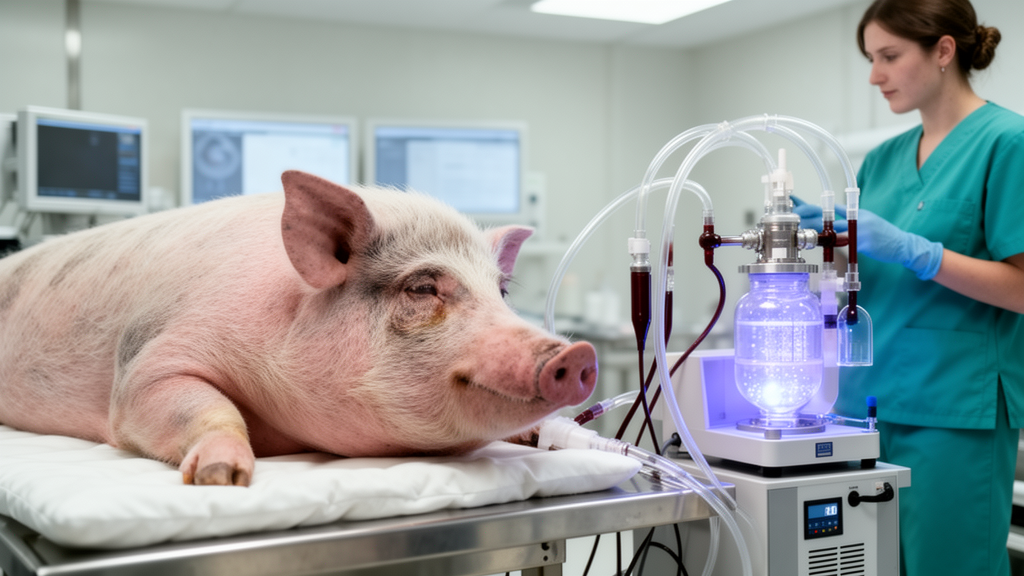
Sepsis remains one of medicine’s most stubborn challenges. It is described in the new study as the third leading cause of death worldwide, yet no specific anti-inflammatory therapy, apart from steroids, has been shown to significantly improve clinical outcomes in septic patients. A research team in Sweden has now reported early, cautiously framed evidence that an unusual approach, treating blood with ozone outside the body, may improve clinically relevant measures in an experimental model of acute gram-negative sepsis. The work, published as a Brief Report in an open-access journal on 25 October 2026, is explicitly exploratory, and its authors stress that far more rigorous studies are needed before any clinical conclusions can be drawn.
The experiment involved nine pigs, weighing on average 31 plus or minus 2 kilograms, of both sexes. Sepsis was induced by a 30-minute intravenous infusion of the bacterium Pseudomonas aeruginosa, delivered at a final concentration equivalent to 2.5 times ten to the eighth colony-forming units per millilitre. After the infusion ended, the animals were given an additional 30 minutes without further bacteria to allow sepsis to develop, defined as a Sequential Organ Failure Assessment, or SOFA, score of at least 2. The SOFA score is the same organ-failure classification tool used in human intensive care, which the researchers highlight as a strength because it keeps the measurements on a clinically transferable level. The pigs were then assigned using a simple every-other allocation method: five received no extracorporeal treatment, serving as a model of standard routine intensive care, while four were connected to the ozone device.
The treatment itself used a patented system called SangAsept, developed by Sangair AB of Lund and Cenova AB of Mjölby, Sweden. Blood was drawn from a central dialysis catheter placed in the femoral vein and circulated through the machine at 50 millilitres per minute. In a gas chamber, the blood was exposed to a mixture of oxygen and ozone at a ratio of 98 to 2 percent, with an ozone concentration of 40 grams per cubic metre. Treatment lasted exactly one hour, after which the circuit was disconnected and the animals were monitored for a further two hours, making the total observation window four hours from the start of the bacterial infusion. The untreated pigs received no catheter, no heparin and no external circuit.
The headline finding concerned organ failure. At the endpoint, SOFA scores were significantly lower in the ozone-treated pigs than in the untreated controls, with a reported p-value of 0.005. The authors attribute this mainly to the cardiovascular component of the score: the treated animals maintained a normal mean arterial pressure without vasopressor support, whereas 80 percent of the untreated pigs required noradrenaline infusions to keep their mean arterial pressure above 65 millimetres of mercury. Noradrenaline use differed significantly between the groups. The treatment had no significant effect on the respiratory SOFA component in this acute setting, and no animal showed clinical evidence of kidney or liver impairment by SOFA criteria; only one untreated pig developed a platelet score of 1 at the endpoint.
Supporting measures pointed in the same direction. Bilirubin levels were twofold higher in the untreated pigs than in the ozone-treated group, a difference that reached statistical significance, although none of the subjects met the SOFA threshold for bilirubin. Hemoglobin and albumin were significantly higher in the untreated animals even though fluid administration was identical across both groups at 10 millilitres per kilogram per hour; hemoglobin stayed within the normal range in the treated pigs while rising in the untreated ones. Plasma lactate, a shock criterion when it reaches 2 millimolar or above, was elevated in one treated pig compared with 80 percent of the untreated animals. Notably, no subject had detectable bacteremia at the endpoint, and an exploratory analysis found no correlation between the peak bacterial concentration and either the initial or the endpoint total SOFA score, which the authors interpret to mean that the absolute bacterial count may not be the determining factor in sepsis severity.
The inflammatory results were more equivocal. Previous work by the same group had shown that extracorporeal ozone has potent gram-negative bactericidal properties and that the treatment suppressed interleukin-6, a key pro-inflammatory cytokine, in porcine Pseudomonas septic shock. In this acute cohort, however, there were no significant effects of ozone on either interleukin-6 or interleukin-1 beta, even though both cytokines were numerically higher in the untreated group; the authors report interleukin-6 values of 2551 versus 693 picograms per millilitre and suggest the small sample size may have obscured a real effect. At the endpoint, interleukin-6 showed one significant correlation, with hemoglobin, while interleukin-1 beta correlated negatively with the pulmonary SOFA score. No correlations appeared at the initial sepsis phase for either cytokine. The authors frame these association analyses as preliminary signals suggesting interleukin-6 might be a key player in the acute decline of cardiovascular function, while cautioning that more robust long-term studies are required to support that conclusion.
Safety data from the study are thin, a point the authors acknowledge directly. Hemolysis, the destruction of red blood cells, is an obvious concern when blood is exposed to a reactive gas, but the researchers measured it in only two randomly chosen treated pigs, comparing plasma hemoglobin in the line entering the machine with the line leaving it. Pig one showed 0.3 grams per litre before and 0.5 after; pig two showed 0.4 before and 1 after. The authors describe these changes as not clinically relevant but concede that such limited sampling does not provide the full picture of treatment safety, and that more rigorous monitoring must be validated before the approach could be considered for clinical use.
The study’s limitations extend beyond safety monitoring. Because there was no sham group, no animals receiving the dialysis catheter, heparinisation, extracorporeal circuit and oxygen without ozone, the researchers cannot exclude that some of the observed hemodynamic benefit came from the preparation itself rather than the ozone. Each of those steps could separately affect circulation, and the authors explicitly advise cautious interpretation for this reason. The sample size of nine is small, allocation was by a simple every-other method rather than blinded randomisation, and the observation window covered only the acute phase, ending four hours after bacterial infusion. The Pseudomonas model used produces a phenotype dominated by cardiovascular and respiratory failure; liver, kidney and coagulation impairment might be expected at later stages that this protocol did not capture. The authors also note the model’s strength: it represents true sepsis as defined by the MQTiPSS preclinical guidelines, rather than the pseudo-sepsis produced by lipopolysaccharide injection models.
What the study does offer is a hypothesis worth testing. In this translational cohort, one hour of extracorporeal ozone treatment was associated with lower organ-failure scores, preserved blood pressure without vasopressors, and attenuated hemoconcentration and bilirubin rise in pigs with acute gram-negative sepsis. The authors propose that the cardiovascular benefit might reflect a direct hemodynamic effect, perhaps inhibiting vasodilation, protecting the glycocalyx, or augmenting endogenous vasopressors such as angiotensin II, endothelin or noradrenaline, though they emphasise that the mechanism remains unclear and requires thorough investigation. Ozone is widely used to sterilise fluids and materials but lacks clinical evidence of benefit in human disease, so the leap from a four-hour pig experiment to the intensive care unit is a long one. The team’s own conclusion is measured: the exploratory results warrant further extensive studies, first in larger and longer-term experimental models, before the strategy can advance toward clinical testing. For a field that has seen repeated failures of novel sepsis therapies, even a cautiously reported signal of this kind is noteworthy, but it is a starting point, not a treatment.
Subject of Research: Extracorporeal ozone treatment in an experimental pig model of acute gram-negative sepsis
Article Title: Using extracorporeal ozone to treat experimental gram-negative sepsis: an exploratory study
Article References: Razmand, B., Fowler, C., Skorup, P., Sjöholm, J., Wictor, P.-O., Günther, M., Lipcsey, M., & Franzén, S. (2026). Using extracorporeal ozone to treat experimental gram-negative sepsis: an exploratory study. Critical Care: Sepsis and Severe Infection, 1(1), Article 17. https://doi.org/10.1186/s44541-026-00020-8
Image Credits: AI Generated
DOI: 10.1186/s44541-026-00020-8
Keywords: sepsis, extracorporeal ozone, Pseudomonas aeruginosa, SOFA score, porcine model, interleukin-6, organ failure, critical care, bactericidal therapy, hemodynamics, preclinical study, vasopressors
Cite Scienmag News
Ophelia Keating. (October 27, 2026). Extracorporeal Ozone Shows Early Promise Against Experimental Gram-Negative Sepsis in Pigs. Scienmag. https://scienmag.com/extracorporeal-ozone-shows-early-promise-against-experimental-gram-negative-sepsis-in-pigs/
Ophelia Keating. "Extracorporeal Ozone Shows Early Promise Against Experimental Gram-Negative Sepsis in Pigs." Scienmag, 27 October 2026, https://scienmag.com/extracorporeal-ozone-shows-early-promise-against-experimental-gram-negative-sepsis-in-pigs/. Accessed 28 October 2026.
Ophelia Keating. "Extracorporeal Ozone Shows Early Promise Against Experimental Gram-Negative Sepsis in Pigs." Scienmag. October 27, 2026. https://scienmag.com/extracorporeal-ozone-shows-early-promise-against-experimental-gram-negative-sepsis-in-pigs/