


The tectonic clash between the Indian and Asian continents has long been a matter of significant geological interest, particularly in its association with the formation of the Himalayas and the Tibetan Plateau. Traditional views have posited a continuous collision caused by ongoing tectonic convergence since the Cenozoic Era, relying on two primary assumptions: first, that the India-Asia collision is a continuous process; and second, that the Indian plate is actively subducting beneath the Tibetan hinterland. However, emerging research presents compelling contradictions to these longstanding notions, indicating that the dynamics of this continental collision may be far more complex and nuanced than previously understood.
Recent analyses integrating geological, geophysical, and geochemical data provide an alternative perspective on this monumental tectonic event. The results suggest that the initial collisional phase between the Indian and Asian plates was much more transient than once thought, occurring in the Early Cenozoic era. This short-lived orogeny challenges the dominant views of ongoing and extensive collisional processes and brings to light the significant role of post-collisional mantle dynamics in shaping the Tibetan Plateau during the Late Cenozoic.
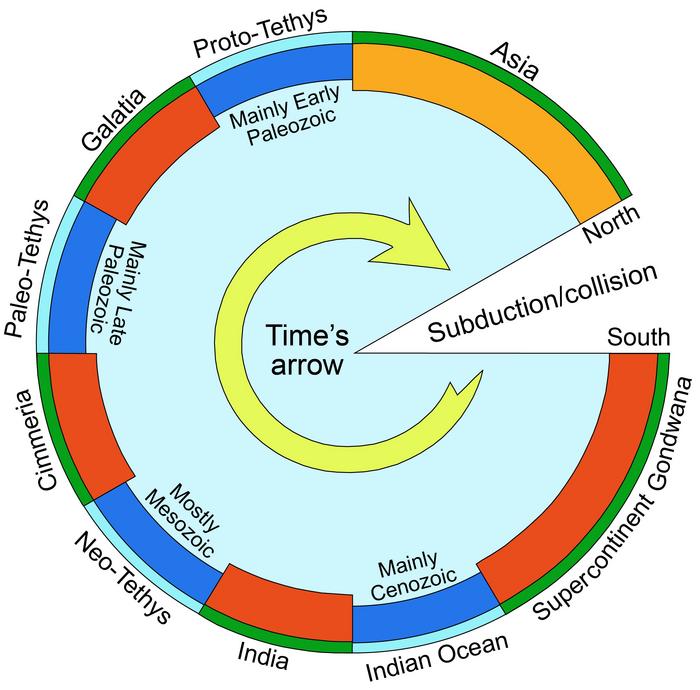
One of the key findings of this study is the recognition that the geological architecture of the Tibetan Plateau is not merely a product of a singular, continuous collision but rather a mosaic of terranes. These terranes were accreted northward over millions of years, from the Early Paleozoic through the Mesozoic eras. This highlights the intricate interactions and geological processes at play, suggesting that features such as sutures and terranes exhibit variable reactivation triggered predominantly during the brief collisional event of the Early Cenozoic, rather than as a result of a steady, enduring collision over the Cenozoic period.
A thorough review of existing literature reveals that major geological paradigms rooted in the two key assumptions concerning the India-Asia collision are facing skepticism as new evidence emerges. Seismic tomography, coupled with helium isotope studies, limits the extent of the Indian continent’s subduction beneath the Tibetan Plateau to depths of only 200–300 kilometers. These depths are primarily situated beneath the Yarlung-Zangpo Suture, which delineates the southern margin of the Tibetan Plateau. This finding provokes further inquiry into the paleomagnetic interpretations of Greater India, positing that the extent of underthrusting has often been exaggerated and is constrained to distances of fewer than 300 kilometers.
The implications of these findings extend further into the tectonic evolution of the region, partitioning the complex formation of the Himalayan orogen into two distinct chronological stages. The first phase involves a progression from soft collision through hard collision to deep subduction, primarily occurring between 55 and 45 million years ago during the Early Cenozoic. The second phase, following this initial collision, is characterized by post-collisional processes such as the upwelling of asthenospheric mantle, induced by the sinking of the lithospheric mantle. This has facilitated geological phenomena such as crustal melting, the emergence of leucogranites, and the development of metamorphic core complexes, which significantly contributed to the domical uplift that the region has experienced from about 30 to 10 million years ago in the Late Cenozoic.
Moreover, the study emphasizes that the tectonic evolution of the Himalaya-Tibet region should not merely be viewed through the lens of collision dynamics; instead, it must also account for the intricate interplay of tectonic processes that define the entire region’s geological narrative. The recent findings advocate for an integrated approach in understanding the post-collisional landscape, which may provide new insights into the mechanisms driving continental uplift and the intricate systems that govern the behavior of tectonic collages.
As geological and geochemical data are scrutinized, it becomes increasingly evident that the prevailing assumptions about the India-Asia collision may require a substantial reevaluation. Insights gained from the study stress the necessity for advanced geodynamic models that accurately represent the complexities of geological processes, mechanisms, and effects associated with the India-Asia collision. Recognizing the dominant role of post-collisional dynamics over syn-collisional effects may shed light on other continental tectonics at converged plate margins worldwide.
This pivotal plunge into the tectonic dynamics of the Himalaya-Tibet collage not only redefines our understanding of a key geological feature but also challenges researchers to reconsider seismic and paleomagnetic interpretations previously dictated by simpler linear models. The evolving narrative of how continents collide and interact underscores the importance of adapting our scientific inquiries to the complexities and fluidity inherent in geological systems. It becomes increasingly clear that the rich tapestry of geological history demands a reinterpretation that embraces new data and challenges the status quo.
In summary, the tectonic saga of the Indian and Asian continents serves as a profound reminder of the dynamic and multifaceted nature of continental formations. The deceptive simplicity of traditional models gives way to a more nuanced understanding that will likely push the boundaries of geological inquiry. As researchers unravel the complexities of the region’s tectonic history, they offer transformative insights that beckon a reevaluation of global tectonic processes, ultimately enriching our understanding of the Earth’s geological evolution.
Cite Scienmag News
Violet Maxwell. (April 14, 2025). Exploring the Ongoing Continental Collision: India Meets Asia Again. Scienmag. https://scienmag.com/exploring-the-ongoing-continental-collision-india-meets-asia-again/
Violet Maxwell. "Exploring the Ongoing Continental Collision: India Meets Asia Again." Scienmag, 14 April 2025, https://scienmag.com/exploring-the-ongoing-continental-collision-india-meets-asia-again/. Accessed 6 September 2026.
Violet Maxwell. "Exploring the Ongoing Continental Collision: India Meets Asia Again." Scienmag. April 14, 2025. https://scienmag.com/exploring-the-ongoing-continental-collision-india-meets-asia-again/


