


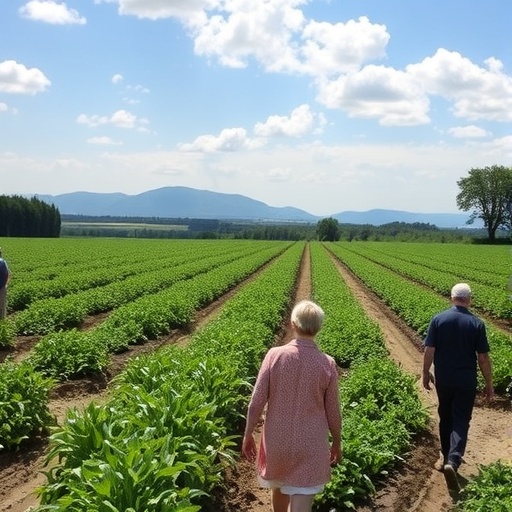
In recent years, the ongoing discourse around sustainable agricultural practices has evolved significantly, especially in light of the pressing challenges posed by climate change, soil degradation, and socio-economic disparities in rural communities. A systematic review published in Discov Agric by Gaspar, Moïse, Versaillot, and colleagues, delves deep into the often-overlooked dimension of social capital within the regenerative agriculture paradigm. This investigation elucidates the intricate web connecting social relationships and agricultural outcomes, thereby raising pivotal questions about the future of farming practices.
Regenerative agriculture, primarily focused on restoring soil health and enhancing biodiversity, aims to create sustainable agricultural systems that benefit both the environment and the communities that rely on these systems. However, traditional studies have largely fixated on tangible metrics such as yield and soil quality, leaving a significant gap regarding the social fabric that underpins successful agricultural ecosystems. The review by Gaspar et al. seeks to bridge this gap by systematically examining how social capital, defined as the networks, trust, and norms facilitating cooperation among individuals, influences agricultural practices and outcomes.
The review shines a light on several critical dimensions of social capital that are essential for the effective implementation of regenerative agriculture. Trust among community members fosters collaboration, encouraging the sharing of ideas, knowledge, and resources. This can lead to improved practices that are more responsive to local ecological needs and specific agricultural challenges. The authors argue that cultivating trust and mutual respect among farmers can significantly enhance the effectiveness of regenerative practices.
Additionally, the findings reveal that social networks play a crucial role in information dissemination. Farmers involved in robust social networks are often better informed about innovative regenerative practices and are more willing to adopt them. The social capital embedded within these networks facilitates the sharing of experiences and lessons learned, thus promoting a culture of continuous improvement and adaptation. These networks also provide emotional and practical support, particularly crucial in times of agricultural stress or market volatility.
The review further emphasizes the importance of collective action in achieving regenerative agricultural goals. When farmers collectively engage in practices such as cooperative purchasing or shared marketing efforts, they can reduce costs and increase market access. This collective approach not only amplifies individual efforts but also builds resilience within farming communities, making them more capable of adapting to external shocks such as climate fluctuations or socio-economic changes. The findings underline that the strength of community bonding and collective identity among farmers directly correlates with their ability to implement and sustain regenerative practices.
Gaspar et al. also highlight the role of institutions in nurturing social capital within agricultural communities. Supportive institutional frameworks can enhance trust and promote collaborative initiatives among farmers. This could include policy measures aimed at facilitating farmer cooperatives, creating educational programs that bolster community engagement, and ensuring equitable access to resources. Policymakers, therefore, have a pivotal role in recognizing and harnessing the power of social capital as a complementary facet to ecological and economic sustainability.
Furthermore, the review draws attention to the need for interdisciplinary approaches in agricultural research. By integrating insights from social sciences with environmental studies, researchers can develop a more holistic understanding of the factors driving regenerative agriculture. This integration can lead to innovative solutions that leverage neighborly cooperation alongside scientific advancements in agronomy and ecology, creating a more robust and inclusive framework for future farming practices.
With the increasing urgency of addressing food security and environmental sustainability, the review serves as a clarion call for the agricultural community—researchers, practitioners, and policymakers alike—to recognize the profound implications of social capital in regenerative agriculture. The connections between farmers, their communities, and their agricultural practices are not just tangential but rather central to shaping resilient and sustainable food systems for future generations.
Moreover, the implications of these findings extend beyond the realm of agriculture. As discussions on sustainable development continue worldwide, understanding the dynamics of social capital can inform broader initiatives aimed at achieving sustainability across various sectors. Whether it involves developing urban green spaces or promoting local food systems, the principles outlined in this review could contribute significantly to advancing collective efforts toward a more sustainable and equitable future.
In conclusion, the systematic review by Gaspar, Moïse, Versailot, and their colleagues establishes a critical nexus between social capital and regenerative agriculture, inviting further exploration and dialogue. It elevates the conversation by emphasizing that sustainability in agriculture cannot merely focus on environmental and economic efficiencies but must inherently incorporate the human and social dimensions that shape farming communities. As the agricultural landscape continues to evolve, infusing discussions with insights from this review could catalyze significant transformations in how we approach the challenges of agriculture in the 21st century.
To effect meaningful change, the agricultural sector must adapt its strategies to foster social capital. Approaches that prioritize relationship-building and community trust will be instrumental in driving the adoption of regenerative practices. By recognizing and enhancing the role of social networks in agriculture, we can chart a course toward a more resilient and sustainable agricultural future, making strides that will benefit not only our soils and yields but also the very communities that nurture them.
Cite Scienmag News
Alan Morgan. (November 11, 2025). Exploring Social Capital’s Impact on Regenerative Agriculture. Scienmag. https://scienmag.com/exploring-social-capitals-impact-on-regenerative-agriculture/
Alan Morgan. "Exploring Social Capital’s Impact on Regenerative Agriculture." Scienmag, 11 November 2025, https://scienmag.com/exploring-social-capitals-impact-on-regenerative-agriculture/. Accessed 4 September 2026.
Alan Morgan. "Exploring Social Capital’s Impact on Regenerative Agriculture." Scienmag. November 11, 2025. https://scienmag.com/exploring-social-capitals-impact-on-regenerative-agriculture/


