


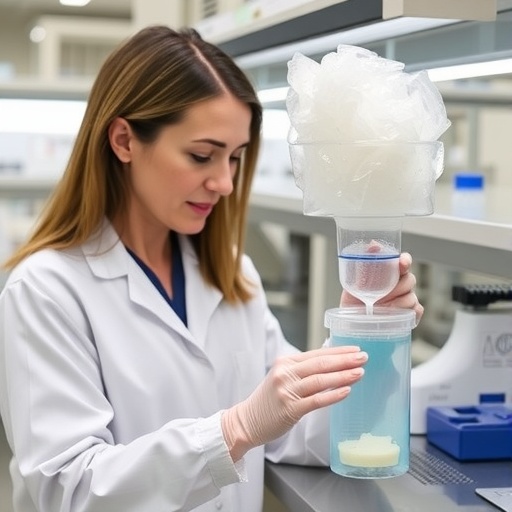
In a groundbreaking study set to revolutionize wastewater treatment processes, researchers have focused their attention on the utilization of Grewia Optiva amorphous nanocellulose and its magnetite composite for the removal of pharmaceuticals from contaminated water. This innovative approach, marked by a multifaceted exploration of material properties, adsorptivity, reusability, and phytotoxicity, promises to provide a sustainable solution to address one of the pressing environmental challenges of our time.
Grewia Optiva, commonly known as the Dhaman tree, is a species known for its numerous ecological and economic benefits. The transformative use of its natural resources highlights an emerging trend in environmental science: harnessing the power of indigenous materials for cutting-edge technological applications. The unique structure of nanocellulose derived from this plant not only enhances its versatility but also elevates its effectiveness as an adsorbent for pharmaceutical compounds, which have become a primary contaminant in water systems globally due to improper disposal practices.
The study delves into the remarkable adsorptive capabilities of Grewia Optiva amorphous nanocellulose. Through rigorous experimentation, scientists have demonstrated that this bio-derived material exhibits significant binding affinity for various pharmaceutical agents. The process of pharmaceutical adsorption involves a complex interplay of physical and chemical interactions, making it imperative to investigate the efficiency and mechanisms at work in these nanocellulose composites. As the concern surrounding pharmaceutical pollutants increases, the demand for effective and eco-friendly remediation strategies becomes more urgent.
One of the primary highlights of this research is the emphasis on reusability. Traditional adsorbents often lose efficiency after several cycles of use, leading to increased operational costs and waste. Grewia Optiva nanocellulose and its magnetite composite display an unprecedented capacity for regeneration—retaining their adsorptive properties even after multiple cycles of exposure to pharmaceutical contaminants. This quality not only promotes economic viability but also aligns with the principles of sustainability crucial for contemporary environmental science endeavors.
In evaluating the ecological implications of using Grewia Optiva nanocellulose in water treatment, the researchers have critically assessed the material’s phytotoxicity. The interaction between any remediation agent and the surrounding environment is vital for ensuring that the solution does not inadvertently introduce new problems. Through detailed assessments, the team aims to confirm the biocompatibility of the materials employed, ensuring that the use of nanocellulose composites enhances environmental health rather than compromise it.
In an era where water scarcity is making headlines, the pressure to develop sustainable solutions for water purification cannot be overstated. Current technologies often rely on expensive and complex processes that may not be feasible for all regions, particularly in developing countries. The innovative application of naturally derived materials like Grewia Optiva nanocellulose offers a glimmer of hope, presenting a low-cost alternative that is accessible and environmentally benign.
The research further explores the polymeric nature of the amorphous nanocellulose, delving into how its molecular structure can be optimized to enhance its adsorptivity for a broader range of contaminants. Advanced characterization techniques provide insights into the interactions between nanocellulose and pharmaceutical molecules, which plays a crucial role in determining the effectiveness of this remediation strategy. This technical emphasis highlights the intersection of material science and environmental engineering, showcasing how interdisciplinary collaboration can lead to significant advancements.
Given the pressing urgency of pharmaceutical pollution in aquatic ecosystems, the study illustrates a decisive shift towards the integration of natural materials into water treatment frameworks. By capitalizing on the inherent advantages of Grewia Optiva, the authors present a compelling case for policy makers and environmental engineers alike to consider plant-derived solutions in future designs of waste management systems. This paradigm shift is not merely a theoretical proposition; it represents a tangible step towards real-world applications that could transform how industries approach water pollution.
The broader implications extend to global water sustainability, particularly within regions facing acute water shortages which are often exacerbated by pollution. By harnessing abundant natural resources, this research acknowledges the critical need for scalable solutions that can be implemented worldwide, particularly in areas with limited access to advanced technological resources. The prospect of utilizing local materials for environmental cleanup reinforces the importance of community involvement and indigenous knowledge in scientific research, creating pathways for empowerment and ecological stewardship.
In summary, the research on Grewia Optiva amorphous nanocellulose as a potent adsorbent offers an exciting glimpse into the future of wastewater treatment. It not only addresses a critical environmental issue but also embodies a philosophy that seeks to harmonize technological advances with ecological sustainability. The interplay between material science and environmental application is a testament to the innovative potential that lies within the natural world, urging continuous exploration of indigenous resources in the realm of environmental science.
As the findings circulate within the scientific community, they are expected to inspire further studies and applications of natural adsorbents. This enthusiasm resonates with an urgency, as the urgency for effective and sustainable solutions continues to rise. By integrating these insights and broadening the conversation around materials like Grewia Optiva into public discourse, the research stands at the forefront of a much-needed movement toward cleaner water and healthier ecosystems.
With the impending publication in the Environmental Science and Pollution Research journal, the researchers anticipate that their findings will catalyze a wider acknowledgment of the role that natural materials can play in combating one of the most pervasive forms of water pollution. The synergy between environmental stewardship and innovative materials science could very well reshape our approach to pollution control and resource sustainability for generations to come.
Chaudhary, P., Nayak, A., Bhushan, B. et al. Insights on the material, adsorptivity, reusability and phytotoxicity of Grewia Optiva amorphous nanocellulose and its magnetite composite for pharmaceuticals removal. Environ Sci Pollut Res (2025). https://doi.org/10.1007/s11356-025-37271-w
Cite Scienmag News
Violet Maxwell. (December 15, 2025). Exploring Grewia Optiva Nanocellulose for Pharmaceutical Adsorption. Scienmag. https://scienmag.com/exploring-grewia-optiva-nanocellulose-for-pharmaceutical-adsorption/
Violet Maxwell. "Exploring Grewia Optiva Nanocellulose for Pharmaceutical Adsorption." Scienmag, 15 December 2025, https://scienmag.com/exploring-grewia-optiva-nanocellulose-for-pharmaceutical-adsorption/. Accessed 3 September 2026.
Violet Maxwell. "Exploring Grewia Optiva Nanocellulose for Pharmaceutical Adsorption." Scienmag. December 15, 2025. https://scienmag.com/exploring-grewia-optiva-nanocellulose-for-pharmaceutical-adsorption/


