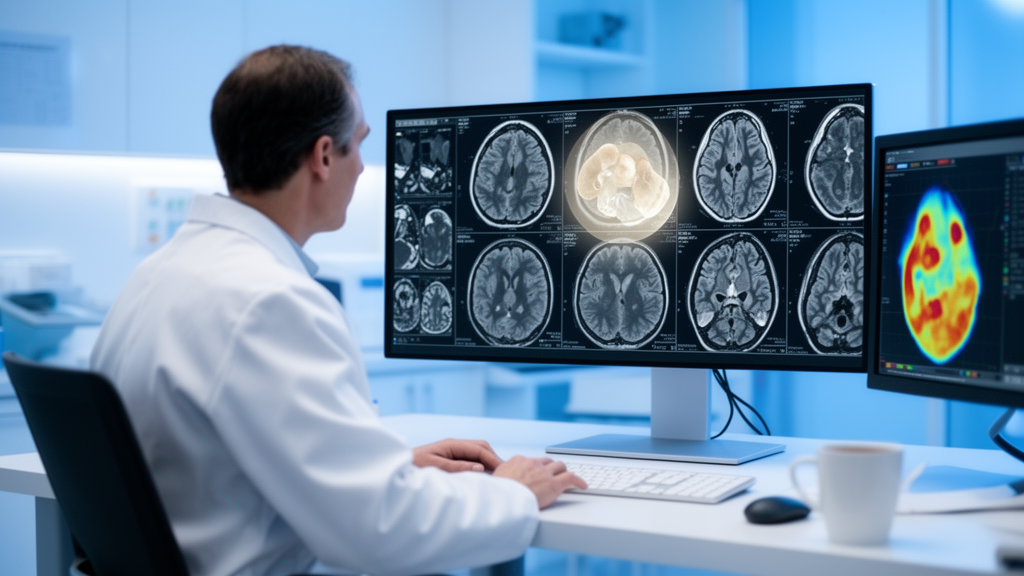
Researchers have developed a hybrid deep learning framework that combines transformer and convolutional neural network architectures to classify brain tumors from MRI images, reporting per-class accuracies of up to 99.56 percent in a study published in Scientific Reports.
The team, led by Bukkapatnam Rakesh Babu and Vullanki Rajesh, with Pardhu Thottempudi and Ravilla Dilli, designed the system to sort MRI scans into four categories: meningioma, glioma, pituitary tumors, and cases with no tumor. The work is presented as an accepted, peer-reviewed article shared early, subject to further edits before the final version of record.
Before any classification takes place, the pipeline processes each MRI scan through several preprocessing steps. These include skull stripping to remove non-brain tissue, contrast enhancement using CLAHE, normalization, resizing, and data augmentation, which the authors say produces uniform, high-quality inputs for the model.
At the heart of the framework is TransUNet, a segmentation architecture that merges convolutional neural networks with transformer-based attention. This combination allows the model to capture both local image detail and long-range contextual relationships, which the researchers use to delineate tumor regions within each scan.
The segmentation masks generated by TransUNet then define regions of interest for feature extraction. A DenseNet121 network, pretrained on ImageNet, processes these regions with its final classification layer removed, and global average pooling condenses the output into discriminative feature representations.
An attention-based refinement step further improves these feature representations before they pass into a regularized fully connected classifier. That classifier, equipped with batch normalization and dropout, performs the final four-class tumor decision.
A distinguishing feature of the approach is its emphasis on explainability. The system uses Grad-CAM++ and attention visualization to highlight which image regions drove each classification, allowing users to see whether the model is focusing on tumor-related areas rather than irrelevant features. The authors argue this transparency is important because MRI-based tumor identification informs clinical decisions.
In experimental evaluation, the framework achieved accuracies of 98.54 percent for meningioma, 98.65 percent for glioma, 99.45 percent for pituitary tumors, and 99.56 percent for no-tumor cases. These are the reported results of the study’s own evaluation; the abstract does not describe external validation or clinical deployment.
The authors conclude that the TransUNet–DenseNet121 approach offers an accurate, reliable, and interpretable method for automatic brain tumor detection from MRI scans.
Subject of Research: Explainable hybrid transformer–CNN deep learning for multi-class brain tumor classification from MRI images
Article Title: An explainable hybrid transformer–CNN framework for multi-class brain tumor classification from MRI images
Article References: Babu, B. R., Rajesh, V., Thottempudi, P., & Dilli, R. (2026). An explainable hybrid transformer–CNN framework for multi-class brain tumor classification from MRI images. Scientific Reports. https://doi.org/10.1038/s41598-026-76162-z
Image Credits: AI Generated
DOI: 10.1038/s41598-026-76162-z
Keywords: brain tumor, MRI, deep learning, TransUNet, DenseNet121, Grad-CAM++, explainable AI, image segmentation, transformer, CNN, medical imaging, classification
Cite Scienmag News
Cassandra Pierce. (October 29, 2026). Explainable AI model classifies brain tumors from MRI scans with high accuracy. Scienmag. https://scienmag.com/explainable-ai-model-classifies-brain-tumors-from-mri-scans-with-high-accuracy/
Cassandra Pierce. "Explainable AI model classifies brain tumors from MRI scans with high accuracy." Scienmag, 29 October 2026, https://scienmag.com/explainable-ai-model-classifies-brain-tumors-from-mri-scans-with-high-accuracy/. Accessed 2 November 2026.
Cassandra Pierce. "Explainable AI model classifies brain tumors from MRI scans with high accuracy." Scienmag. October 29, 2026. https://scienmag.com/explainable-ai-model-classifies-brain-tumors-from-mri-scans-with-high-accuracy/