


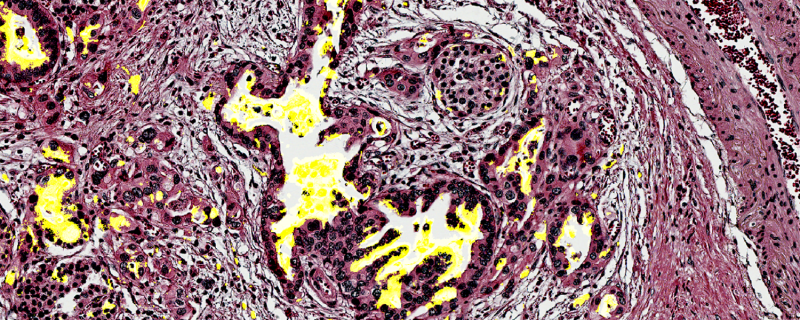
An experimental blood test detects early-stage pancreatic cancer more effectively than other available tests, reports a new study published in Cancer Letters.

The findings pave the way for further evaluation of the test in a clinical setting, an important step toward approval as a potential diagnostic method for pancreatic cancer.
“Catching pancreatic cancer early dramatically improves survival, but our current tools for doing so are limited,” said the study’s co-corresponding author Brian Haab, Ph.D., a professor at Van Andel Institute. “Our results reveal that our combination test improves accurate detection of pancreatic cancer in a lab setting by 27%. The next step is to evaluate the test’s effectiveness in a clinical lab rather than academic lab.”
The new test works by detecting two sugars — CA199.STRA and CA19-9 — that are produced by pancreatic cancer cells and escape into the bloodstream. CA19-9 is the current gold-standard biomarker for pancreatic cancer. Haab’s lab identified CA199.STRA as a cancer biomarker and developed the technology to detect it.
On its own, the CA19-9 test correctly identified only 44% of pancreatic cancer samples in the lab. When CA199.STRA was added, the new combination test correctly identified 71% of pancreatic cancer samples.
The combination test also greatly reduced the number of false negatives while maintaining a low false positive rate. Low rates of false positives and false negatives are important because they reflect the test’s ability to correctly identify the presence or absence of cancer.
This study was made possible by a longstanding collaboration of cancer researchers who participate in the National Cancer Institute’s Early Detection Research Network (EDRN). Haab and Randall E. Brand, M.D., a physician-scientist and professor of medicine at the University of Pittsburgh, are co-corresponding authors of the study.
The findings resulted from double-blinded assessments of several pancreatic cancer biomarker candidates by EDRN-affiliated labs at VAI, Fred Hutchinson Cancer Research Center, UPMC Hillman Cancer Center, and University of Nebraska. This is the first time multiple pancreatic cancer biomarkers from different labs have been evaluated in combination.
The analysis also revealed that combining CA199.STRA, CA19-9 and a protein biomarker called LRG1 improved specificity, which refers to a test’s ability to return a negative result in samples without cancer. The three-panel test accurately identified nearly all cases correctly and had far fewer false positives than CA19-9 alone.
“Another take-home message from this study is the importance of having multiple different validated biomarkers for pancreatic cancer,” Haab said. “A one-size-fits-all approach won’t work. It’s encouraging that we have many promising candidates that can be combined to better detect cancer.”
The new findings build on a 2019 study by Haab and colleagues that explored combining CA19-9 and STRA to diagnose pancreatic cancer. A 2020 study also suggested that STRA may identify pancreatic cancers that will respond to treatment versus those that will not.
Other authors include Ben Staal, M.S., of VAI; Lu Qian, M.S., Camden Lopez, M.S., Runlong Tang, Ph.D., and Ying Huang, Ph.D., of Fred Hutchinson Cancer Research Center; Christine Worthington, D.O., Denise Prosser, Liudmila Velokokhatnaya and Anna Lokshin, Ph.D., of University of Pittsburgh Medical Center; Maneesh Jain, Ph.D., Gopalakrishnan Natarajan, Ph.D., Sushil Kumar, Ph.D., Lynette Smith, Ph.D., and Surinder K. Batra, Ph.D., of University of Nebraska Medical Center; and Johnannes Fahrmann, Ph.D., Mark W. Hurd, Ph.D., Sam Hanash, M.D., Ph.D., and Anirban Maitra, MBBS, of MD Anderson Cancer Center.
Research reported in this publication was supported by the National Cancer Institute of the National Institutes of Health under award nos. U01CA200466 (Brand and Batra), U01CA200468 (Maitra), U01CA152653 (Haab, Allen and Brand), U01CA226158 (Haab and Brand), and U24CA086368 (Zheng, Etzioni and Feng); and the Sheikh Khalifa bin Zayed Foundation (Maitra). The content is solely the responsibility of the authors and does not necessarily represent the official views of the National Institutes of Health or other funders.
###
ABOUT VAN ANDEL INSTITUTE Van Andel Institute (VAI) is committed to improving the health and enhancing the lives of current and future generations through cutting edge biomedical research and innovative educational offerings. Established in Grand Rapids, Michigan, in 1996 by the Van Andel family, VAI is now home to more than 500 scientists, educators and support staff, who work with a growing number of national and international collaborators to foster discovery. The Institute’s scientists study the origins of cancer, Parkinson’s and other diseases and translate their findings into breakthrough prevention and treatment strategies. Our educators develop inquiry-based approaches for K–12 education to help students and teachers prepare the next generation of problem-solvers, while our Graduate School offers a rigorous, research-intensive Ph.D. program in molecular and cellular biology. Learn more at vai.org.
References:
Haab, B., Qian, L., Staal, B., Jain, M., Fahrmann, J., Worthington, C., … & Brand, R. E. (2024). A Rigorous Multi-Laboratory Study of Known PDAC Biomarkers Identifies Increased Sensitivity and Specificity Over CA19-9 Alone. Cancer Letters, 217245.
Journal
Cancer Letters
DOI
10.1016/j.canlet.2024.217245
Article Title
A rigorous multi-laboratory study of known PDAC biomarkers identifies increased sensitivity and specificity over CA19-9 alone
Article Publication Date
12-Sep-2024

