


In the neighborhoods of Asunción, a long-running accusation has finally been put to the test. For roughly three decades, residents of Paraguay’s capital have blamed the exotic tropical house gecko Hemidactylus mabouia for the disappearance of the native skink Notomabuya frenata, the amber-colored lizard locally known as Amberé. Many households recall that about thirty years ago the skinks lived on and around their homes, only to vanish as the geckos arrived. A new study published in the journal Herpetozoa has now examined this belief with ecological data, and the verdict is surprising: the gecko is largely innocent, and the real culprit is the city itself.
The research team, led by Paraguayan herpetologists including Pier Cacciali, set out to measure how much the two lizards actually overlap in their ecological niches. According to the classic framework of Colwell and Futuyma, niche overlap describes the shared use of resources by two taxa, but true interspecific competition can only be inferred when that sharing trends toward the displacement or exclusion of one species. To evaluate this, the authors compared diet, activity patterns, habitat preferences, reproduction, defense, and communication between the two lizards, drawing on published literature, museum specimens from the Museo Nacional de Historia Natural del Paraguay, and thousands of observational records from the citizen science platform iNaturalist.
The biological comparison revealed that the two species share remarkably few traits. Both are insectivorous, both tolerate life near human dwellings, and both rely primarily on mimesis, aided by caudal autotomy, as a defensive strategy. Beyond that, their lives diverge sharply. Notomabuya frenata is diurnal, ovoviviparous, and communicates through visual and chemosensory behavior, while Hemidactylus mabouia is nocturnal, oviparous, and adds acoustic displays to its repertoire. Most tellingly, the skink climbs using claws and cannot scale smooth surfaces, whereas the gecko’s adhesive lamellae allow it to exploit walls, glass, and metal that are entirely inaccessible to its alleged victim.
Dietary analysis produced nuanced results. Using literature data from sympatric populations in Valinhos, São Paulo, Brazil, the researchers found substantial overlap in prey items at the order level, yet a chi-square test revealed a highly significant difference in the frequency of prey consumption (χ² = 92.89, DF = 23, p < 0.001). The gecko consumes more arachnids and a large share of flying insects attracted to artificial lights, such as beetles of the family Elateridae, mayflies, dipterans, and moths. The skink, by contrast, ingests substantial quantities of termites along with terrestrial, diurnal arthropods including jumping spiders and orthopterans. Notably, ants, a staple for many lizards, were not a significant component of either species’ diet.
Stomach contents from museum specimens collected in Asunción added further detail, though the small sample size of eight geckos and five skinks limited statistical power. The prey of both species in the city coincided in the ingestion of spiders, coleopterans, and homopterans, and rarefaction curves showed similar dietary structure, with the confidence interval of the skink entirely encompassed by that of the gecko. This suggests that in the urban environment, where resources may be limited, the diets do coincide. Intriguingly, the gecko stomachs also contained sand, fabric fibers, and remnants of shed skin, presumably its own, items never found in the skink specimens and a reflection of foraging in a heavily built-up setting.
The temporal record told its own story. The last museum voucher of Notomabuya frenata in Asunción dates from 1986, with only two additional iNaturalist records, one from 1995 and one from 2017. Hemidactylus mabouia, by contrast, has a voucher from 2016 and fifteen iNaturalist records between 2013 and 2022, with observations becoming notoriously frequent from 2017 onward. A significant data gap from 1996 to 2012 complicates the picture, but the pattern is consistent with the gecko colonizing Asunción and Ciudad del Este after its oldest verified Paraguayan record from Concepción in January 1983, a dispersion facilitated by human-modified environments since the species likely first entered South America in northeastern Brazil around 1640.
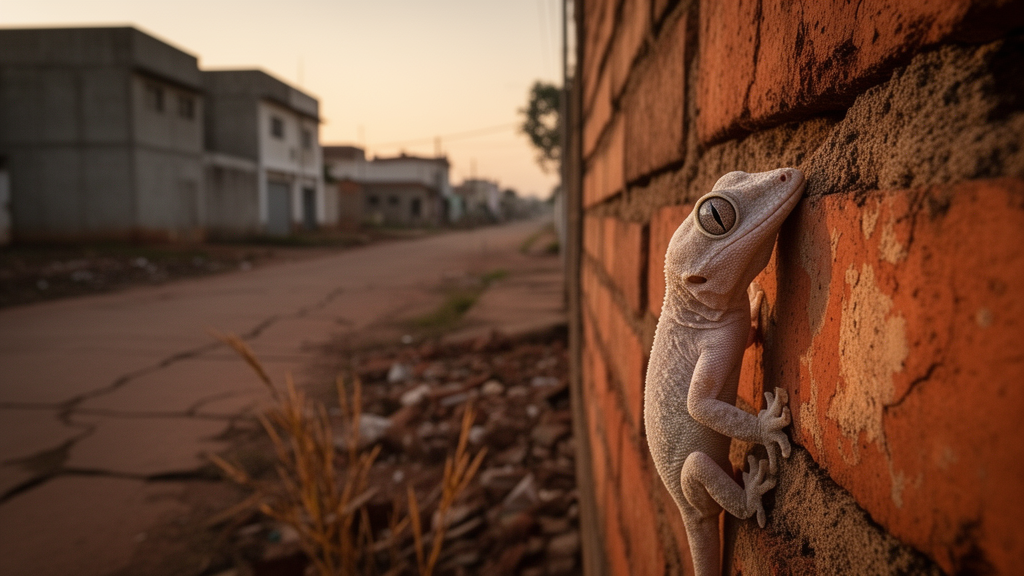
Microhabitat data from iNaturalist proved decisive. After removing records of deceased, handled, or collected animals, the researchers compared 98 observations of the skink with 791 of the gecko. Most skink records came from grass or other natural substrates (30%) or from trees and shrubs (27%), with only about 11% each on brick and wooden walls and 9% on tile floors. The gecko showed the opposite profile: 71% of records came from smooth and brick walls, including 3% on metal and glass surfaces never used by the skink. Wooden walls were the only microhabitat used with roughly equal frequency by both species, at about 10%. The two lizards, in other words, live side by side in the city but barely share the same surfaces.
The authors emphasize that sharing a resource does not automatically imply competition. When a resource is abundant or oversupplied, species may coexist without conflict, and the enormous diversity of insects available in Paraguay suggests that food is not the limiting factor. Prior work by Rocha and Anjos in Brazil found that even when H. mabouia shares food with native diurnal lizards such as Tropidurus itambere and N. frenata in wild areas, interspecific competition remains low because activity patterns and microhabitat preferences differ. The study’s conclusion follows the scenario described by Ricciardi and MacIsaac, in which many invasions succeed primarily by occupying available niches rather than by outcompeting residents. The architectural features of urban development, tall smooth walls, electric installations offering shelter, and artificial lights concentrating nocturnal prey, coincide precisely with the gecko’s requirements while being unsuitable for skinks.
The evidence points instead to habitat transformation as the driver of the skink’s decline. Where Notomabuya frenata has disappeared from Asunción, the streets are paved, the walls are tall and smooth, and green areas are few, hindering dispersal and isolating individuals. Where urban gardens still allow connections among populations, the skink persists regardless of the gecko’s presence. Satellite imagery of the corridor between the botanical garden and Parque Guasu Metropolitano shows the expansion of concrete structures between 2003 and 2023 and the corresponding loss of gardens, green areas, and unpaved roads. The same anthropogenic changes that harm the skink likely benefit the human-commensal gecko, making the displacement a consequence of human activity rather than a biological invasion.
The researchers are careful not to declare the gecko harmless in general. In regions where H. mabouia has been introduced elsewhere, it has demonstrably displaced native geckos through competition and predation, and its aggressive behavior and high reproductive rates make it a formidable invader in some contexts. In Paraguay, however, the species remains mostly confined to cities, and no direct negative effects on native lizards have yet been recorded. Interestingly, in the riverine town of Bahía Negra, the native gecko Phyllopezus przewalskii occupies human dwellings where the exotic gecko is absent, suggesting that a native species with similar body size, activity, and microhabitat use can resist colonization. Yet recent reports of local extinction of the endemic gecko Phyllopezus heuteri in areas now occupied by H. mabouia leave open whether human activity preceded the exotic gecko or direct competition occurred. The team calls for continuous monitoring, supported by citizen science platforms like iNaturalist, while cautioning that conspicuous wall-dwelling geckos are easier to photograph than skinks, a recording bias that must be acknowledged when interpreting such databases. This study marks the first step toward understanding the exotic gecko’s true effect on Paraguay’s fauna, and it clears the Amberé’s accused rival of the charge that made it famous.
Subject of Research: Niche overlap between the exotic gecko Hemidactylus mabouia and the native skink Notomabuya frenata in Paraguay
Article Title: Guilty or innocent? Could the exotic lizard Hemidactylus mabouia ( Squamata , Gekkonidae ) be responsible for the displacement of the native species Notomabuya frenata ( Squamata , Mabuyidae ) in anthropic environments?
Article References: Cacciali, P., & Maneyro, R. (2024). Guilty or innocent? Could the exotic lizard Hemidactylus mabouia (Squamata, Gekkonidae) be responsible for the displacement of the native species Notomabuya frenata (Squamata, Mabuyidae) in anthropic environments?. Herpetozoa, 37, 319-326. https://doi.org/10.3897/herpetozoa.37.e133456
Image Credits: AI Generated
DOI: 10.3897/herpetozoa.37.e133456
Keywords: Hemidactylus mabouia, Notomabuya frenata, invasive species, niche overlap, urban ecology, Paraguay, Asunción, lizard competition, microhabitat use, citizen science, iNaturalist, habitat loss
Cite Scienmag News
Drew Townsend. (October 19, 2026). Exotic gecko acquitted: urban sprawl, not competition, drove Paraguay’s native lizard decline. Scienmag. https://scienmag.com/exotic-gecko-acquitted-urban-sprawl-not-competition-drove-paraguays-native-lizard-decline/
Drew Townsend. "Exotic gecko acquitted: urban sprawl, not competition, drove Paraguay’s native lizard decline." Scienmag, 19 October 2026, https://scienmag.com/exotic-gecko-acquitted-urban-sprawl-not-competition-drove-paraguays-native-lizard-decline/. Accessed 19 October 2026.
Drew Townsend. "Exotic gecko acquitted: urban sprawl, not competition, drove Paraguay’s native lizard decline." Scienmag. October 19, 2026. https://scienmag.com/exotic-gecko-acquitted-urban-sprawl-not-competition-drove-paraguays-native-lizard-decline/


