


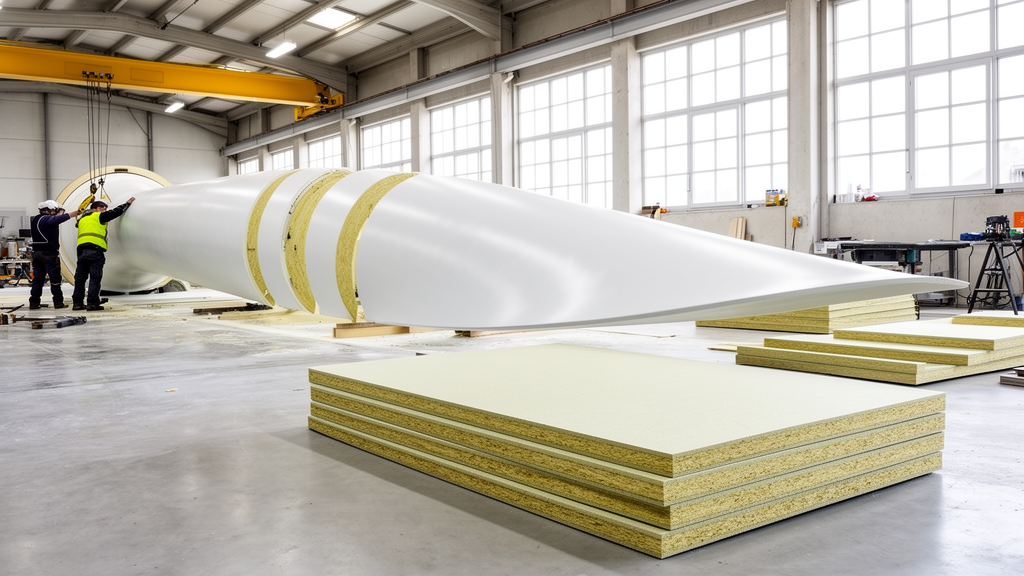
Every year, thousands of wind turbine blades reach the end of their operational lives, and disposing of them has become one of the renewable energy sector’s most stubborn problems. These massive structures, which can stretch over 80 meters in length, are built from thermosetting epoxy resin and glass fibers—materials engineered for decades of durability but notoriously difficult to separate and reuse once bonded together. Most retired blades end up in landfills or are incinerated, wasting valuable resources and creating ecological pressure. Now, a research team from Anhui Jianzhu University and Hefei University of Technology in China has developed a method that transforms this waste into high-performance building insulation panels, offering a dual-recycling route that recovers both the epoxy resin and the glass fibers simultaneously.
The study, published in the Journal of Materials Science, demonstrates that decommissioned wind turbine blade waste can be co-recycled into laminates with remarkable thermal insulation properties. The researchers prepared active recycled epoxy powder and reclaimed glass fibers through a sequence of cutting, crushing, and screening operations. These recovered materials were then compounded with polypropylene—a widely available thermoplastic matrix—and manufactured into laminates using hot-press molding. The approach sidesteps the energy-intensive chemical recycling processes typically required to break down thermosetting resins, instead relying on mechanical processing to produce usable feedstock.
To optimize the formulation, the team conducted orthogonal tests, a statistical experimental design method that allows multiple variables to be investigated simultaneously with fewer trials than conventional one-factor-at-a-time approaches. Three parameters were examined for their influence on the laminates’ mechanical and thermal performance: the epoxy mesh size, the epoxy mass fraction, and the glass fiber mass fraction. The response variables included flexural strength, compressive strength, and thermal conductivity. Mesh size refers to the particle fineness of the recycled epoxy powder, with finer particles generally providing better dispersion and interfacial bonding within the polymer matrix.
The results revealed that particle size plays a critical role in determining mechanical performance. When the recycled epoxy powder was screened to 200 mesh—corresponding to particles approximately 75 micrometers in diameter—the laminates achieved superior flexural and compressive strengths compared to coarser formulations. The finer epoxy particles distribute more uniformly throughout the polypropylene matrix, reducing stress concentrations at particle boundaries and improving load transfer between the recycled resin and the surrounding polymer. This finding has practical significance because it establishes a clear processing target for recyclers preparing blade waste feedstock.
Beyond mechanical optimization, the researchers incorporated hollow glass beads (HGBs) into the laminate formulation to enhance thermal insulation. These microscopic spheres, typically ranging from 10 to 100 micrometers in diameter, contain sealed internal gas pockets that dramatically reduce heat transfer. The beads act as discrete thermal barriers dispersed throughout the composite matrix. When heat attempts to pass through the material, it must navigate around the hollow spheres, extending the effective heat transfer path and increasing thermal resistance. The sealed gas inside each bead has an extremely low thermal conductivity—far below that of the solid glass shell or the surrounding polymer—making the beads highly efficient insulators.
Scanning electron microscopy (SEM) characterization revealed the interfacial microstructure of the optimized laminates. The images showed that moderate HGB loadings disperse uniformly throughout the matrix and remain structurally intact during the hot-press molding process. This structural integrity is essential: crushed or fractured beads lose their sealed gas pockets and their insulating advantage. The SEM analysis also confirmed good interfacial adhesion between the recycled epoxy particles, the glass fibers, and the polypropylene matrix, suggesting that the mechanical processing steps do not severely degrade the surface chemistry needed for bonding.
The optimal laminate formulation—15% hollow glass beads by mass, 200 mesh epoxy resin, 50% epoxy mass fraction, and 20% glass fiber mass fraction—achieved a flexural strength of 11.5 MPa, a compressive strength of 461.3 MPa, and a thermal conductivity of just 0.116 W/(m·K). This thermal conductivity represents a 48.44% reduction compared to equivalent laminates without hollow glass beads and satisfies the building insulation criterion of less than 0.12 W/(m·K). The compressive strength figure is particularly striking, indicating that the recycled composite can withstand substantial structural loads despite being derived from waste materials.
The implications extend beyond the laboratory. Global wind power capacity continues to expand rapidly, and the first generation of large-scale installations is now approaching retirement. Estimates suggest that by 2050, cumulative wind turbine blade waste could reach tens of millions of tonnes worldwide. Traditional disposal methods—landfill and incineration—carry significant environmental risks, including the release of microplastic particles and the loss of energy-intensive materials that took substantial resources to manufacture. The dual-recycling approach demonstrated here offers a pathway to convert this growing waste stream into value-added construction products.
The research team, led by Ping He and including Lei Hong, Runfa Liu, Ming Yan, Bin Yuan, Xinyu Li, and Jing Liu, emphasizes that this work establishes an eco-friendly route for wind turbine blade waste management. By avoiding the resource loss and environmental hazards of conventional disposal, the method expands the application scenarios of recycled composites into the field of building thermal insulation. The laminates could find use in wall panels, roofing elements, or other construction applications where both mechanical performance and thermal insulation are required.
The study was supported by the National Natural Science Foundation of China and several other funding bodies. As the renewable energy industry grapples with its first major wave of blade retirements, approaches like this one demonstrate that the materials embedded in these structures need not become a liability. Instead, with appropriate mechanical processing and formulation optimization, they can be reborn as functional components of the sustainable built environment—closing the loop on one of the green energy sector’s most visible waste challenges.
Subject of Research: Retired Wind Turbine Blades Reborn as Super-Insulating Building Panels
Article Title: A method of preparing laminates by blending hollow glass beads with recycled epoxy resin and glass fibers
Article References: He, P., Hong, L., Liu, R., Yan, M., Yuan, B., Li, X., & Liu, J. (2026). A method of preparing laminates by blending hollow glass beads with recycled epoxy resin and glass fibers. Journal of Materials Science, 61(42), 32606-32623. https://doi.org/10.1007/s10853-026-13693-w
Image Credits: AI Generated
DOI: 10.1007/s10853-026-13693-w
Keywords: method, preparing, laminates, blending, hollow, glass, beads, recycled, epoxy, resin, fibers, scientific research
Cite Scienmag News
Faith Mcneil. (October 19, 2026). Retired Wind Turbine Blades Reborn as Super-Insulating Building Panels. Scienmag. https://scienmag.com/retired-wind-turbine-blades-reborn-as-super-insulating-building-panels/
Faith Mcneil. "Retired Wind Turbine Blades Reborn as Super-Insulating Building Panels." Scienmag, 19 October 2026, https://scienmag.com/retired-wind-turbine-blades-reborn-as-super-insulating-building-panels/. Accessed 19 October 2026.
Faith Mcneil. "Retired Wind Turbine Blades Reborn as Super-Insulating Building Panels." Scienmag. October 19, 2026. https://scienmag.com/retired-wind-turbine-blades-reborn-as-super-insulating-building-panels/


