


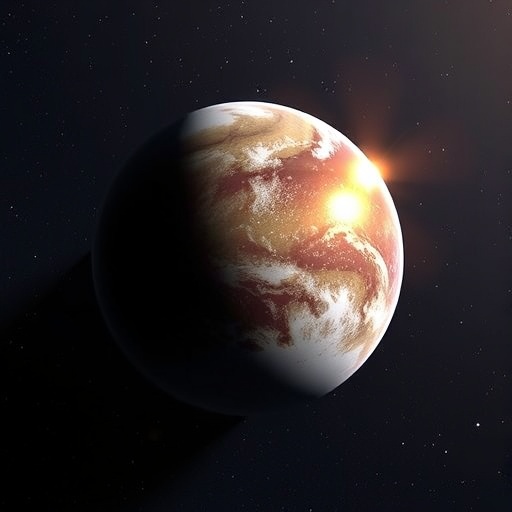
Astronomers are making groundbreaking strides in exoplanet research, and a recent revelation from a team co-led by a Cornell University expert has raised the bar in our understanding of distant worlds. For the first time, scientists have successfully generated a detailed three-dimensional map of an exoplanet, revealing the intriguing variations and complexities of its atmosphere. This innovative approach focuses on WASP-18b, an elephantine gas giant classified as an “ultra-hot Jupiter,” found approximately 400 light years away from Earth. The findings are both revolutionary and imperative for the future of planetary studies.
A significant breakthrough in this research is the application of a novel technique known as 3D eclipse mapping. Prior work led to the advent of this method, which builds on earlier two-dimensional models. These models demonstrated the potential of spectroscopic observations using NASA’s James Webb Space Telescope (JWST), showcasing how advanced instrumentation can foster meaningful explorations of the cosmos. Through the use of this sophisticated spectroscopic eclipse mapping, researchers are now able to glean insights into the atmospheric structure of exoplanets that a mere few years ago would have been relegated to theoretical predictions.
Among the invaluable observations made possible by JWST, the temperature distribution across WASP-18b’s atmosphere stands out. The substantial heat fluctuations, which can reach upwards of 5,000 degrees Fahrenheit, surround the planet, creating different temperature zones. Such extreme conditions offer wealth of information about the underlying physical and chemical processes occurring in this alien realm. By harnessing the power of 3D eclipse mapping, astronomers can now visualize these temperature gradients, akin to how Earth-based telescopes long ago charted Jupiter’s tumultuous dynamics.
Ryan Challener, a key figure in this research and a postdoctoral associate in the Department of Astronomy at Cornell, articulated the significance of this new technique. He stated that the methodology permits scientists to evaluate planets that may not be directly observable due to the brightness of their respective host stars. This is a substantial advantage because the majority of exoplanets are faint and difficult to detect, often glowing dimly against the illuminated backdrop of their suns. This innovative capability of JWST allows astronomers to paint a clearer picture of exoplanets like WASP-18b.
The process of eclipse mapping is not a trivial task. It requires scientists to meticulously measure the light reflected from these distant planets, often obscured as they pass behind their stars. This sparse light must then be correlated to specific regions of the planet to create a visual representation of its changes in brightness. Through this painstaking analysis, minute variances in light can be transformed into comprehensive temperature maps that reveal the thermal characteristics of the exoplanet across three dimensions: latitude, longitude, and altitude.
This research elucidates previously obscure properties of WASP-18b, highlighting a fascinating feature: a distinct circular “hotspot” on the planet’s dayside. This hotspot receives the most direct starlight, leading to extreme temperatures there. As a result, an intriguing phenomenon arises—winds in this region are seemingly weak and unable to distribute the heat evenly across WASP-18b. Surrounding this infernal hotspot exists a colder “ring” around the outward edges of the planet’s atmosphere, a stark contrast to the searing heat at the center.
Moreover, the findings suggest a concerning side effect of the blistering temperatures in the hotspot: significant water vapour breakdown. Challener describes how reduced water presence correlates with high temperatures, marking a previously theorized process that has now been verified through observation. This lends credence to current models regarding the atmospheric chemistry of ultra-hot Jupiters and offers vital data for understanding how such extreme conditions can alter climate and chemical composition dramatically.
JWST’s impressive instrumentation played a crucial role in rendering this 3D map. Unlike the earlier 2D attempts, which focused on a singular wavelength, the current study analyzed various wavelengths derived from the JWST’s Near-Infrared Imager and Slitless Spectrograph (NIRISS). Each wavelength allowed researchers to probe different atmospheric levels, giving insight into the thermal structure at various altitudes. This crucial data paved the way for a rudimentary understanding of atmospheric zones and their temperatures.
The implications of this research extend far beyond WASP-18b alone. Challener predicts that by employing 3D eclipse mapping, future studies could illuminate the atmospheric characteristics of many other similar exoplanets, thereby enhancing our overall understanding of these distant worlds. With hundreds of ultra-hot Jupiters already cataloged among the 6,000 exoplanets discovered to date, the gateway to comparative analysis is now wide open.
As astronomers gear up for additional programmes utilizing JWST, opportunities abound for fine-tuning the 3D eclipse maps generated thus far. Not only does this signify a bright future for exoplanet research, but it also represents a monumental shift in our approach to studying the atmospheres of distant worlds. With improved spatial resolution and advanced observational techniques, the potential to explore the intricacies of exoplanet atmospheres is vast and tantalizing.
This groundbreaking research builds on decades of theory regarding exoplanet atmospheres and lays the groundwork for future studies that promise to deepen our comprehension of planetary systems beyond our own. Through persistent innovation and creativity, scientists are unlocking the secrets of remote exoplanets like WASP-18b, expanding the horizons of astrophysics and astronomy in remarkable fashion.
In conclusion, the realization of generating a 3D temperature map of WASP-18b marks a pivotal point in the study of exoplanets, ushering in a new era of exploration that encourages the examination of diverse planetary atmospheres across the galaxy. As we enhance our understanding of these distant worlds, the overarching implications for planetary science, astrobiology, and the future of exploration make endeavors like this all the more significant and urgent.
Keywords
Exoplanets, WASP-18b, 3D eclipse mapping, James Webb Space Telescope, atmospheric structure, ultra-hot Jupiter, temperature variations, astronomical research.
Cite Scienmag News
Grant Pearson. (October 28, 2025). Exoplanets in Focus: 3D Mapping Revolutionizes Our Understanding of Distant Worlds. Scienmag. https://scienmag.com/exoplanets-in-focus-3d-mapping-revolutionizes-our-understanding-of-distant-worlds/
Grant Pearson. "Exoplanets in Focus: 3D Mapping Revolutionizes Our Understanding of Distant Worlds." Scienmag, 28 October 2025, https://scienmag.com/exoplanets-in-focus-3d-mapping-revolutionizes-our-understanding-of-distant-worlds/. Accessed 10 September 2026.
Grant Pearson. "Exoplanets in Focus: 3D Mapping Revolutionizes Our Understanding of Distant Worlds." Scienmag. October 28, 2025. https://scienmag.com/exoplanets-in-focus-3d-mapping-revolutionizes-our-understanding-of-distant-worlds/


