


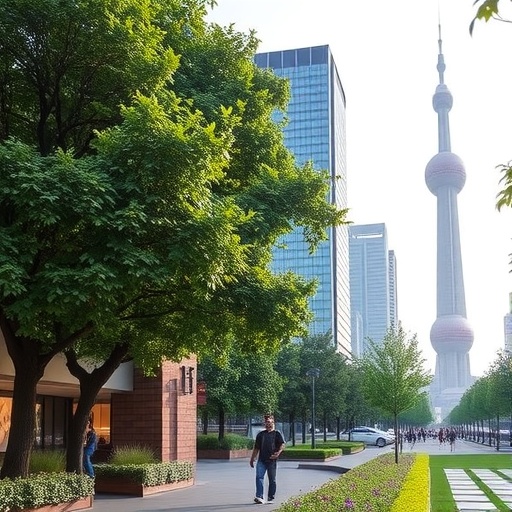
As urbanization accelerates across the globe, cities confront a dual challenge: how to provide sufficient green spaces while ensuring that these areas are accessible to all citizens. A pioneering study conducted in Shanghai, as highlighted by the work of Yang, Zheng, Wang, and their colleagues, unveils critical insights into the accessibility dynamics of urban green spaces. The research focuses specifically on the implications of opening and sharing affiliated green spaces, which could significantly enhance equitable access and improve the overall quality of urban life.
The study underscores the essential role that green spaces play in urban ecosystems, providing habitats for diverse flora and fauna while also serving as vital recreational areas for city dwellers. However, the extent to which these green spaces are inclusive varies dramatically, often determined by socio-economic factors and geographical distribution. Yang and his team meticulously examined how the integration and sharing of these green spaces can alleviate inequalities. By utilizing a case study approach in Shanghai, they illuminated the complexities associated with access and use patterns in urban settings.
The research methodology employed by the authors was notably rigorous. They analyzed various data sources including satellite imagery, socio-economic statistics, and case studies of specific neighborhoods within Shanghai. This multi-faceted approach allowed for a comprehensive assessment of how proximity to green spaces influences usage patterns among different socioeconomic groups. The findings indicate that merely increasing the number of green spaces is insufficient; rather, equitable access hinges on effective policy measures and community engagement.
One striking revelation from the research is the disparity in usage rates of green spaces among different demographic groups. Wealthier neighborhoods tend to have greater access to parks and recreational areas, whereas marginalized communities often lack sufficient green spaces within a reasonable distance. This inequality not only impacts the physical health of these populations but also their mental well-being, emphasizing the need for policies that prioritize inclusive access to nature.
To address this increasing inequality, Yang et al. recommend innovative solutions focused on the opening and sharing of green spaces. By allowing multiple locations to function as interconnected areas of greenery, urban planners can create a network that enhances accessibility. This could involve initiatives that encourage private developers to contribute to public green space or the transformation of underutilized lots into community parks.
Furthermore, the authors advocate for participatory planning processes that incorporate community voices in decision-making regarding green space development. Engaging local residents not only ensures that the needs of diverse groups are met, but also fosters a sense of ownership and pride in these communal areas. The emotional and social ties that people form with their local environment can significantly enhance the quality of urban life and community relations.
The researchers also explored the environmental benefits of open and shared green spaces. The establishment of green corridors can assist in improving air quality, reducing the urban heat island effect, and promoting biodiversity. As cities contend with climate change, optimizing the distribution and maintenance of green spaces becomes critical. Careful planning can facilitate greater ecosystem services, which in turn enhances the resilience of urban areas.
While the study’s findings are crucial for Shanghai, they carry significant implications for cities worldwide grappling with similar challenges. Lessons learned from this case study can be extrapolated to different urban contexts, pushing for a global dialogue on green space accessibility. Policymakers, urban planners, and communities must collaborate to share best practices that promote sustainable, equitable urban development.
Looking ahead, Yang and the research team hope to motivate further investigations into the long-term impacts of accessible green spaces on community health and social cohesion. Continued research in this domain could reveal even deeper correlations that might inform future urban designs, promoting not only physical health but also mental wellness.
In conclusion, this groundbreaking research sheds light on the intricate connections between green space accessibility, social equity, and urban health. By outlining clear strategies for enhancing the sharing and opening of green areas, the authors provide a roadmap for cities looking to forge a more inclusive urban future for all residents. Urban green spaces should not be a privilege for the few; rather, they must be a fundamental right enjoyed by each citizen, fostering vibrant, healthy, and sustainable communities.
Yang, J., Zheng, S., Wang, S. et al. Analysis of the impact of opening and sharing of affiliated green spaces on the accessibility and equal access of green spaces: a case study in Shanghai.
Discov Sustain 6, 1162 (2025). https://doi.org/10.1007/s43621-025-01856-9
Cite Scienmag News
Violet Maxwell. (November 2, 2025). Examining Equity in Shanghai’s Shared Green Spaces. Scienmag. https://scienmag.com/examining-equity-in-shanghais-shared-green-spaces/
Violet Maxwell. "Examining Equity in Shanghai’s Shared Green Spaces." Scienmag, 2 November 2025, https://scienmag.com/examining-equity-in-shanghais-shared-green-spaces/. Accessed 3 September 2026.
Violet Maxwell. "Examining Equity in Shanghai’s Shared Green Spaces." Scienmag. November 2, 2025. https://scienmag.com/examining-equity-in-shanghais-shared-green-spaces/


