


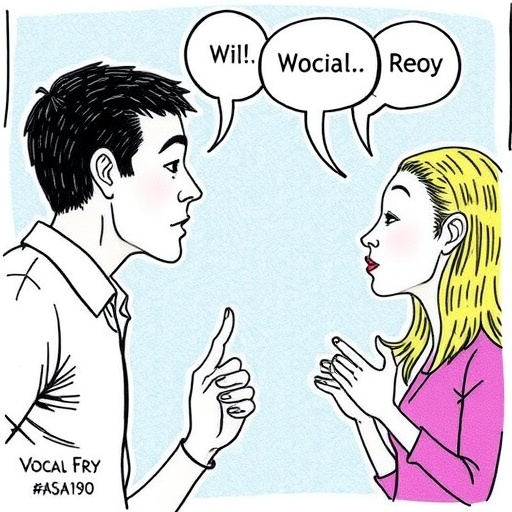
In recent years, vocal fry—or creaky voice—has gained widespread attention, often linked disparagingly to young women and criticized as an indicator of insecurity or unprofessionalism. This popular narrative, frequently amplified by mainstream media, has perpetuated the stereotype that this particular speech pattern signifies a lack of confidence or intelligence. However, recent acoustic research challenges this long-held assumption, revealing a more nuanced reality behind vocal fry, its perception, and its distribution across different speakers.
Jeanne Brown, a researcher at McGill University, has devoted significant attention to dismantling the myths surrounding vocal fry. Presenting her findings at the 190th Meeting of the Acoustical Society of America, Brown’s study utilizes rigorous acoustic analyses coupled with perceptual experiments, shedding new light on the characteristics and social biases inherent in vocal fry perception. Her work suggests that the commonly held belief linking vocal fry primarily to young women is fundamentally flawed.
Brown’s investigation explored the acoustic properties of vocal fry by examining voice recordings from speakers spanning various genders and ages. What emerged from this analysis was a compelling revelation: the factor most strongly associated with perceived “creakiness” was not the speaker’s gender but rather the pitch of their voice. Lower pitch, rather than any demographic category, proved to be the primary determinant of creaky voice perception. This fundamental insight challenges the simplistic stereotypes about vocal fry and demands a reconsideration of the social narratives that surround it.
Perceptual studies conducted by Brown further corroborated this finding. Listeners asked to rate the extent of creakiness in speech samples rated voices with a lower pitch as more creaky, regardless of whether the speaker was male or female. Interestingly, it was found that older speakers and men actually displayed more vocal fry than young women, the demographic most often unfairly stigmatized in popular discourse. This dissonance between empirical evidence and popular belief starkly highlights the presence of deeply ingrained social biases.
Brown emphasizes that the persistence of these misunderstandings stems from socially constructed perceptions rather than objective reality. Our everyday judgments about speech patterns are not solely grounded in acoustic evidence but are heavily influenced by expectations about how different groups “should” sound. Such expectations reinforce and perpetuate gender stereotypes, creating what Brown describes as a “bias” that is heard rather than found in the actual voice.
Understanding the interaction between acoustic features and listener expectations is complex. Brown cautions that it remains unclear how much of the perception of vocal fry is driven by purely acoustic elements such as pitch and how much is shaped by social cognitive biases. This ambiguity underlines the challenge in disentangling perceptual and social factors in speech judgment and points to a fertile area for further interdisciplinary research.
Brown’s work advocates for a more comprehensive approach to examining speech patterns—one that integrates acoustic measurements, speech production mechanisms, perceptual psychology, and social context. Only through such a multifaceted lens can the scientific community hope to unravel the intricate layers shaping vocal fry and its social significance. This approach promises not only to clarify the empirical properties of speech but also to address the damaging stereotypes often associated with certain voice qualities.
Perhaps most consequentially, Brown challenges the cultural imperative that places the burden on speakers—primarily young women—to modify their vocal habits to conform to societal expectations. She argues that admonishing women to avoid vocal fry in professional and social settings reinforces unjust biases rather than addressing the root causes embedded in listener perception. The real issue lies not in the vocal fry itself, but in why listeners perceive and judge creakiness as negatively as they do.
The implications of this research extend broadly, touching on gender dynamics, linguistic prejudice, and social communication norms. If vocal fry is, as Brown shows, more prevalent among older men and not restricted to young women, then anti-vocal fry narratives serve more as vehicles for reinforcing gender stereotypes than as reflections of objective speech science. Such revelations demand a reconsideration of how we evaluate and talk about speech differences.
Furthermore, Brown’s findings hold meaningful importance for vocal health, speech training, and education. Understanding the natural distribution of vocal fry across speakers of different ages and genders can inform speech therapy practices and help reduce stigma. Encouraging a shift from a deficit-based view to a descriptive and neutral understanding of speech patterns can foster inclusivity and enrich our appreciation of vocal diversity.
As social media and popular culture continue to scrutinize and sometimes mock speech idiosyncrasies, Brown’s research offers a timely counter-narrative grounded in scientific rigor. By questioning the assumptions baked into societal attitudes toward vocal fry, her work illuminates the broader cultural forces at play in shaping how we perceive voices and, by extension, the people behind them.
In a field where sound intersects with identity and social judgment, Jeanne Brown’s contributions underscore the vital role acoustic science plays in addressing broader human issues. This research not only redefines a stigmatized speech pattern but also invites society to reflect critically on its predispositions, encouraging a move toward empathy and evidence-based understanding.
News Publication Date: May 14, 2026
Web References: https://acoustics.org/asa-press-room/, https://acoustics.org/lay-language-papers/, https://acousticalsociety.org/
Keywords
Linguistics, Speech, Speech perception, Acoustics, Vocal fry, Social biases, Gender stereotypes, Voice pitch, Acoustic analysis, Perceptual study, Vocal production, Communication norms
Cite Scienmag News
Bethany Barker. (May 14, 2026). Examining and Overcoming Biases Surrounding Vocal Fry #ASA190. Scienmag. https://scienmag.com/examining-and-overcoming-biases-surrounding-vocal-fry-asa190/
Bethany Barker. "Examining and Overcoming Biases Surrounding Vocal Fry #ASA190." Scienmag, 14 May 2026, https://scienmag.com/examining-and-overcoming-biases-surrounding-vocal-fry-asa190/. Accessed 3 September 2026.
Bethany Barker. "Examining and Overcoming Biases Surrounding Vocal Fry #ASA190." Scienmag. May 14, 2026. https://scienmag.com/examining-and-overcoming-biases-surrounding-vocal-fry-asa190/


