


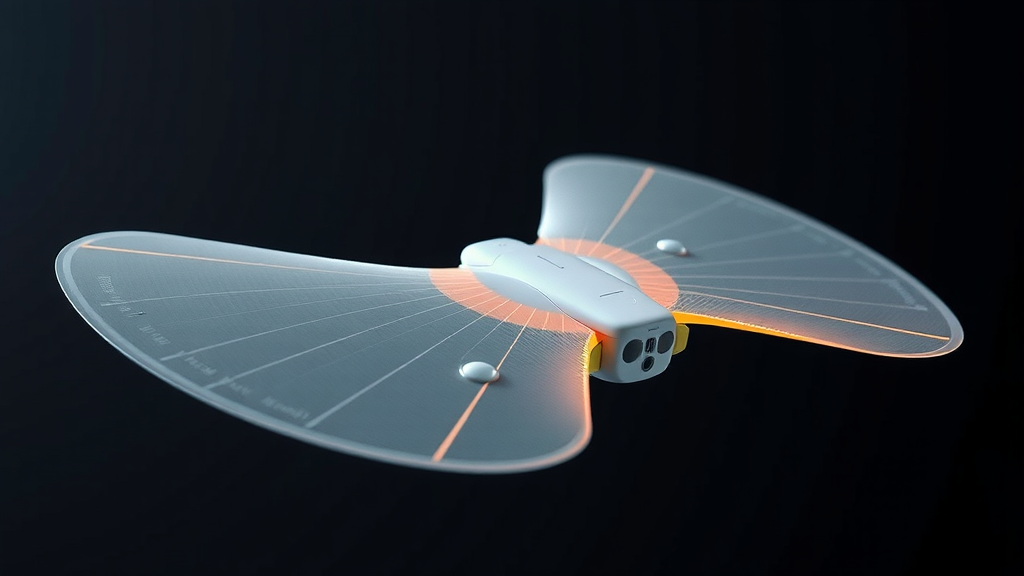
Unmanned aerial vehicles have moved rapidly from military prototypes to everyday tools, delivering packages, filming live events and, increasingly, serving as scientific scouts in places no human can easily reach. Yet the same drones that glide efficiently through the dense air of Earth’s lower atmosphere face a sobering reality when designers imagine sending them to Mars. The Martian atmosphere is roughly one hundred times thinner than our own, and wing profiles that perform beautifully at terrestrial speeds and densities lose their advantage entirely in that near-vacuum. A team at Tokyo Metropolitan University led by Professor Masahiro Kanazaki has now tackled this problem from first principles, using an evolutionary algorithm to search for wing shapes that thrive under exactly the hostile fluid conditions a small aircraft would encounter on another planet or in the miniature world of micro-aerial vehicles.
The key physical quantity at stake is the Reynolds number, a dimensionless measure that compares inertial forces to viscous forces in a flowing fluid. Large, fast aircraft operate at high Reynolds numbers, where inertia dominates and the air behaves, in many respects, like an idealized medium sliding past a streamlined body. Small drones, and any aircraft braving a thin atmosphere, operate at low Reynolds numbers, where the viscous dissipation of energy becomes dominant. In this regime the air clings to surfaces, boundary layers thicken relative to the wing’s size, and flow separation occurs more readily, robbing the wing of lift and burdening it with drag. Design rules distilled from a century of conventional aeronautics simply do not transfer, which is why the researchers turned to an unexpected source of inspiration: insects.
Insect wings are marvels of biological engineering that operate squarely in the low-Reynolds-number regime. They are not the smooth, rigid, cambered slabs of conventional aircraft but ultra-thin, membrane-like structures, often bearing pronounced corrugations, ridges and valleys that run along the span. For years, biologists and aerodynamicists have debated what these corrugations actually do. Some studies suggested they stiffen the wing structurally; others reported that the pleated profile can trap small vortices in its valleys, effectively streamlining the wing and reducing the drag penalty of its sharp, thin leading edge. What has been missing is a systematic, quantitative answer to the design question: if you were free to shape the corrugation pattern of an ultra-thin wing however you liked, what pattern would best minimize drag, and what pattern would best maximize lift?
Answering that question experimentally is extraordinarily difficult. Building and testing thousands of micro-scale wing profiles in a wind tunnel would take years and enormous resources, and any physical model inevitably introduces its own complications, such as the finite thickness of the leading edge, which itself strongly influences how air separates from the wing. The Tokyo Metropolitan University team therefore chose a computational route, but with a twist that sets their study apart. They adopted what aerodynamicists call a zero-thickness airfoil model, a mathematical idealization in which the wing has no thickness at all and is represented purely by its camber line, the curved centerline of the profile. No such wing could exist in reality, but within a computer the idealization is perfectly well defined and, crucially, it isolates one single variable: the shape of the corrugation pattern itself, uncontaminated by leading-edge thickness effects.
With the geometry framework in place, the researchers unleashed an evolutionary optimization algorithm, a computational method inspired by natural selection. The algorithm begins with a population of candidate airfoil shapes, runs aerodynamic simulations on each one, evaluates how well each design performs against defined objectives, and then breeds the best performers together, introducing mutations and crossovers to generate a new generation of candidate shapes. Poor designs are discarded, promising traits are propagated and recombined, and over many generations the population converges toward shapes that are exceptionally well suited to their tasks. Because the team pursued multiple objectives, notably minimizing drag and maximizing lift, the procedure maps out the trade-offs between these competing goals rather than forcing a single compromise answer. The simulations were carried out with a Cartesian-grid-based computational fluid dynamics approach, well suited to handling the sharp geometric features that corrugated profiles introduce.
The results, published in the journal Computers & Fluids, reveal strikingly different design philosophies depending on the objective. When the algorithm selected for minimal drag, the winning shapes were strongly corrugated, their surfaces rippled with pronounced pleats. Far from being aerodynamic liabilities, these corrugations proved beneficial: near the leading edge they encouraged the formation of small, stable rolls of air that settled into the valleys of the profile. These trapped vortices acted as a kind of aerodynamic buffer, reducing the frictional drag that the wing experienced compared with a perfectly flat sheet. In other words, at low Reynolds numbers, a deliberately wrinkled wing can outperform the smoothest imaginable flat plate, a conclusion that vindicates the corrugated architecture that insects arrived at through hundreds of millions of years of evolution.
The lift-optimized designs told a completely different story. When the objective shifted to generating the greatest possible lift, the evolutionary process stripped away most of the corrugations. The winning profiles were predominantly smooth and convex overall, presenting a gently curved upper surface that accelerates airflow and generates the pressure difference that produces lift. The one exception appeared near the trailing edge, where the optimal shapes featured a distinct concave dip. This subtle rearward concavity appears to fine-tune the pressure distribution and circulation around the wing, squeezing additional lift out of the profile without reintroducing the drag penalties associated with extensive corrugation. The contrast between the two families of solutions, rippled for drag reduction and smooth with a dipped tail for lift, provides designers with an intuitive visual grammar for low-Reynolds-number wing design.
One of the most intriguing implications of the work concerns the interplay between corrugation and camber, the overall arching curvature of a wing. Living insects are not limited to static shapes; their membrane wings deform dynamically in flight, flexing between corrugated and cambered configurations as aerodynamic loads shift through each wingbeat. The zero-thickness study, by treating these two design elements separately, effectively quantifies what each contributes on its own. The findings suggest that a three-dimensional wing design that incorporates elements of both, combining strategically placed corrugations for drag control with an overall cambered form for lift generation, could deliver robust performance across a wide range of flight conditions and atmospheric densities. That flexibility is exactly what a deployable, lightweight UAV would need when transitioning from the launch environment to the thin air of a destination planet.
The practical stakes extend well beyond interplanetary exploration. Miniaturization is one of the defining trends in drone technology, and as aircraft shrink, their wings inevitably enter the same low-Reynolds-number regime that troubles Mars-bound designs. Membrane-like, ultra-thin wings are attractive for such vehicles because they are light, foldable and portable, qualities that matter both for a drone squeezed into a delivery van and for one packed inside the confined payload bay of a spacecraft. By demonstrating that corrugation patterns can be tuned rationally, with drag-optimized and lift-optimized motifs identified computationally, the study gives engineers a principled starting point rather than a trial-and-error guessing game. The researchers believe their findings will directly guide the miniaturization of UAVs and the design of wings for thin atmospheres.
The research also showcases the growing power of evolutionary optimization as a design tool in fluid dynamics. Rather than imposing human intuitions about what a wing should look like, the algorithm was allowed to explore the full space of zero-thickness shapes and converge on solutions that human designers might never have sketched, including the counterintuitive result that heavy corrugation aids drag reduction at small scales. Supported by funding from the JSPS KAKENHI program and Japan’s national high-performance computing infrastructure initiatives, the work points toward a future in which bio-inspired, computationally evolved wing geometries, refined through simulation before a single prototype is built, become standard practice in the design of the small flying machines that will deliver our packages, film our cities and, one day, scout the skies of Mars.
Subject of Research: Evolutionary optimization of zero-thickness corrugated airfoil shapes for low-Reynolds-number UAV wings
Article Title: Unweaving the aerodynamics of ultra-thin, bio-inspired airfoils
Article References: Unweaving the aerodynamics of ultra-thin, bio-inspired airfoils. (n.d.). Original publication
Image Credits: AI Generated
DOI: Not provided
Keywords: airfoil aerodynamics, evolutionary algorithm, corrugated wings, low Reynolds number, UAV design, bio-inspired wings, zero-thickness model, computational fluid dynamics, Mars atmosphere, drag reduction, lift optimization, membrane wings
Cite Scienmag News
Gavin Prescott. (September 20, 2026). Evolutionary Algorithms Reveal Optimal Shapes for Ultra-Thin, Bio-Inspired Drone Wings. Scienmag. https://scienmag.com/evolutionary-algorithms-reveal-optimal-shapes-for-ultra-thin-bio-inspired-drone-wings/
Gavin Prescott. "Evolutionary Algorithms Reveal Optimal Shapes for Ultra-Thin, Bio-Inspired Drone Wings." Scienmag, 20 September 2026, https://scienmag.com/evolutionary-algorithms-reveal-optimal-shapes-for-ultra-thin-bio-inspired-drone-wings/. Accessed 4 October 2026.
Gavin Prescott. "Evolutionary Algorithms Reveal Optimal Shapes for Ultra-Thin, Bio-Inspired Drone Wings." Scienmag. September 20, 2026. https://scienmag.com/evolutionary-algorithms-reveal-optimal-shapes-for-ultra-thin-bio-inspired-drone-wings/


