


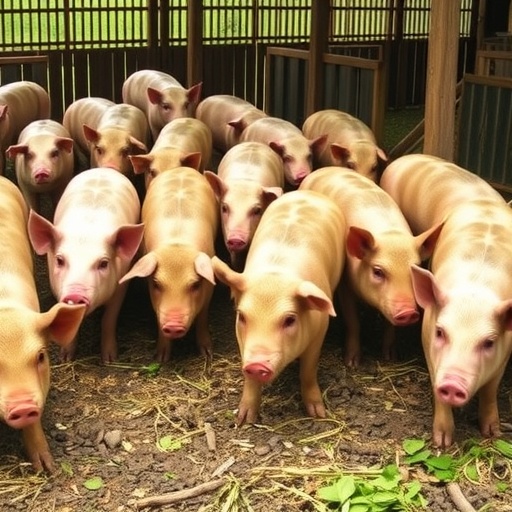
In an intriguing exploration of ancient animal husbandry practices on Okinawa Island, a recently published study sheds light on the post-introduction husbandry systems for pig breeding, specifically within the context of the indigenous species. The research, conducted by a team of prominent scholars including E. Yamada, Y. Muranishi, and S. Kim, uncovers the evolutionary trajectories influenced by the arrival of domestic breeds. Their findings have broad implications for understanding the intersection of agriculture, anthropology, and conservation in this unique ecological setting.
The significance of this research lies in its focus on the island of Okinawa, a region with a rich agricultural history and ecological diversity. The study meticulously examines how the introduction of domestic pig breeds affected the husbandry systems that had been instituted by local communities for centuries. By exploring this transition, the researchers provide a lens through which we can evaluate the broader trends of domestication and its impact on sociocultural practices within the region.
Domestication is a critical process that has shaped human civilization over millennia. Animals have been selectively bred for their utility, appearance, and adaptability to human settlements. Pigs, in particular, have been integral to agricultural societies worldwide, serving as a reliable source of protein and other resources. The research on Okinawa Island offers a nuanced examination of this dynamic relationship, providing insights that could be applicable to other regions where domestication occurred.
The study capitalizes on archaeological records, genetic analyses, and ethnographic accounts to paint a comprehensive picture of husbandry practices. For example, the researchers trace the origins of the domestic breeds introduced to the island, analyzing their lineage compared to native species. This approach allows for an understanding of how genetic diversity has influenced livestock management strategies on Okinawa, shaping not only the animal populations but also the cultural practices surrounding them.
Moreover, the implications of this research extend beyond the biological realm. The transformative effects of introducing domestic pig breeds have reverberated throughout Okinawan society, influencing dietary habits, agricultural systems, and even cultural traditions. The study underscores how intertwined animal husbandry is with human social structure, emphasizing the importance of understanding historical context when considering contemporary practices in rural economies.
As the study delves deeper into the nuances of pig management post-introduction, it reveals the challenges that local farmers faced in adapting their practices. The shift from traditional methods to those informed by new breeds necessitated significant alterations in resource allocation, breeding practices, and herding strategies. The authors detail the adaptive measures taken by farmers, emphasizing their innovative approaches to blending old and new practices in husbandry.
In addition to the practical aspects of managing livestock, this study also touches on the ethical considerations surrounding domestication and farming practices. The shift to domestic breeds introduces questions regarding animal welfare, sustainability, and food security. As such, the researchers advocate for the necessity of sustainable farming practices that respect both animal needs and cultural heritage in Okinawa.
Contextually, Okinawa Island’s environmental conditions play a critical role in shaping husbandry practices. The island’s subtropical climate, rich biodiversity, and available resources dictate the feasibility of certain breeding strategies over others. Understanding these ecological parameters helps explain why some husbandry systems may thrive while others falter, particularly in the face of climate change and environmental stressors.
In assessing the broader impacts of the introduction of domestic breeds, this research establishes a framework for evaluating animal husbandry within the context of globalization. As breeds and farming practices transcend regional boundaries, the dynamics of local economies and ecosystems shift in complex ways. The story of pig husbandry on Okinawa is but one example of how global forces can influence and reshape traditional practices.
The commitment to collaborative research is evident in the methodologies utilized by the study’s authors. By combining interdisciplinary approaches, they harness the strengths of archaeology, genetics, and social sciences, thereby enriching the analysis. This collaborative spirit is essential to tackling the multifaceted challenges presented by animal husbandry in contemporary contexts.
As the study reaches its conclusion, the authors call for further research to explore the long-term impacts of domestication on the genetic makeup of pig populations. The potential for cryopreservation and other advanced biotechnological methods offers exciting avenues for conservation and biodiversity. Additionally, understanding pig populations’ adaptation mechanisms may provide valuable insights into resilience in the face of environmental change.
In summary, this research piece presents a thoughtful exploration of historical and contemporary practices of pig husbandry on Okinawa Island, emphasizing the seamless integration of agricultural techniques, ecological factors, and sociocultural dynamics. The findings serve as a reminder of the intricate tapestry of human-animal relationships that shape our world, prompting reflection on how we can learn from traditional practices as we navigate modern agricultural challenges.
This groundbreaking research not only enriches our understanding of Okinawan agriculture but also serves as a crucial reminder of the broader implications of how human actions and environmental contexts interact to shape the world around us. With increasing interest in sustainable practices and traditional knowledge systems, the insights gleaned from this study are more relevant than ever, inspiring future generations to protect and preserve the rich agricultural heritage of the world.
Yamada, E., Muranishi, Y., Kim, S. et al. Husbandry system of Sus on Okinawa Island, Japan, after introduction of domestic breeds.
Archaeol Anthropol Sci 17, 218 (2025). https://doi.org/10.1007/s12520-025-02338-9
Cite Scienmag News
Gavin Prescott. (November 16, 2025). Evolution of Pig Farming in Okinawa Post-Domestication. Scienmag. https://scienmag.com/evolution-of-pig-farming-in-okinawa-post-domestication/
Gavin Prescott. "Evolution of Pig Farming in Okinawa Post-Domestication." Scienmag, 16 November 2025, https://scienmag.com/evolution-of-pig-farming-in-okinawa-post-domestication/. Accessed 4 September 2026.
Gavin Prescott. "Evolution of Pig Farming in Okinawa Post-Domestication." Scienmag. November 16, 2025. https://scienmag.com/evolution-of-pig-farming-in-okinawa-post-domestication/


