


When it comes to treating cardiac arrest, acting quickly can mean the difference between life and death.

Credit: Takenobu Shimada, Osaka Metropolitan University (CC BY 4.0,
When it comes to treating cardiac arrest, acting quickly can mean the difference between life and death.
Researchers from Osaka Metropolitan University have developed a new scoring model, using only prehospital resuscitation data, that accurately predicts neurological outcomes of patients with out-of-hospital cardiac arrest (OHCA). This model potentially allows healthcare providers to make quick and accurate decisions upon the patient’s arrival at the hospital, ultimately improving patient care and resource allocation.
Their findings were published in Resuscitation on May 31.
Cardiac arrest can lead to death within minutes. OHCA is not uncommon and often results in low survival rates. In Japan, over 100,000 patients experience OHCA annually, with less than 10% returning to normal life.
Rapid and accurate neurological prediction calculations are critical in OHAC cases. Effective prediction models can save lives, reduce suffering, and cut down on unnecessary costs associated with futile resuscitation efforts.
“Current prognosis prediction models require complex calculations and blood test data, making them impractical for rapid use immediately after patient transport,” said Takenobu Shimada, a medical lecturer at Osaka Metropolitan University’s Graduate School of Medicine and lead author of the study.
The research team addressed this gap by constructing a scoring model that uses readily available prehospital data to predict unfavorable neurological outcomes. Analyzing data from the All-Japan Utstein Registry, they examined information collected between 2005 and 2019 on prehospital resuscitation and neurological recovery one month post-arrest for 942,891 adults with presumed cardiac-origin OHCA. Adverse outcomes include severe disability, vegetative state, or death.
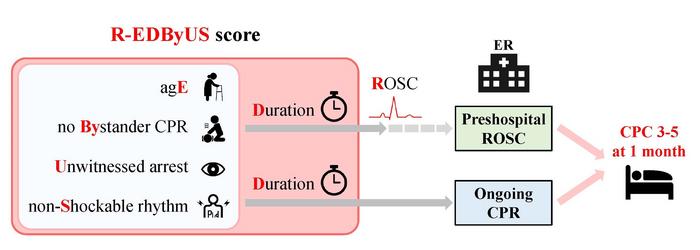
Named the “R-EDByUS score,” the developed model is derived from the initials of its five variables: age, duration to return of spontaneous circulation (ROSC) or time to hospital arrival, absence of bystander CPR, whether the arrest was witnessed and, finally, initial heart rhythm (shockable versus non-shockable).
Patients were divided into two groups based on whether they achieved ROSC before hospital arrival or were still undergoing CPR upon arrival. The researchers developed detailed regression-based and simplified models to calculate R-EDByUS scores for each group.
The results demonstrated that the R-EDByUS scores predicted neurological outcomes with high precision, achieving C-statistics values of approximately 0.85 for both groups. C-statistics measure the predictive accuracy of a model, ranging from 0.5 (no predictive power) to 1.0 (perfect accuracy), with higher values indicating superior performance.
“The R-EDByUS score enables high-precision prognosis prediction immediately upon hospital arrival, and its application via smartphone or tablet makes it suitable for everyday clinical use,” Shimada said.
This scoring model is expected to become a valuable tool for healthcare providers, aiding in the prompt assessment and management of patients undergoing resuscitation.
“In emergency care for OHCA, invasive procedures, such as mechanical circulatory support, can be lifesaving but are also highly burdensome,” Shimada said. “Our predictive model helps identify patients who are likely to benefit from intensive care while reducing unnecessary burdens on those with poor predicted outcomes.”
###
About OMU
Established in Osaka as one of the largest public universities in Japan, Osaka Metropolitan University is committed to shaping the future of society through “Convergence of Knowledge” and the promotion of world-class research. For more research news, visit and follow us on social media: X, Facebook, Instagram, LinkedIn.
Journal
Resuscitation
Method of Research
Observational study
Subject of Research
People
Article Title
Neurological prognosis prediction upon arrival at the hospital after out-of-hospital cardiac arrest: R-EDByUS score
Article Publication Date
31-May-2024
COI Statement
The authors declare that they have no known competing financial interests or personal relationships that could have appeared to influence the work reported in this paper.
Cite Scienmag News
Ophelia Keating. (July 29, 2024). Every minute counts: rapid and accurate prediction model for cardiac arrest treatment. Scienmag. https://scienmag.com/every-minute-counts-rapid-and-accurate-prediction-model-for-cardiac-arrest-treatment/
Ophelia Keating. "Every minute counts: rapid and accurate prediction model for cardiac arrest treatment." Scienmag, 29 July 2024, https://scienmag.com/every-minute-counts-rapid-and-accurate-prediction-model-for-cardiac-arrest-treatment/. Accessed 4 September 2026.
Ophelia Keating. "Every minute counts: rapid and accurate prediction model for cardiac arrest treatment." Scienmag. July 29, 2024. https://scienmag.com/every-minute-counts-rapid-and-accurate-prediction-model-for-cardiac-arrest-treatment/

