


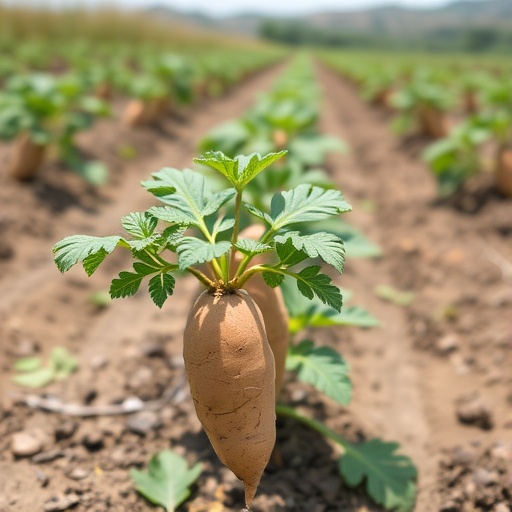
Sweet potatoes are not only a staple food source in many regions but also a potential crop for combating food insecurity exacerbated by climate change. Recent research presents a considerable advancement in the understanding and identification of drought-resistant sweet potato genotypes. The study conducted by de Melo, E.P.R., Signorini, V.J., and da Silva, D.S., focuses on the physiological traits that indicate drought tolerance, aiming to facilitate the pre-screening of these genotypes for breeding programs.
The implications of climate change are particularly dire for agriculture, where water scarcity adversely affects crop yields worldwide. Sweet potato, known scientifically as Ipomoea batatas, is crucial for global food security, particularly in developing regions where it serves as a primary source of carbohydrates. As the population grows, the need for resilient crop varieties becomes increasingly urgent, especially those capable of thriving in harsh conditions such as drought.
Drought stress results in various physiological and biochemical alterations in crops, leading to reduced yield and, in extreme cases, crop failure. Understanding how sweet potato plants respond to such stress factors is critical for identifying genotypes that possess inherent drought resistance. The research highlights the importance of physiological traits, including root development, leaf water potential, and stomatal conductance, which collectively inform the plants’ capability to survive in water-limited environments.
The methodology employed by the researchers involved a systematic evaluation of multiple sweet potato genotypes under controlled drought conditions. By assessing the physiological characteristics of these varieties, the team aimed to pinpoint specific traits linked to drought tolerance. Notably, the study emphasizes the role of root architecture in enhancing water uptake, whereby genotypes exhibiting deep and extensive root systems tend to show improved resilience during drought periods.
Moreover, the research investigates leaf pigment composition and photosynthetic efficiency, both crucial elements in assessing how well plants can adapt to abiotic stress. As water availability diminishes, photosynthesis is often impaired, leading to decreased biomass production. The analysis of chlorophyll contents and associated photosynthetic rates provides insights into how effectively sweet potatoes can convert sunlight into energy, thus influencing their growth and survival during drought scenarios.
In parallel, the study examines the role of osmotic adjustment and stress-responsive metabolic pathways. Under drought stress, plants often accumulate compatible solutes such as proline and soluble sugars to counteract the detrimental effects of water scarcity. The researchers meticulously quantified these metabolites, establishing a correlation between their concentrations and the drought tolerance observed in various genotypes. This biochemical response serves as a natural mechanism that aids in maintaining cell turgor and, ultimately, crop viability.
Another critical aspect of this research is the integration of genetic and phenotypic analysis, facilitating a multi-disciplinary approach to breeding for drought tolerance. The identification of specific genetic markers associated with desirable traits can significantly expedite the breeding process, allowing for more precise selection in developing new sweet potato varieties capable of withstanding climate-induced stressors. The combination of traditional breeding practices with modern genomic techniques holds promise for enhancing the resilience of this vital crop.
With the growing urgency to address climate challenges, the results of this study provide a foundational framework for future research endeavors. The identification of drought-tolerant sweet potato genotypes not only enhances our understanding of plant physiology but also contributes significantly to the ongoing global efforts in food security. Breeders can utilize these findings to accelerate the development of improved varieties, ensuring that sweet potatoes can continue to thrive even under adverse environmental conditions.
The agricultural community stands to gain immensely from the insights provided by this research. Farmers equipped with drought-resistant sweet potato varieties may find themselves better positioned to mitigate the impacts of climate variability on crop production. This enhanced resilience will not only benefit individual farmers but also contribute to the sustainability of food systems regionally and globally.
Furthermore, policymakers and agricultural organizations are encouraged to consider integrating these findings into larger strategies aimed at combatting food insecurity. The proactive identification and deployment of drought-tolerant crop varieties can represent a significant step towards creating more resilient agricultural systems, particularly in areas where water scarcity is a growing threat to livelihoods and food supply.
In summary, the study executed by de Melo and colleagues underscores the intricate relationships between physiological traits and drought tolerance in sweet potatoes. As researchers continue to delve deeper into these relationships and explore additional factors that contribute to resilience, the potential for developing robust, high-yielding sweet potato varieties becomes increasingly tangible. These advancements not only aim to secure the future of sweet potatoes as a leading food source but also foster a broader dialogue about sustainable agricultural practices amid escalating climate challenges.
The path ahead is both challenging and encouraging. As more studies emerge, they will undoubtedly enrich the existing body of knowledge and enhance our ability to combat food insecurity through innovative agricultural practices. Through the collaborative efforts of scientists, farmers, and policymakers, the resilience of sweet potato crops can be fortified, ultimately contributing to a more sustainable and food-secure future.
de Melo, E.P.R., Signorini, V.J., da Silva, D.S. et al. Pre-screening sweet potato genotypes for drought tolerance through assessment of physiological traits.
Discov. Plants 2, 219 (2025). https://doi.org/10.1007/s44372-025-00309-x
Cite Scienmag News
Alan Morgan. (August 29, 2025). Evaluating Sweet Potato Varieties for Drought Resistance. Scienmag. https://scienmag.com/evaluating-sweet-potato-varieties-for-drought-resistance/
Alan Morgan. "Evaluating Sweet Potato Varieties for Drought Resistance." Scienmag, 29 August 2025, https://scienmag.com/evaluating-sweet-potato-varieties-for-drought-resistance/. Accessed 4 September 2026.
Alan Morgan. "Evaluating Sweet Potato Varieties for Drought Resistance." Scienmag. August 29, 2025. https://scienmag.com/evaluating-sweet-potato-varieties-for-drought-resistance/


