

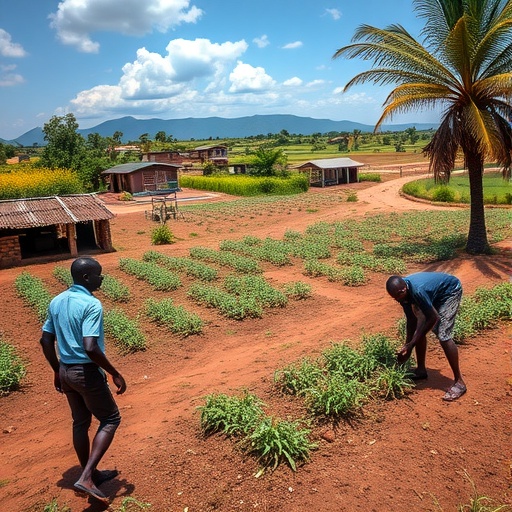
Amid the ongoing discourse surrounding climate change and its far-reaching impacts, a critical area that demands immediate attention is the resilience of smallholder farmers, particularly in regions highly vulnerable to climatic shifts, such as the Sidaama region of Ethiopia. A recent study conducted by researchers Lankamo, Dayanandan, and Dira, sheds light on this pressing issue by utilizing advanced statistical techniques like beta regression to measure livelihood resilience and its determinants. The research not only examines the multifaceted challenges these farmers face but also aims to provide a comprehensive understanding of the socio-economic factors that influence their resilience in the face of adversity.
In the introduction of their study, the authors highlight that smallholder farmers make up a significant portion of Ethiopia’s agriculture, which is the backbone of the country’s economy. However, with climate change precipitating more extreme weather events like droughts and floods, the livelihoods of these farmers are increasingly at risk. The researchers aim to elucidate the various factors that contribute to or detract from the resilience of these farmers, recognizing that resilience is not merely a personal trait but is heavily influenced by external socio-economic and environmental factors.
One of the standout features of this study is its methodological robustness. By employing beta regression, a technique well-suited for modeling variables restricted to the (0, 1) range, the authors are able to derive nuanced insights into the resilience of the farmers. In doing so, they highlight how traditional methods might fall short in capturing the complexities of resilience as a multi-dimensional construct. This methodological rigor lends greater credence to their findings and underscores the importance of employing appropriate statistical techniques when investigating intricate socio-environmental phenomena.
The findings from their analysis reveal that various factors significantly influence the resilience of smallholder farmers in the Sidaama region. For instance, access to financial resources, educational opportunities, and social networks were found to enhance resilience, while environmental degradation and limited access to markets posed significant threats. These insights are vital for policymakers and development organizations aiming to design interventions that bolster the resilience of vulnerable farming communities. They stress the importance of tailoring resilience-building strategies to local contexts to ensure their effectiveness.
Moreover, the authors eloquently argue that resilience should not be viewed solely through the lens of individual capability but should also incorporate a broader understanding of systemic barriers that farmers face. This perspective is particularly relevant in the context of Ethiopia, where socio-economic disparities can exacerbate vulnerabilities. By emphasizing systemic factors, the research advocates for comprehensive policy approaches that address the root causes of vulnerability, rather than merely treating the symptoms.
In a detailed analysis of the farmer’s socio-economic conditions, the study highlights how the interplay of education, land ownership, and income diversification can significantly impact resilience. For example, farmers with higher education levels tend to have better access to information on climate adaptation strategies, which enables them to make more informed decisions about their agricultural practices. Additionally, the diversification of income sources helps reduce dependency on a single crop, thereby cushioning farmers against market fluctuations and climatic shocks.
Furthermore, the study does not shy away from discussing the challenges posed by climate change itself. The authors meticulously outline how shifting weather patterns and the unpredictable nature of climatic events have forced farmers to adapt their practices. From altering planting schedules to experimenting with drought-resistant crop varieties, the resilience of these farmers is evident but is undermined by the continued unpredictability of climate-related impacts. This underscores the urgent need for adaptive strategies that are flexible enough to cope with an uncertain future.
The authors also reflect upon the role of government and non-governmental organizations in supporting these resilient practices. They argue that investment in agricultural education and infrastructure, as well as initiatives aimed at enhancing access to markets, are critical in fostering an environment conducive to resilience. By aligning their efforts with the unique challenges faced by farmers in the Sidaama region, stakeholders can play a pivotal role in enhancing the overall sustainability of agricultural practices in the face of climate change.
In discussing policy implications, the researchers caution that resilience is a dynamic process that requires ongoing support and adaptation. They argue that policies should not just react to immediate challenges but should also be forward-looking, equipping farmers with the tools and knowledge necessary for long-term resilience. This involves creating platforms for knowledge sharing, facilitating access to technology, and ensuring the sustainable management of natural resources.
The conclusion of the study urges for a paradigm shift in how resilience is conceptualized within the discourse of climate change and agriculture. Instead of viewing resilience as a static attribute, it should be recognized as an evolving process that must be nurtured and supported by comprehensive socio-economic policies. The research findings serve as a clarion call for both national and international actors to prioritize the resilience of smallholder farmers, ensuring their livelihoods are safeguarded in the face of an ever-changing climate.
In summary, the study conducted by Lankamo, Dayanandan, and Dira offers a profound exploration of the resilience of smallholder farmers in the Sidaama region of Ethiopia. By highlighting the intricate interconnections between social, economic, and environmental factors, the authors provide valuable insights that can help inform future policy and practice aimed at enhancing the resilience of vulnerable farming communities. The need for an integrated approach that considers systemic barriers to resilience is emphasized, positioning this research as a critical contribution to the ongoing dialogue on climate change and agricultural sustainability.
With climate change posing an ever-growing threat to global food security, the importance of understanding and enhancing the resilience of smallholder farmers cannot be overstated. This research underscores the urgent need for concerted efforts to support these farmers, not just in Ethiopia, but globally, as they work to adapt to an uncertain future.
Subject of Research: Measuring livelihood resilience and its determinants among smallholder farmers facing climate change in the Sidaama region of Ethiopia.
Article Title: Measuring livelihood resilience and its determinants among smallholder farmers facing climate change in the Sidaama region of Ethiopia using beta regression.
Article References:
Lankamo, A.A., Dayanandan, R., Dira, S.J. et al. Measuring livelihood resilience and its determinants among smallholder farmers facing climate change in the Sidaama region of Ethiopia using beta regression. Discov Sustain (2026). https://doi.org/10.1007/s43621-025-02563-1
Image Credits: AI Generated
DOI: 10.1007/s43621-025-02563-1
Keywords: Livelihood resilience, smallholder farmers, climate change, beta regression, Sidaama region, Ethiopia.


