


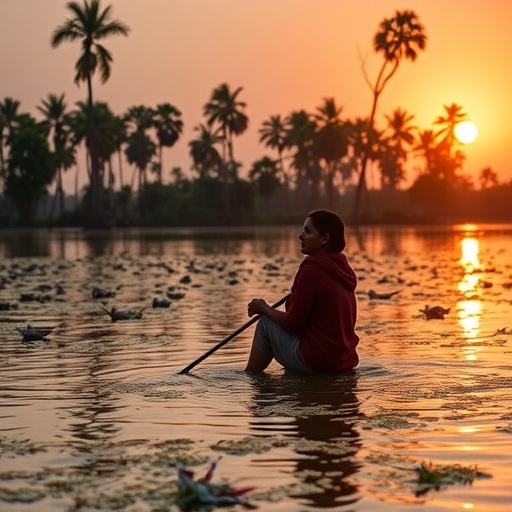
As climate change intensifies across the globe, the looming threat of sea level rise becomes increasingly urgent, particularly for vulnerable regions like the Indian Sundarbans delta. Researchers, led by A.K. Shukla, B. Ganguli, and Nirwan, have embarked on an essential study that investigates the multifaceted dimensions of livelihood vulnerability arising from this environmental phenomenon. Their work seeks to unravel the complex interactions between climate vulnerability and adaptation strategies that communities in the Sundarbans will need to consider as they navigate these daunting challenges.
The Indian Sundarbans delta, recognized as one of the most biodiverse regions on the planet, is home to millions of people who rely heavily on agriculture, fishing, and forestry for their livelihoods. With its unique ecosystem comprising mangroves, wetlands, and estuarine zones, the area faces significant risks due to rising sea levels. This research delves into the socioeconomic impacts these changes may have, particularly on the fishing sectors, which are vital for local economies and food security.
One of the primary focuses of the study is the extent of vulnerability faced by the Sundarbans’ communities. As sea levels rise, the intrusion of saline water into freshwater systems threatens agriculture and aquaculture, both of which are key components of the local economy. The research highlights that farmer incomes are likely to plummet as arable land is diminished and productivity is challenged. The findings underscore a pressing need for comprehensive assessments to ascertain the viability of different crops and methods in light of changing salinity levels.
Moreover, the local fishing communities face their own set of challenges as traditional fishing grounds may become submerged or altered due to climate impacts. The researchers point out that shifts in fish populations and migratory patterns will not only affect the availability of fish but also the economic stability of those who depend on it. This intertwining of environmental changes with economic consequences paints a dire picture for the Sundarbans’ livelihoods, necessitating an urgent response.
The authors detail specific adaptation strategies that could be implemented to mitigate these vulnerabilities. For agriculture, crop diversification and innovative farming techniques that emphasize salt-resistant varieties are crucial. Enhanced irrigation methods could also play a role in managing water resources more effectively, minimizing the impacts of saltwater intrusion. Similarly, for the fishing industries, developing sustainable practices and alternative livelihoods could provide crucial support systems for those adversely affected.
Additionally, the study goes beyond perception and highlights the importance of community involvement in adaptation planning. Engaging local communities in climate resilience initiatives ensures that the solutions devised will not only be context-relevant but also culturally appropriate. Collaborative efforts can foster a sense of ownership and empowerment among community members, which is vital for sustainable adaptation efforts.
The researchers utilized a mix of quantitative and qualitative methods, allowing them to capture a comprehensive understanding of local perceptions regarding climate risks. Surveys, interviews, and participatory workshops were conducted to assess how people perceive the impacts of sea level rise on their daily lives and economic prospects. Through these methodologies, the study reveals that anxiety about the future is prevalent, and many community members express uncertainty about their ability to adapt to these changes.
On the technical side, the research incorporates modeling to predict future scenarios under various sea level rise trajectories. By simulating different levels of potential sea level rise, the study can offer insights into what the Sundarbans might look like in the coming decades if current trends continue. Such modeling is essential for informing policymakers about the urgency of intervention and investment in adaptation strategies.
Ultimately, the pivotal message of the research is clear: timely action is essential to safeguard the livelihoods of those in the Sundarbans. As sea levels continue to climb, adapting to these changes is not simply a matter of survival; it is a necessity for preserving culture, dignity, and hope for future generations. The urgency of these findings cannot be overstated—the researchers call for systemic changes at both local and national levels to address the intersection of climate change and social inequality.
The implications of this study extend beyond the Sundarbans, as many coastal communities around the globe face similar challenges due to climate change. The insightful analysis provided by Shukla and his colleagues serves as a wake-up call, urging stakeholders across various sectors to foster resilience in vulnerable communities. By learning from the experiences of the Sundarbans, the global community may uncover pathways that could inform climate adaptation strategies elsewhere.
In closing, the study of livelihood vulnerability to sea level rise in the Indian Sundarbans delta represents a critical contribution to understanding and addressing the challenges posed by climate change. The research encompasses not only the scientific intricacies of sea level rise but also the human stories tied to the ecosystems we cherish. The call for collective action and sustainable adaptation strategies echoes profoundly, urging us all to recognize the shared responsibility we have in securing our planet’s future.
The research by Shukla and colleagues not only sheds light on the vulnerabilities specific to the Sundarbans but also invites a broader discourse about climate justice and equity. As communities grapple with rising seas, it is imperative that we prioritize scientific research, equitable resource distribution, and innovative solutions that empower those most affected.
In the face of an uncertain future, let us draw upon the insights gleaned from this pivotal study, forging pathways toward resilience that honor the spirit of adaptation, collaboration, and shared humanity as we navigate the complexities of a changing planet.
Cite Scienmag News
Thomas Green. (December 1, 2025). Evaluating Sea Level Rise Impact on Sundarbans Livelihoods. Scienmag. https://scienmag.com/evaluating-sea-level-rise-impact-on-sundarbans-livelihoods/
Thomas Green. "Evaluating Sea Level Rise Impact on Sundarbans Livelihoods." Scienmag, 1 December 2025, https://scienmag.com/evaluating-sea-level-rise-impact-on-sundarbans-livelihoods/. Accessed 3 September 2026.
Thomas Green. "Evaluating Sea Level Rise Impact on Sundarbans Livelihoods." Scienmag. December 1, 2025. https://scienmag.com/evaluating-sea-level-rise-impact-on-sundarbans-livelihoods/


