


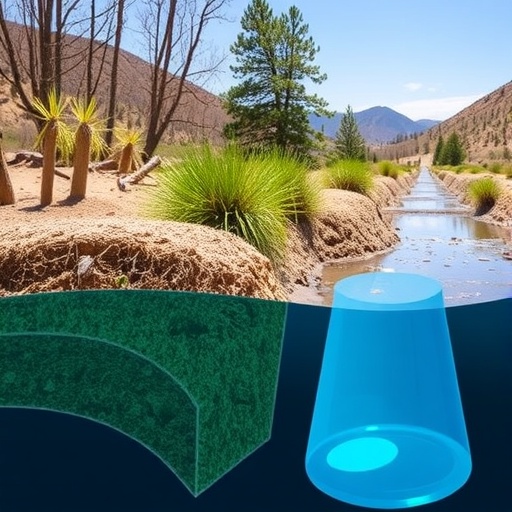
In a groundbreaking study that was recently published, researchers have underscored the critical importance of groundwater recharge structures in highland watersheds. The study, led by Sharma and colleagues, proposes a multi-criteria assessment and decision-making approach that could revolutionize how we plan and implement these vital structures. Groundwater recharge, a process that replenishes aquifers and maintains the sustainability of water resources, is of paramount significance, especially in regions facing water scarcity and environmental degradation.
Highland watersheds are unique ecosystems characterized by varying topographies and climatic conditions that directly influence water availability. The research highlights that these watersheds are often subjected to substantial anthropogenic pressures, including deforestation, urbanization, and agriculture, which can severely deplete groundwater resources. Recognizing these challenges, the researchers aimed to develop a comprehensive approach that takes into account multiple criteria, ensuring that groundwater recharge structures are optimally planned and implemented.
One of the focal points of this study is the development of a multi-criteria decision-making framework. This framework integrates various factors that influence groundwater recharge, including environmental, social, and economic criteria. By utilizing advanced decision-making tools and techniques, the researchers were able to analyze and evaluate different recharge strategies, ensuring that the chosen methods are not only efficient but also equitable for local communities.
The research emphasizes the need to consider the local context when planning groundwater recharge structures. It advocates for involving local stakeholders in the decision-making process, as their insights and knowledge can significantly enhance the effectiveness of recharge initiatives. This participatory approach fosters a sense of ownership and responsibility among the community, leading to better maintenance and sustainability of the infrastructure.
Furthermore, the implications of climate change on groundwater resources cannot be overlooked. The study reveals that shifting precipitation patterns and rising temperatures could exacerbate the challenges faced by highland watersheds. Therefore, the multi-criteria approach also incorporates climate resilience strategies, ensuring that the proposed recharge structures can withstand future environmental shifts. This proactive strategy is essential for mitigating risks associated with climate variability and ensuring long-term water security.
Another significant aspect of the research lies in its methodological rigor. The researchers employed a mix of qualitative and quantitative analysis, providing a robust basis for their findings. Through the utilization of geographical information systems (GIS) and statistical modeling, they were able to accurately map areas suitable for groundwater recharge structures. This precise identification of potential sites is critical for optimizing resource allocation and maximizing the benefits of recharge initiatives.
The advantages of implementing groundwater recharge structures are manifold. These structures not only replenish aquifers but also enhance local biodiversity by providing habitats for various species. Moreover, improved groundwater levels can lead to increased agricultural productivity, thus supporting food security in highland areas. The study underscores the interlinkages between water management, ecological health, and human well-being, highlighting the need for integrated planning approaches.
Additionally, the researchers have identified potential funding sources and policy recommendations to support the implementation of their proposed framework. By advocating for the allocation of resources towards sustainable water management practices, they aim to influence policymakers and drive the adoption of their multi-criteria assessment model in highland regions worldwide. The financial backing of such initiatives is crucial; without it, the implementation of groundwater recharge structures may remain a distant dream.
In conclusion, the study led by Sharma et al. presents a vital piece of the puzzle in addressing the challenges related to groundwater recharge in highland watersheds. The multi-criteria assessment and decision-making model not only provides a practical and strategic approach to planning and implementation but also emphasizes the importance of stakeholder involvement, climate adaptability, and ecological considerations. This research could serve as a blueprint for sustainable water management practices, ensuring that highland communities are resilient and capable of navigating the complexities of water scarcity and environmental change.
By drawing attention to these critical issues, the researchers hope to inspire further studies and collaborative efforts aimed at safeguarding groundwater resources in highland watersheds. As the global population continues to grow and environmental challenges escalate, the urgency for innovative and sustainable water management solutions has never been more pressing.
In essence, this work is more than an academic exercise; it is a call to action. The findings from this study should resonate with stakeholders from various sectors, including government agencies, environmental organizations, and local communities. Together, they can forge a path toward sustainable groundwater management, ultimately benefiting not only highland watersheds but also the broader environment.
Sharma, S., Tamrakar, Y., Deep, A. et al. Multi-criteria assessment and decision-making approach for planning of groundwater recharge structures in a highland watershed.
Discov Sustain 6, 1163 (2025). https://doi.org/10.1007/s43621-025-02054-3
Cite Scienmag News
Violet Maxwell. (November 2, 2025). Evaluating Groundwater Recharge: A Multi-Criteria Approach. Scienmag. https://scienmag.com/evaluating-groundwater-recharge-a-multi-criteria-approach/
Violet Maxwell. "Evaluating Groundwater Recharge: A Multi-Criteria Approach." Scienmag, 2 November 2025, https://scienmag.com/evaluating-groundwater-recharge-a-multi-criteria-approach/. Accessed 4 September 2026.
Violet Maxwell. "Evaluating Groundwater Recharge: A Multi-Criteria Approach." Scienmag. November 2, 2025. https://scienmag.com/evaluating-groundwater-recharge-a-multi-criteria-approach/


