


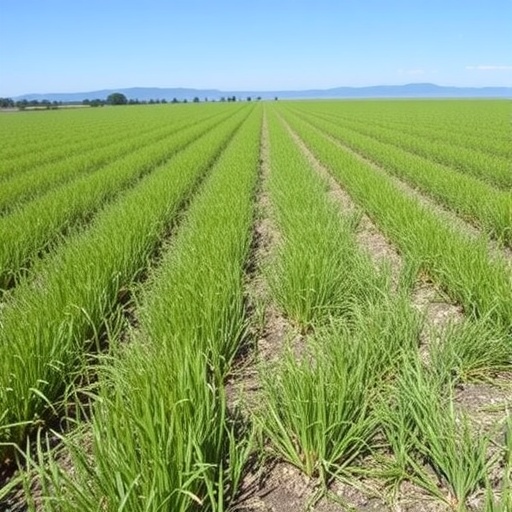
In the ever-evolving landscape of agricultural science, addressing the challenges posed by salinity in semiarid regions has become increasingly critical. Saline soils present significant barriers to cultivation, often leading to reduced crop yields and posing a risk to food security. Researchers are continuously exploring alternative solutions to mitigate the effects of salinity on agricultural productivity. The recent work by da Silva et al. sheds light on two alternative forage options that may possess the potential to thrive in Brazil’s saline semiarid regions.
The study begins by emphasizing the urgent need for sustainable agricultural practices in regions affected by salinity. Saline soils are characterized by high salt concentrations, which can inhibit plant growth, interfere with nutrient uptake, and ultimately reduce the viability of crops. In semiarid climates, where water availability is limited, the challenge of salt-affected soils becomes even more pronounced. The implications of these conditions impact farmers directly, often leading to economic strain and reduced food supply.
To counteract these issues, da Silva and colleagues focused their investigation on two specific forages known for their resilience in saline environments. These forages were meticulously chosen not only for their ability to withstand salinity but also for their nutritional benefits to livestock. The study meticulously outlines the selection process of these forage crops, drawing upon both their biological characteristics and historical performance in similar environments. This selection is crucial, as it sets the foundation for further exploration into their adaptability and overall efficacy in Brazilian conditions.
What sets this research apart is its comprehensive approach, utilizing field trials to assess the forages’ performance under saline stress. Through rigorous experimentation, the authors were able to gather empirical data on growth rates, biomass production, and nutritional content. These parameters are essential for determining not only the forages’ survival but their capacity to provide substantial feed for livestock amidst challenging conditions. This nuanced methodology emphasizes the necessity of practical, field-based research in understanding the real-world implications of alternative solutions.
The findings suggest that both forage types displayed remarkable resilience to saline stress. This resilience is paramount not only for ensuring livestock health but also for promoting sustainable agricultural practices in these challenging environments. The implications of these results extend beyond mere survival; they offer the promise of improved forage management strategies for farmers grappling with salinity. This aspect reinforces the concept that innovative agricultural research, grounded in practical applications, is essential for advancing food production systems.
Moreover, the nutritional analysis of the selected forages revealed their potential to contribute significantly to livestock diets. Livestock health and productivity are fundamentally tied to the quality of their feed; thus, identifying forages that effectively deliver essential nutrients can have broad-reaching implications. The integration of these salinity-resistant forages into existing farming systems can enhance livestock productivity, which is crucial for the economic viability of pastoral communities in Brazil.
As the study progresses, it delves into the environmental considerations associated with cultivating these forages. In addition to improving livestock nutrition, the potential for these crops to contribute positively to soil health cannot be overlooked. The introduction of salinity-tolerant forages may help restore the ecological balance in affected soils, promoting biodiversity and aiding in the restoration of degraded lands. This aspect aligns seamlessly with global agricultural goals focused on sustainability and resilience in the face of climate change.
Furthermore, the study highlights the socio-economic benefits that could arise from adopting these alternative forages. Farmers in saline semiarid regions often face significant economic challenges, and improving livestock nutrition through innovative foraging strategies could lead to increased productivity and incomes. The potential for these forages to create a more resilient agricultural system could serve as a model for similar regions around the world, wherein salinity poses a barrier to sustainable farming.
To contextualize the implications of this research, it is essential to consider Brazil’s broader agricultural landscape. As one of the largest agricultural producers globally, Brazil plays a pivotal role in ensuring food security not only for its population but also for many countries around the world. Addressing the challenges of salinity in semiarid regions thus presents an opportunity for Brazil to lead the way in research and development of sustainable agricultural practices. The steps taken by researchers like da Silva et al. could serve as a blueprint for overcoming similar agricultural challenges elsewhere.
In summary, the work conducted by da Silva and colleagues not only contributes valuable empirical data to the field of agronomy but also addresses pressing global issues related to food security, sustainability, and resilience in agriculture. The exploration of salinity-tolerant forages in Brazil’s semiarid regions represents a hopeful avenue for future agricultural practices. As scientists continue to seek solutions to complex agricultural challenges, it is vital to remain focused on strategies that combine environmental stewardship with economic viability.
The study’s results raise pertinent questions for future research: what additional environmental factors may impact the performance of these forages? How can farmers best integrate these crops into their existing systems for maximum benefit? As the discourse surrounding agricultural innovation progresses, it is essential to foster collaborative efforts among scientists, farmers, and policymakers to ensure that research findings translate into practical applications that can benefit communities grappling with the realities of salinity.
Ultimately, the ongoing quest for sustainable solutions to salinity-related challenges emphasizes the importance of multidisciplinary approaches in agricultural research. By bridging the gaps between ecological science, nutrition, and socio-economic factors, innovative solutions like those proposed by da Silva and his team can pave the way for more resilient agricultural systems capable of feeding a growing global population amidst changing climatic conditions.
In conclusion, as the world grapples with increasing agricultural challenges due to climate change and resource scarcity, studies like these cannot be overstated in their significance. The persistence and ingenuity demonstrated in agricultural research offer a beacon of hope, illustrating that with the right knowledge and commitment, it is indeed possible to create a sustainable future for agriculture in the face of adversity.
da Silva, M.F., Pedrozo, A.F., de Souza, A. et al. Assessing the potential of two alternative forage for saline semiarid regions in Brazil.
Discov. Plants 2, 216 (2025). https://doi.org/10.1007/s44372-025-00304-2
Cite Scienmag News
Alan Morgan. (August 25, 2025). Evaluating Alternative Forages for Brazil’s Saline Semiarid Regions. Scienmag. https://scienmag.com/evaluating-alternative-forages-for-brazils-saline-semiarid-regions/
Alan Morgan. "Evaluating Alternative Forages for Brazil’s Saline Semiarid Regions." Scienmag, 25 August 2025, https://scienmag.com/evaluating-alternative-forages-for-brazils-saline-semiarid-regions/. Accessed 6 September 2026.
Alan Morgan. "Evaluating Alternative Forages for Brazil’s Saline Semiarid Regions." Scienmag. August 25, 2025. https://scienmag.com/evaluating-alternative-forages-for-brazils-saline-semiarid-regions/


