


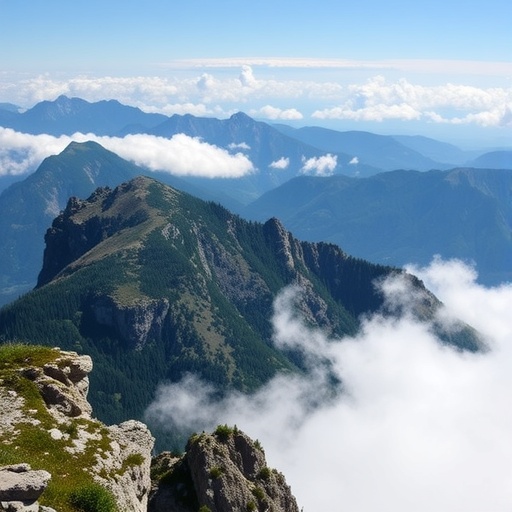
Europe’s mountain summits are turning warmer in botanical terms, but not always for the reasons scientists expected. Across dozens of high-elevation sites, plants associated with warmer conditions have become increasingly common over the past two decades, revealing a broad process known as thermophilisation. Yet a major international analysis shows that the amount of vegetation change at any individual summit is only weakly connected to the amount of local warming recorded there. The finding challenges a simple version of the climate-change story and suggests that alpine ecosystems are responding through a complicated combination of temperature, species availability, landscape context and local environmental conditions.
The study, led by researchers from the University of Vienna, the Austrian Academy of Sciences and BOKU University, examined an exceptionally large dataset drawn from the GLORIA network, the Global Observation Research Initiative in Alpine Environments. Researchers analysed 724 permanent monitoring plots distributed across 53 mountain summits in all major European mountain regions. Each plot was surveyed four times over a 21-year period, allowing the team to compare changes in plant communities rather than relying on a single snapshot. The scale and duration of the research make it one of the most comprehensive assessments yet of how Europe’s summit vegetation is changing under a warming climate.
The central signal was clear: warmth-associated species now occupy a larger role in many alpine plant communities than they did at the beginning of the monitoring period. These species are not defined merely by whether they can survive a hot day. Their distributions and ecological characteristics indicate an affinity for comparatively warmer conditions, meaning that a growing presence on high mountain summits can signal a shift in the environmental conditions experienced by plant communities. The process does not necessarily mean that every cold-adapted plant has disappeared. Instead, it reflects a change in the balance of species, with plants linked to warmer habitats becoming more frequent, more widespread or more dominant in many locations.
At first glance, the result appears to offer a straightforward explanation: temperatures rise, and plants adapted to warmth move upward. Mountain ecosystems are often viewed as natural thermometers because their steep environmental gradients compress large climatic differences into relatively short distances. As conditions become warmer, species from lower elevations may be expected to colonise higher ground, while alpine specialists face increasing pressure. However, when the researchers compared vegetation changes at individual plots with a wide range of temperature indicators from multiple climate datasets, the relationship was surprisingly weak. A summit that experienced measurable warming did not always show the strongest thermophilisation, and locations with similar temperature trends could undergo notably different botanical changes.
According to lead author Johannes Hausharter of the University of Vienna, the evidence demonstrates that European summit vegetation is changing, but rising temperature alone cannot predict the speed or direction of change at every plot. This distinction is important because climate impacts are frequently assessed using broad averages, while plants live in highly localised environments. At the scale of a few square metres, a mountain summit may contain exposed ridges, sheltered hollows, rock crevices and patches of soil that differ substantially in moisture, wind exposure, snow duration and solar radiation. A temperature value derived from a nearby station or a broad climate model may therefore fail to capture the conditions that determine whether a particular plant can germinate, survive and reproduce.
The surrounding species pool appears to be one of the most important pieces of the puzzle. The analysis found that vegetation responses were stronger where warmth-associated species were already present in the broader landscape. In ecological terms, climate change can create suitable conditions, but the response also depends on whether potential colonists are close enough to arrive. A summit surrounded by lower-elevation vegetation containing many warmth-associated plants may receive a steady supply of seeds, pollen or vegetative fragments. Another summit experiencing a similar temperature increase may change more slowly if those species are absent from the surrounding region, if dispersal is limited or if physical barriers restrict movement.
This helps explain why alpine plant communities do not respond like identical instruments exposed to the same rise in temperature. Climate establishes a changing background of potential habitat, but biological migration, competition and local geography determine which species actually occupy that habitat. Newly arriving plants must germinate in difficult terrain, establish roots in shallow or rocky soils and survive intense winds, freeze-thaw cycles and irregular water availability. Existing species can also alter the outcome by competing for light, nutrients and space. The result is a delayed, uneven and spatially variable transformation rather than an immediate botanical rearrangement that mirrors the thermometer.
The researchers nevertheless emphasise that the weak local correlation should not be interpreted as evidence that climate change is unimportant. When the monitoring plots were considered together across larger geographic areas, a broader pattern emerged: mountain ranges that had warmed more substantially also tended, on average, to show a stronger shift toward warmth-associated summit vegetation. In other words, the climate signal becomes more apparent when local noise is averaged across regions. This distinction between local and large-scale patterns is familiar in ecology, where fine-scale topography and species interactions can obscure a regional trend without eliminating it. More warming generally means more warmth-associated plants, but individual summits may follow different timelines.
The findings carry immediate consequences for conservation and future biodiversity forecasts. Alpine ecosystems are already isolated, fragmented and exposed to multiple pressures, and many high-mountain species have limited opportunities to move farther uphill once they approach the summit. Predicting which plants will expand, persist or decline requires more than projecting future temperatures. Scientists will need long-term observations that track species distributions, snow cover, soil moisture, land-use influences, grazing, nutrient availability and the composition of nearby vegetation. The GLORIA network demonstrates the value of repeating surveys over decades, because gradual biological changes can remain invisible in short-term studies and because different drivers may become important at different stages of a species’ expansion.
The study ultimately presents Europe’s mountain summits as laboratories of climate change—but laboratories in which the results are shaped by context. Thermophilisation is widespread, yet its local expression depends on what species are nearby, how the landscape is structured and how environmental conditions vary across each summit. Harald Pauli, who leads the GLORIA network at the Austrian Academy of Sciences and BOKU University, argues that continued monitoring and expanded data collection will be essential for understanding the future of high-mountain biodiversity. As warming reshapes the ecological limits of European plants, the most revealing question may not be simply how much temperatures rise, but which species are ready and able to follow.
Web References: https://doi.org/10.1038/s41559-026-03150-x
References: Nature Ecology & Evolution; GLORIA long-term monitoring network; University of Vienna; Austrian Academy of Sciences; BOKU University.
Cite Scienmag News
Violet Maxwell. (August 14, 2026). European mountain summits warm, but vegetation responds in surprisingly divergent ways. Scienmag. https://scienmag.com/european-mountain-summits-warm-but-vegetation-responds-in-surprisingly-divergent-ways/
Violet Maxwell. "European mountain summits warm, but vegetation responds in surprisingly divergent ways." Scienmag, 14 August 2026, https://scienmag.com/european-mountain-summits-warm-but-vegetation-responds-in-surprisingly-divergent-ways/. Accessed 3 September 2026.
Violet Maxwell. "European mountain summits warm, but vegetation responds in surprisingly divergent ways." Scienmag. August 14, 2026. https://scienmag.com/european-mountain-summits-warm-but-vegetation-responds-in-surprisingly-divergent-ways/


