


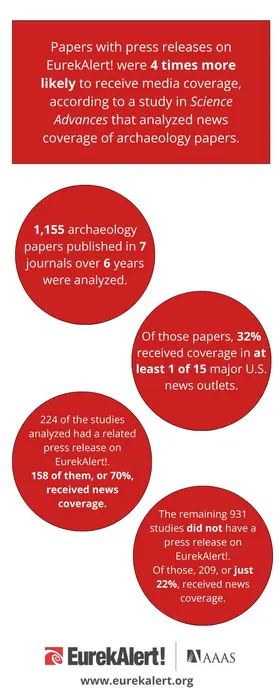
In an era where scientific discovery increasingly relies on public support and understanding, the pathway from academic publication to mainstream media coverage is crucial yet complex. A recent detailed inquiry by a team at Harvard University delved deeply into this dynamic by examining how archaeology research disseminates from scholarly journals into the broader media ecosystem. By analyzing 1,155 archaeology papers spanning a six-year period, the researchers sought to elucidate the role of media platforms in shaping public engagement with scientific findings.
Central to their findings is the outsized impact of EurekAlert!, a news release distribution service operated by the American Association for the Advancement of Science (AAAS). The study, published in the prestigious Science Advances, reveals that archaeology articles accompanied by a press release on EurekAlert! were approximately four times more likely to attain coverage in 15 prominent U.S. media organizations compared to those without such releases. This discovery underscores EurekAlert!’s function as a pivotal bridge connecting researchers and journalists.
This amplification effect may be partly attributed to the embargo system EurekAlert! employs, which allows journalists early access to embargoed scientific content. Such advance access enables journalists to thoroughly prepare and craft timely stories aligned closely with publication dates, enhancing the media’s ability to present fresh research narratives. Bridget Alex, a co-corresponding author from Harvard’s human evolutionary biology department, highlighted this mechanism as likely crucial in boosting visibility.
Significantly, the study reports that 70% of archaeology articles with EurekAlert! press releases received media attention in the specified outlets, while only about 22% of articles without press releases achieved similar coverage. In total, nearly one-third of the examined papers were featured by at least one major U.S. news source. These statistics vividly demonstrate that strategic science communication practices can dramatically alter the public resonance of academic research.
Beyond the presence of press releases, journal prestige also exerted considerable influence on media attention. The team documented that over 90% of archaeology papers published in high-impact journals such as Nature and Science received coverage. This suggests that news editors weigh journal reputation heavily when selecting studies to feature, implying that journal impact factor operates as a proxy for news value in editorial decisions.
However, the study also reveals significant geographical disparities in media coverage that warrant concern. Archaeological research originating from the United States, the United Kingdom, Israel, Palestine, and Australia was three times more likely to be reported than studies emanating from China or Taiwan. Despite China and Taiwan accounting for the highest volume of papers, their media coverage in U.S. outlets was disproportionately low unless centered on themes resonating culturally or scientifically with American audiences.
Proximity between research sites and newsrooms appeared to influence coverage probability, with cultural and geographic affinities playing substantial roles. For example, nearly half of North American archaeological studies were reported by U.S. media, reflecting potential biases favoring domestic or culturally proximate research endeavors. Such patterns spotlight systemic tendencies that shape which scientific stories gain prominence and which remain marginalized, independent of intrinsic academic merit.
Researchers caution against equating media attention with scientific value, noting that editorial gatekeeping often prioritizes newsworthiness over scholarly significance. Moreover, the interaction of press releases and journal prominence with media visibility underscores how external communication strategies and institutional support profoundly affect research exposure. This insight urges scientists aiming for public impact to collaborate proactively with press offices and leverage platforms like EurekAlert!
Nevertheless, the study acknowledges disparities in resource availability among researchers that may exacerbate inequities in scientific visibility. Not all scientists possess institutional support for crafting press releases or engaging with media distribution services, potentially skewing public representation of global research contributions. Addressing these structural imbalances is essential for fostering a more equitable scientific communication landscape.
While this investigation focused exclusively on one distribution service and a select group of U.S. news outlets, it raises broader questions about the global dissemination of science news and the mechanisms shaping public science literacy. Future research expanding to diverse platforms and international media contexts could enrich understanding of the pathways and bottlenecks that influence which scientific narratives reach society at large.
Ultimately, this comprehensive study confirms that strategic science communication, particularly through specialized distribution channels like EurekAlert!, significantly enhances the visibility of academic archaeology research. Coupled with journal prestige, these factors determine whether scientific discoveries extend beyond scholarly audiences to captivate public imagination and inform cultural discourse. For scientists committed to public engagement, harnessing these tools and addressing geographic and institutional disparities remains imperative.
EurekAlert! continues to serve as a vital conduit for research dissemination, enabling journalists timely access to embargoed and public press materials. With a network exceeding 14,000 journalists and 1,600 submitting organizations, its role in bridging the gap between the scientific community and media is substantial and growing. This study’s findings validate its efficacy and encourage researchers to utilize such platforms for broadening the impact and reach of their work.
The implications of these insights extend beyond archaeology, offering a blueprint for other scientific disciplines seeking to enhance public engagement through effective media strategies. By navigating the interplay of press releases, journal prestige, and media proximity, the scientific community can better steer which discoveries are amplified, fostering a more informed and engaged society.
Cite Scienmag News
Courtney Benton. (October 1, 2025). EurekAlert! Boosts Media Coverage Potential of Academic Papers Fourfold. Scienmag. https://scienmag.com/eurekalert-boosts-media-coverage-potential-of-academic-papers-fourfold/
Courtney Benton. "EurekAlert! Boosts Media Coverage Potential of Academic Papers Fourfold." Scienmag, 1 October 2025, https://scienmag.com/eurekalert-boosts-media-coverage-potential-of-academic-papers-fourfold/. Accessed 4 September 2026.
Courtney Benton. "EurekAlert! Boosts Media Coverage Potential of Academic Papers Fourfold." Scienmag. October 1, 2025. https://scienmag.com/eurekalert-boosts-media-coverage-potential-of-academic-papers-fourfold/


