


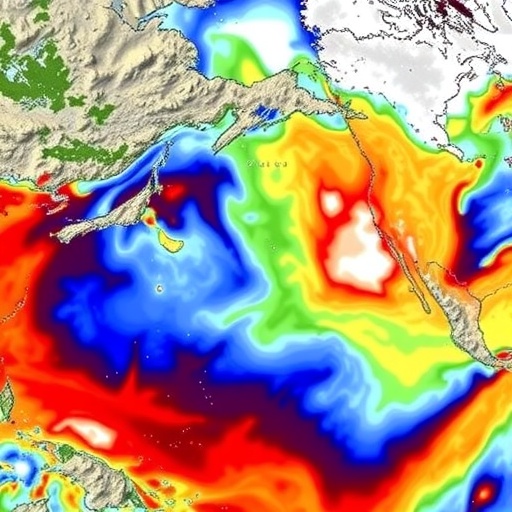
Across the vast belt of mid- to high-latitude Eurasia, spring heat has begun to behave in a way climate scientists did not expect from one of the region’s most closely watched oceanic precursors. A new study reports that the broad, continent-spanning “monopole” pattern of extreme spring heat events has become less strongly connected to a characteristic arrangement of winter sea-surface temperature anomalies in the North Pacific since the late 1990s. The finding points to a major shift in the climate links that once allowed ocean conditions thousands of kilometres away to help shape the timing and distribution of unusually hot spring weather across Eurasia. It also raises an urgent forecasting problem: signals that previously offered useful clues about upcoming heat may no longer carry the same predictive power in the warming climate.
The term monopole describes a large region in which temperature anomalies tend to have the same sign. In this case, the pattern involves widespread spring extreme heat over mid- to high-latitude Eurasia rather than a narrow hot spot confined to one country or subregion. Such events can arrive early in the warm season, accelerating snowmelt, drying soils and vegetation, increasing wildfire risk, and placing stress on agriculture and water supplies before summer has fully begun. Because Eurasia stretches across several climate zones, a coherent heat pattern over the continent reflects more than local weather. It indicates that the atmosphere has organized into a persistent configuration capable of transporting and retaining heat over an enormous area.
The North Pacific signal examined by the researchers is known as a tripolar sea-surface-temperature pattern. Instead of forming one continuous warm or cold patch, the anomaly is arranged in three broad zones with alternating temperature signs across the basin. These oceanic contrasts can influence the atmosphere above them by modifying the exchange of heat and moisture between the sea and air, changing the position and strength of jet streams, and altering pressure systems that steer planetary-scale waves. During winter, the North Pacific is particularly important because it is a major source of atmospheric energy. Storm tracks, oceanic temperature gradients and the release of latent heat can combine to launch or reinforce wave patterns that travel across the Northern Hemisphere.
In the climate system’s traditional sequence, winter ocean conditions can persist long enough to influence the atmosphere in the following spring. A tripolar temperature structure in the North Pacific may help establish a chain of circulation anomalies extending from the Pacific across Siberia and into Europe. The resulting pressure pattern can encourage sinking air, clear skies and stronger solar heating over parts of Eurasia, while also changing the path of cold-air outbreaks and storm systems. When several of these effects align, the atmosphere may produce a continent-scale warm anomaly. The important point is that the ocean does not directly “send heat” across Eurasia. Instead, it acts as a boundary condition that can reshape atmospheric circulation, allowing heat to accumulate or cold air to be displaced over land.
The study’s central result is that this relationship weakened after the late 1990s. Before that transition, variations in the winter North Pacific tripolar pattern were more closely associated with the monopole pattern of spring extreme heat over mid- to high-latitude Eurasia. Afterward, the same oceanic configuration no longer corresponded as consistently to the continental heat pattern. A weakened statistical relationship does not mean that the North Pacific has stopped affecting Eurasian climate, nor does it imply that every spring heat event now has a different cause. Rather, it means that the strength, pathway or reliability of the connection has changed. For seasonal forecasters, that distinction is crucial: a predictor can remain physically influential while becoming less dependable as a standalone warning signal.
Climate teleconnections are not fixed wires connecting one region to another. They depend on the background state of the atmosphere and ocean, including the position of the jet stream, the distribution of snow and sea ice, soil moisture, and the phase of other climate modes. The late 1990s marked a period of notable reorganization in Pacific climate variability, including changes in tropical Pacific behaviour and North Pacific atmospheric circulation. As the background climate shifted, the atmospheric wave response to the tripolar sea-surface-temperature pattern may also have changed. A signal that once projected efficiently onto the circulation pattern favouring widespread Eurasian heat could have been redirected, weakened or masked by competing sources of variability.
The researchers’ conclusion is especially significant because spring is a season of rapid transition. The land surface is emerging from winter, sunlight is increasing, and the atmosphere is switching between cold-season and warm-season circulation regimes. Small changes in snow cover or soil moisture can have large effects on how much incoming solar energy becomes sensible heat rather than being consumed by melting snow or evaporating water. If the soil is dry, more energy warms the air; if it is moist, evaporation can moderate surface temperatures. These land-atmosphere feedbacks can amplify a circulation anomaly once it is established, potentially making the final heat pattern less dependent on the original North Pacific trigger than it was in the past.
The shift also has implications beyond seasonal prediction. Extreme spring warmth can disrupt crop calendars, cause plants to bloom before pollinators are active, and increase the likelihood that a later freeze will damage newly emerged vegetation. Earlier snowmelt can produce a short-lived surge in river flow followed by reduced water availability later in the season. In northern Eurasia, unusual heat can accelerate permafrost thaw and intensify fire weather, while in densely populated regions it can expose communities to dangerous temperatures before heat-health systems are fully activated. If the large-scale drivers of these events are changing, risk assessments based only on historical relationships may underestimate how quickly warning systems need to adapt.
The study does not suggest that prediction is becoming impossible; it suggests that the search for reliable precursors must become more dynamic. Future forecasting systems may need to combine North Pacific ocean temperatures with tropical Pacific conditions, Arctic variability, Eurasian snow cover, soil moisture and the evolving structure of the jet stream. Climate models will also need to reproduce not only the average temperature trend but the changing strength of teleconnections between distant regions. The weakening of the North Pacific–Eurasian link is a reminder that global warming can alter the architecture of climate variability itself. As the planet’s background state continues to evolve, yesterday’s strongest predictors may lose influence, while new combinations of oceanic, atmospheric and land-surface signals emerge as the fingerprints of tomorrow’s extreme spring heat.
Cite Scienmag News
Sloane Callahan. (August 25, 2026). Eurasian Spring Heat Monopole–North Pacific Tripolar SST Link Weakens Since 1990s. Scienmag. https://scienmag.com/eurasian-spring-heat-monopole-north-pacific-tripolar-sst-link-weakens-since-1990s/
Sloane Callahan. "Eurasian Spring Heat Monopole–North Pacific Tripolar SST Link Weakens Since 1990s." Scienmag, 25 August 2026, https://scienmag.com/eurasian-spring-heat-monopole-north-pacific-tripolar-sst-link-weakens-since-1990s/. Accessed 4 September 2026.
Sloane Callahan. "Eurasian Spring Heat Monopole–North Pacific Tripolar SST Link Weakens Since 1990s." Scienmag. August 25, 2026. https://scienmag.com/eurasian-spring-heat-monopole-north-pacific-tripolar-sst-link-weakens-since-1990s/


