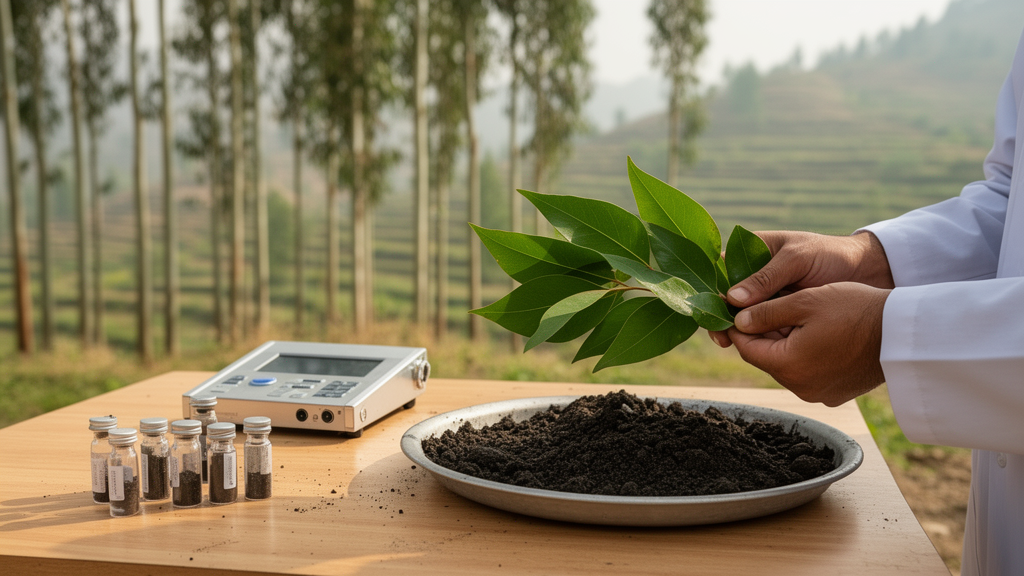
Researchers sampling the hilly terrain of Lower Dir, a district in Khyber Pakhtunkhwa, Pakistan, have reported that the leaves of the deep-rooted eucalyptus tree can serve as a natural probe for buried mineral wealth. In a study of thirty localities across the district, the team measured concentrations of copper, silver and gold in both soil and eucalyptus foliage, using the tree’s ability to draw deep groundwater and dissolved minerals up through its roots as a biological sampling system. Copper and silver were detected at measurable levels in many of the sampled sites, while gold was absent from every soil and leaf sample analyzed. The work, published open access in Discover Minerals in December 2024, represents the first application of this leaf-based detection approach in these remote upland districts of Pakistan.
The logic behind the survey rests on a technique known as phytoremediation, a term first coined in 1991 from the Greek words for plant and remedial. The method uses plants to extract, degrade or stabilize hazardous organic and inorganic chemicals from contaminated soil and water. In mineral exploration, the same principle is turned to advantage: instead of removing pollutants, researchers read the chemistry of plant tissue as a signal of what lies underground. Eucalyptus is particularly suited to this role because its roots extend tens of meters into the ground, reaching water and nutrients that shallow-rooted plants cannot access. As the tree takes up water, it also draws in trace amounts of dissolved metals, which are transported to the leaves where they can be collected and measured.
This botanical prospecting approach has precedents elsewhere. Studies have shown that eucalyptus trees in Australia can absorb gold particles from soil and transport them to their leaves, where the metal can be detected, making the tree a practical indicator for gold mining. In Indonesia, eucalyptus has likewise been used as an indicator plant for gold. In New Zealand, although eucalyptus is not formally associated with mining, researchers have argued that the same absorption pattern could be applied to detect metals in local vegetation. The Lower Dir study extends this idea to a new region, testing whether the tree’s deep feeder roots can flag the presence of precious metals in the geology of northern Pakistan.
The fieldwork covered thirty different localities in Lower Dir, grouped around the Asbanr, Talash, Timergara, Chakdara and Shamlai areas. At each site, the team collected twenty soil samples and twenty eucalyptus leaf samples. Soil samples were packed in polyethylene bags, dried in an oven and ground into a fine powder. Leaves were ground and dried to reduce moisture content before being converted to powder as well. The powdered material was then digested with an acid mixture of nitric, sulfuric and perchloric acid in a 5:1:0.5 ratio, heated until white vapors appeared, diluted to a fixed volume, filtered and stored for analysis. Elemental measurements were performed with atomic absorption spectrometry using a Perkin Elmer instrument, following standard AOAC procedures.
The analytical method carried defined detection windows that shaped what the study could see. For gold, the instrument’s detection range was 50 to 80 micrograms per liter; for silver, 5 to 30 micrograms per liter; and for copper, 10 to 40 micrograms per liter. Within these limits, the survey produced a clear spatial picture. Copper concentrations in soil were highest in samples from Ramyal, Chakdara and Khawas, reaching 3.096, 0.723 and 0.588 milligrams per kilogram respectively. In eucalyptus leaves, copper peaked in samples from Ramyal, Badwan and Bombolai at 2.003, 0.164 and 0.106 milligrams per kilogram. Silver in soil was highest at Qala Asbanr, Shamlai and Khawas, with values of 0.351, 0.058 and 0.036 milligrams per kilogram, while leaf silver was highest at Qilla, Bombolai and Khawas, at 0.048, 0.036 and 0.029 milligrams per kilogram.
Gold told a different story. It was not detected in any sample, whether soil or leaf, at any of the thirty localities. This absence stands in contrast to findings from other regions: a study in Turkey reported soil gold concentrations ranging from 0.005 to 0.54 milligrams per kilogram, and a study of eucalyptus leaves in Tehran, Iran, recorded copper concentrations of 41.7 plus or minus 2.3 milligrams per kilogram, far higher than the levels measured in Lower Dir. A Nigerian study found silver in negligible amounts, a result that partially parallels the Pakistani survey, where many localities also lacked detectable silver.
To quantify how effectively metals moved from soil into plant tissue, the team calculated the bioconcentration factor, defined as the ratio of the metal concentration in plant tissue to its concentration in soil. This ratio indicates the ability of a plant to collect metals from soil and transport them to its shoots, in this case the leaves. For copper, the highest bioconcentration factors were 0.646 at Ramyal Chakdara, 0.625 at Trai Timergara, 0.561 at Shamlai Chakdara and 0.504 at Badwan. For silver, the highest values were 0.888 at Badwan, 0.805 at Khawas Asbanr, 0.538 at Turnow Asbanr and 0.395 at Bombolai Asbanr. No gold uptake was recorded anywhere, consistent with the absence of the metal in the underlying samples.
The authors interpret these patterns as evidence that copper and silver reservoirs exist in the selected areas of Lower Dir and warrant exploration by government agencies, while the data suggest no gold is present in these locations. The study is presented as the first attempt in Pakistan to identify natural mineral resources of the hilly areas of District Dir Lower using this approach, and the authors note that such an approach has not previously been reported from these far-up districts. They argue that mining without proper indicators can waste valuable resources, making phytoremediation a potentially effective and natural way to pinpoint the locations of mines in both hilly and flat terrain. Although eucalyptus has served as a mining indicator in Australia and New Zealand, it had not yet been used for this purpose in Pakistan.
The broader context of mineral exploration in Pakistan gives the findings practical weight. Previous research has identified alluvial gold in the Hunza valley and twenty-four locations with potential gold deposits in the country’s northern regions, with gold deposition predominantly found in the Indus and Chitral rivers. Areas such as Shardi, Suntar Nala and parts of the Neelum river have been acknowledged as having potential for deposits of gold, silver and lead. In Baluchistan, twenty areas have been identified for substantial copper and gold deposits, with the Rikodiq area in the Chaghi district notable for an estimated 414 million tonnes of these minerals. Silver deposits are known at Saindak in Baluchistan and in the Shinkai region of North Waziristan.
The study also carries the standard cautions of the phytoremediation literature. The technique can take longer to remediate water and soil, its effectiveness may be reduced by slow growth rates in some hypo-accumulating plant species, and if managed improperly it can contaminate the food chain, so careful implementation is advised. At the same time, phytoremediation is regarded as environmentally sustainable and cost-effective, applicable over large areas, capable of limiting the spread of pollutants in ecosystems and of addressing both inorganic and organic contaminants. The authors recommend further exploration to confirm the Lower Dir findings, given the high cost of mining, and suggest that the data could be used by Pakistan’s mining agencies to target potential copper and silver deposits, with implications they hope could contribute to economic development in the country’s more remote regions.
Subject of Research: Phytoremediation survey of copper, silver and gold in soils and eucalyptus leaves of Lower Dir, Pakistan
Article Title: Investigation of precious metals; Cu, Ag and Au in soil of Dir lower Pakistan: a phytoremediation approach using deep feeder eucalyptus leaves
Article References: Zahoor, M., Nisar, M., Hussain, S., Ullah, Z., Ullah, R., Umar, M. N., Bari, A., & Khan, A. (2024). Investigation of precious metals; Cu, Ag and Au in soil of Dir lower Pakistan: a phytoremediation approach using deep feeder eucalyptus leaves. Discover Minerals, 1(1), Article 4. https://doi.org/10.1007/s44346-024-00004-x
Image Credits: AI Generated
DOI: 10.1007/s44346-024-00004-x
Keywords: phytoremediation, eucalyptus, copper, silver, gold, Lower Dir, Pakistan, soil analysis, atomic absorption spectrometry, bioconcentration factor, mineral exploration, heavy metals
Cite Scienmag News
Violet Maxwell. (October 30, 2026). Eucalyptus Leaves Reveal Copper and Silver Hidden in Pakistan’s Lower Dir Soils. Scienmag. https://scienmag.com/eucalyptus-leaves-reveal-copper-and-silver-hidden-in-pakistans-lower-dir-soils/
Violet Maxwell. "Eucalyptus Leaves Reveal Copper and Silver Hidden in Pakistan’s Lower Dir Soils." Scienmag, 30 October 2026, https://scienmag.com/eucalyptus-leaves-reveal-copper-and-silver-hidden-in-pakistans-lower-dir-soils/. Accessed 4 November 2026.
Violet Maxwell. "Eucalyptus Leaves Reveal Copper and Silver Hidden in Pakistan’s Lower Dir Soils." Scienmag. October 30, 2026. https://scienmag.com/eucalyptus-leaves-reveal-copper-and-silver-hidden-in-pakistans-lower-dir-soils/