


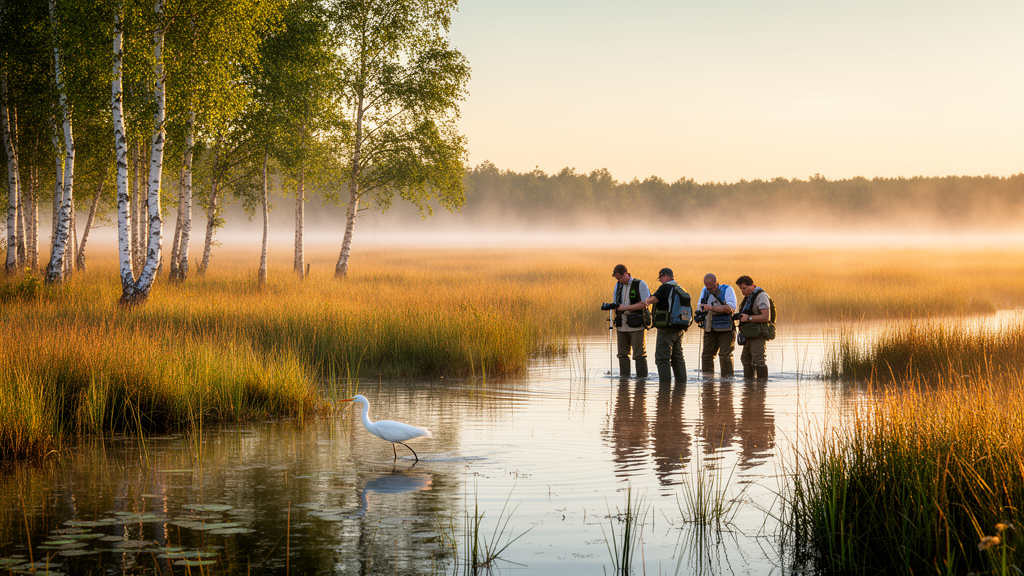
Wetlands are among the most cross-cutting ecosystems in European law. They fall simultaneously under water management, species and habitat conservation, climate mitigation and adaptation, agriculture, flood risk and energy policy, and they are governed by a complex web of legislative instruments rather than a single framework. A new analysis published in the journal Nature Conservation provides the most systematic overview to date of this EU policy mix, assessing which legislations support wetland conservation, restoration and sustainable use, which counteract them, and where implementation weaknesses undermine even the best-designed rules. Its central finding is striking: the newly adopted EU Nature Restoration Regulation could serve as a focal point for synergetic action across sectors — but only if Member States translate its legally binding targets into ambitious and well-funded National Restoration Plans.
The study classifies selected EU environmental and climate policies according to their impacts on wetlands and their reliance on high-quality wetlands to meet their own aims. The picture that emerges is one of supportive nature and water policies undermined by counteracting sectoral policies. The Birds Directive and Habitats Directive, collectively the cornerstone of EU biodiversity law, mandate the protection and restoration of numerous wetland habitat types — from coastal salt marshes and seagrass meadows to mires, bogs and fens — and of wetland-dependent species such as the European otter, the European sturgeon and the marsh fritillary. Where the Natura 2000 network they establish is fully implemented, it has demonstrably slowed species decline and habitat loss compared with non-protected areas. Yet the latest reporting period shows how far objectives remain unmet: only 17% of protected freshwater habitats achieve good conservation status, and 80% of protected fish and 60% of amphibians reliant on these habitats are in poor or bad condition, with freshwater migratory fish abundance down 75% since 1975.
Water management legislation tells a similar story of high ambition and weak delivery. The Water Framework Directive, adopted in 2000, aims to achieve good status for all water bodies by 2027 at the latest, promoting an integrated approach that respects entire ecosystems. Its implementation would highly benefit European wetlands, which regulate water quality and ecosystem health. Yet only 37% of Europe’s surface water bodies achieved good or high ecological status in 2021, with the main pressures being hydrological modification — dams and channelization — and agricultural pollution. The Fitness Check of the Directive identified underestimated ecological timescales, ineffective integration of sectoral policies, and excessive use of exemptions by Member States as key weaknesses, alongside a lack of comparable, centrally stored European monitoring data that delays detection of emerging stressors.
The Floods Directive recognizes wetlands’ role in natural flood management, promoting their use as natural water retention areas that absorb and slowly release floodwater, and holds potential for a paradigm shift from flood protection to integrated flood risk management. That potential has not been realized: reliance on gray infrastructure such as dams and dikes remains the norm, and neither aquatic biodiversity nor ecosystem services are directly mentioned in the Directive’s text. Climate legislation adds another layer. The LULUCF Regulation governs greenhouse gas accounting for land use, land use change and forestry, setting a union target of net removals of 310 million tonnes of CO2 equivalent by 2030. Restoring drained peatlands as nature-based solutions has high potential for emission reductions, and reporting on emissions from managed wetlands will become mandatory in 2026. Yet the overall union target is unlikely to be met, and links with EU biodiversity policy remain weak.
Counteracting these supportive policies is the EU’s Common Agricultural Policy, the biggest fund for land management in the Union. The analysis finds that the CAP needs significantly better targeting to reduce continued wetland damage. Intensive agriculture presents the most significant pressure for both surface and groundwaters in the EU, with little improvement since 2010, and hydrological modification for agricultural use, pollution and degrading management practices rank among the most severe pressures on protected wetland habitats. The newly introduced GAEC 2 standard aims to protect wetlands and peatlands by setting minimum conditions for direct payments, but it does not forbid continued drainage and ploughing of wetlands under agricultural use, and many Member States have exploited its flexibility to delay implementation until 2025 or set only weak national compliance criteria. Agri-environment-climate measures remain limited by small budgets and poor targeting, and the majority of CAP strategic plans have been assessed as insufficient for delivering biodiversity, climate and water objectives.
Renewable energy policy presents a second structural conflict. The Renewable Energy Directive pursues a binding 42.5% renewable share by 2030 and obliges Member States to designate renewable acceleration areas, while generalizing renewable energy as an overriding public interest — exempting projects from the usual Environmental Impact Assessment and subjecting them to the far less stringent Strategic Environmental Assessment. Hydropower expansion in particular can fragment rivers and disrupt wetland biodiversity, yet investments in hydropower are classified as environmentally sustainable under the EU Taxonomy Regulation, though experts suggest plants under 10 megawatts should be excluded due to their environmental impact. The analysis warns of a high potential to divert climate funds to gray infrastructure rather than nature-based solutions, locking in maladaptive practices.
Against this fragmented backdrop, the EU Nature Restoration Regulation, which entered into force in August 2024, represents a legislative milestone. It is the first EU-wide law prioritizing ecosystem restoration within and beyond Natura 2000, combining an overarching target — effective restoration measures covering at least 20% of land and sea by 2030 and all ecosystems in need by 2050 — with quantitative, time-bound targets for specific ecosystem types. Article 4 commits Member States to restoring at least 30% of habitats of community interest not in good condition by 2030, 60% by 2040 and 90% by 2050, covering all wetland habitat types designated under the Habitats Directive. Article 9 targets the removal of obsolete barriers to restore at least 25,000 kilometres of free-flowing rivers by 2030, defining connectivity in longitudinal, lateral and vertical terms — going beyond the Water Framework Directive’s longitudinal focus. Article 11 sets targets for drained peatlands in agricultural use, though only a fraction of mandated measures must involve rewetting.
The Regulation’s implementation architecture is designed to avoid the failures of its predecessors. Each Member State must submit a draft National Restoration Plan by 1 September 2026, identifying areas in need of restoration, specifying measures, financial resources and means of financing, and estimating co-benefits for climate mitigation and land degradation neutrality. The plans must also demonstrate synergies with sectoral policies such as forestry, agriculture and renewable energy — and indicate subsidies that would negatively affect implementation. By requiring this detail, the NRR aims to unify existing legislation, support the Nature Directives with deadlines and tools, and promote win-win scenarios for biodiversity, climate, disaster risk reduction and water resilience. Its adoption was hard-won: the original 2022 proposal was softened to gain support, a provisional trilogue agreement in November 2023 left adoption uncertain, and decisive votes passed only in February and June 2024, partly against political opposition fuelled by misinformation.
The political climate in which implementation now commences has shifted dramatically. The Green Deal is followed by a Clean Industrial Deal focused on competitiveness, and Omnibus packages launched throughout 2025 propose delaying, restricting or weakening many recently adopted Green Deal policies. The Commission’s proposal for the 2028–2034 Multiannual Financial Framework suggests a fundamental CAP reform lacking a ringfenced budget for agri-environmental schemes and replacing binding environmental standards with a more flexible farm stewardship system. Yet the case for upholding environmental ambitions remains as urgent as ever: Europe’s environment is declining across terrestrial, freshwater and marine ecosystems, the European Climate Risk Assessment warns of ever more severe impacts on food security, health and infrastructure, and the State of Water report highlights the need to restore aquatic ecosystems and wetlands at landscape scale to buffer extremes, reduce flood risks and retain water in the landscape.
The analysis concludes that the NRR’s success hinges on political will, funding and cross-sector coherence, requiring a whole-of-government and whole-of-society approach to writing, funding and implementing National Restoration Plans. Wetlands offer a tangible example of multifunctionality — nature’s most effective water managers, as the EU Water Resilience Strategy calls them — yet their contributions are not sufficiently recognized in climate, energy and agriculture policy. To make full use of synergy potentials, prevent counteracting measures and spend resources efficiently, policy integration must be actively pursued across water management, coastal defence, spatial planning, agricultural subsidies, renewable energy and disaster risk reduction. Scaling up wetland restoration through holistic implementation of the NRR is one crucial and urgent step, but it must be complemented by systemic transformations in the sectors currently driving wetland degradation. A transformative change for wetlands is needed in Europe.
Subject of Research: Environmental policy
Article Title: Wetlands in the EU policy context
Article References: Klusmann, C., Brotherton, P., Schiller, T., Wulf, S., & Marsden, K. (2026). Wetlands in the EU policy context. Nature Conservation, 62, 317-335. https://doi.org/10.3897/natureconservation.62.163780
Image Credits: AI Generated
DOI: 10.3897/natureconservation.62.163780
Keywords: wetlands, EU policy, Nature Restoration Regulation, biodiversity, climate change, Common Agricultural Policy, water resilience, peatlands, policy, context, scientific research
Cite Scienmag News
Margaret Porter. (October 18, 2026). EU Nature Restoration Regulation puts wetlands at the heart of Europe’s policy test. Scienmag. https://scienmag.com/eu-nature-restoration-regulation-puts-wetlands-at-the-heart-of-europes-policy-test/
Margaret Porter. "EU Nature Restoration Regulation puts wetlands at the heart of Europe’s policy test." Scienmag, 18 October 2026, https://scienmag.com/eu-nature-restoration-regulation-puts-wetlands-at-the-heart-of-europes-policy-test/. Accessed 18 October 2026.
Margaret Porter. "EU Nature Restoration Regulation puts wetlands at the heart of Europe’s policy test." Scienmag. October 18, 2026. https://scienmag.com/eu-nature-restoration-regulation-puts-wetlands-at-the-heart-of-europes-policy-test/


