


In a world where rising temperatures increase the demand for cooling, traditional air-conditioning (AC) systems contribute significantly to global energy consumption. They also heat the Earth overall: to cool down a certain volume of space (e.g., a room), AC systems typically dump heat nearby (e.g., outside the house). Seeking sustainable alternatives, researchers have turned to radiative cooling—a passive, zero-energy cooling method. Radiative cooling irreversibly removes heat to outer space, so from the point of view of the Earth, it’s a net cooling effect.

Credit: J. Hwang, doi 10.1117/1.JPE.14.028001.
In a world where rising temperatures increase the demand for cooling, traditional air-conditioning (AC) systems contribute significantly to global energy consumption. They also heat the Earth overall: to cool down a certain volume of space (e.g., a room), AC systems typically dump heat nearby (e.g., outside the house). Seeking sustainable alternatives, researchers have turned to radiative cooling—a passive, zero-energy cooling method. Radiative cooling irreversibly removes heat to outer space, so from the point of view of the Earth, it’s a net cooling effect.
Radiative cooling routes thermal radiation from the surface of the Earth through the atmosphere to outer space. Transmissivity of the atmosphere to thermal radiation varies depending on angle: the greatest thermal radiation transmission through the atmosphere happens in the “zenith direction,” right above your head; the least transmissive angle is horizontal.
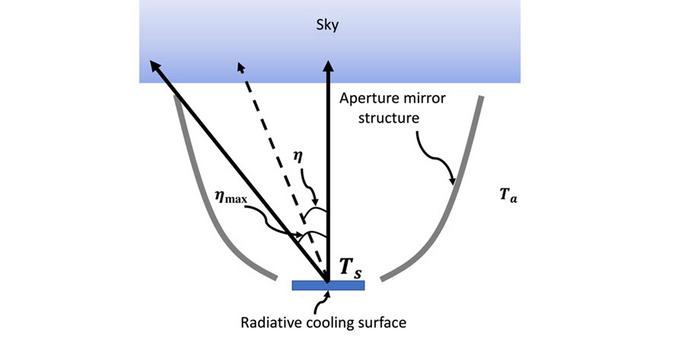
Recent research reported the Journal of Photonics for Energy (JPE) investigates a practical approach to enhancing radiative cooling: arranging a heat mirror structure around a radiative cooling surface to amplify the cooling effect. The mirror structure effectively guides the thermal radiation towards the most transmissive portion of the atmosphere, such that thermal radiation escapes the Earth most efficiently. This stronger cooling can bring down temperatures faster and widen options for designing cooling systems.
The principle is elegantly simple: the more the cooling surface faces upwards, the more cooling power it has. The mirror structure increases this power without needing to expand the surface area. Adding the mirror structure makes the cooling device take up more space for a given area, but this added space is protected from moving air, which helps block heat gain from air flow.
Through parametric simulation, Hwang demonstrates that the mirror structure can be particularly effective in cities, where buildings are close together and different heights can mean that not every building’s roof gets a full view of the sky. This mirror setup enhances radiative cooling by focusing the cooling surface’s view to a specific area in the sky above.
The potential benefits of using such a mirror structure appear to be significant especially for tropical areas, where cooling power may be boosted by more than 40 percent. According to author Jaesuk Hwang at the Centre for Quantum Technologies (National University of Singapore), “Radiative cooling is possible because the atmosphere is thin enough at some angles.” Hwang explains, “Arid regions allow a wider range of angles for thermal emission to transmit through the atmosphere than tropical regions, so redirecting thermal radiation upwards with a heat mirror structure is most effective in tropical climates, yet overall radiative cooling is stronger in dry climates.”
This simple approach for directing thermal energy could offer practical solutions to reduce temperatures and enhance the performance of radiative cooling for buildings, particularly in tropical regions where stagnant heat is a challenge.
For details, see the original article by Hwang, “Climate-dependent enhancement of radiative cooling with mirror structures,” J. Photon. Energy 14(2), 028001 (2024), doi 10.1117/1.JPE.14.028001.
Journal
Journal of Photonics for Energy
Article Title
Climate-dependent enhancement of radiative cooling with mirror structures
Article Publication Date
2-Apr-2024
Cite Scienmag News
Courtney Benton. (April 10, 2024). Enhancing radiative cooling with aperture mirror structures. Scienmag. https://scienmag.com/enhancing-radiative-cooling-with-aperture-mirror-structures/
Courtney Benton. "Enhancing radiative cooling with aperture mirror structures." Scienmag, 10 April 2024, https://scienmag.com/enhancing-radiative-cooling-with-aperture-mirror-structures/. Accessed 4 September 2026.
Courtney Benton. "Enhancing radiative cooling with aperture mirror structures." Scienmag. April 10, 2024. https://scienmag.com/enhancing-radiative-cooling-with-aperture-mirror-structures/

