


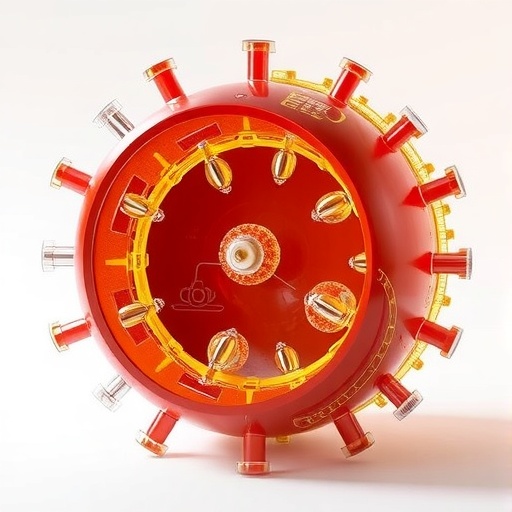
In the constantly evolving realm of biomedical engineering and analytical chemistry, researchers are making groundbreaking strides to enhance the way volatile organic compounds (VOCs) are studied in vitro. Leading this charge is a pioneering team who have introduced an innovative engineered culture vessel and flow system designed explicitly to optimize the analysis of VOCs emitted by biological samples. This cutting-edge platform promises to revolutionize how scientists detect, monitor, and understand volatile metabolites with impressive precision and reproducibility, overcoming long-standing technical barriers that have hampered VOC research in lab settings.
At the heart of this advancement lies the meticulously designed culture vessel, which integrates a dynamic flow system to simulate physiological conditions while capturing VOC emissions in real time. Traditional static culture environments often suffer from issues such as the accumulation of gases, inconsistent diffusion gradients, and suboptimal sample exposure to analytical instruments. This novel device circumvents these limitations by maintaining a controlled flow regime, ensuring that VOCs produced by cultured cells or tissues are promptly transported to detection components, thereby preserving their chemical integrity and temporal fidelity.
The technical sophistication of this system is rooted in its seamless material interface and modular design. Constructed from biocompatible polymers with low adsorption properties, the vessel minimizes background contamination and analyte loss, critical parameters when detecting compounds that may be present in trace amounts. Furthermore, its modular architecture allows easy customization and integration with various downstream analytical techniques, such as gas chromatography-mass spectrometry (GC-MS) and proton-transfer-reaction mass spectrometry (PTR-MS), enabling researchers to tailor the platform according to specific experimental needs.
Innovators behind this technology have emphasized the importance of controlling environmental variables, which are often overlooked but profoundly influence VOC profiles. The system’s capacity to regulate parameters such as temperature, humidity, and flow rate is not merely a convenience but a transformative feature that allows replication of physiological or pathological states in vitro. For instance, subtle changes in oxygen concentration or nutrient flow can trigger shifts in cellular metabolism, which are instantly reflected in the VOC signatures captured, providing an unprecedented window into cellular biochemistry.
Moreover, this engineered flow system addresses a critical bottleneck in VOC research: the challenge of maintaining cell viability and functionality over extended periods within closed environments. The continuous medium perfusion facilitated by the apparatus ensures that cells receive fresh nutrients and waste removal, thereby supporting prolonged studies. This ability opens new avenues for dynamic investigations, such as monitoring metabolic changes in response to drug treatments or environmental toxins through VOC emissions, which were previously arduous due to static culture constraints.
Data generated using this innovative setup reveals remarkable sensitivity and specificity in detecting volatile biomarkers associated with various physiological states and diseases. The precise quantitative measurements facilitated by rapid VOC removal from the culture environment enhance signal-to-noise ratios and reduce complications from secondary reactions or sample degradation. Such improvements elevate the potential of VOC analysis not only in fundamental research but also in translational applications like non-invasive disease diagnostics, personalized medicine, and environmental monitoring.
The implications of this technology extend into fields that rely heavily on VOC monitoring, including cancer research, neurology, and microbiology. For example, cancer cells produce distinct VOC profiles reflective of their altered metabolism and hypoxic microenvironments. The ability to culture tumor cells and continuously monitor their volatile emissions provides critical insights for early detection and therapeutic response evaluation. Similarly, in neuroscience, volatile metabolites released by neurons under stress or injury can be dynamically tracked, revealing novel biomarkers for neurodegenerative disorders.
From a microbiological perspective, the engineered vessel enables controlled cultivation of microbial communities while analyzing their VOC outputs, which are key indicators of microbial metabolism, interspecies communication, and environmental adaptations. Traditional static cultures frequently fail to replicate the complex flow and nutrient conditions microbes encounter in natural ecosystems. This flow system, by contrast, mimics physiological fluid dynamics, creating more representative conditions and thus more meaningful VOC data.
The development process involved extensive computational modeling and experimental validation to optimize fluid dynamics and diffusion characteristics within the vessel. Simulations guided the placement of inlet and outlet channels to minimize dead zones and ensure homogeneous distribution of media and gases. Empirical testing with standard compounds confirmed the system’s ability to maintain stable and reproducible VOC concentrations, reinforcing its suitability for quantitative analytical applications.
Another pivotal aspect is the system’s scalability and accessibility. The design is adaptable for both high-throughput screening and detailed mechanistic studies. Small-scale versions serve laboratories focused on precision medicine, while larger arrays enable pharmaceutical companies to utilize VOC profiling in drug discovery pipelines. Importantly, the simplicity and cost-effectiveness of fabrication processes ensure broader accessibility to the scientific community beyond specialized facilities.
The invention of this engineered culture vessel and flow system addresses a glaring need within the interdisciplinary community that bridges bioengineering, analytical chemistry, and cellular biology. By offering a robust platform that preserves the delicate balance of biochemical environments and enables finely tuned VOC sampling, it stands to transform experimental workflows and unlock new frontiers in our understanding of volatile biomarkers and cellular metabolism.
The collaborative effort driving this innovation exemplifies the power of converging expertise from diverse scientific disciplines. Such synergy has accomplished a feat whereby complex biological phenomena, once hidden behind technical constraints, are now quantifiable with enhanced clarity and temporal resolution. This breakthrough sets a precedent for future devices that integrate environmental control with real-time analytical capabilities, advancing precision medicine and biomarker discovery into a new era.
Looking forward, the research community is eagerly anticipating the integration of this system with emerging technologies, such as artificial intelligence-driven data analytics and microfluidic organ-on-a-chip platforms. These integrations promise to exponentially increase the analytical resolution and functional relevance of VOC analyses, potentially leading to personalized diagnostics that harness the volatile fingerprint of individual cellular responses.
In summation, the development of this innovative culture vessel coupled with a finely tuned flow system represents a landmark achievement that mitigates previous obstacles in the in vitro analysis of volatile organic compounds. Its ability to recreate physiological conditions, maintain cell viability, and capture dynamic VOC profiles with unprecedented accuracy will undoubtedly catalyze significant advances across multiple biomedical arenas. As this technology disseminates and matures, its impact on understanding, diagnosing, and treating human disease through non-invasive volatile biomarkers will become increasingly profound and far-reaching.
Cite Scienmag News
Denise Maddox. (September 24, 2025). Engineered Vessel Enhances In Vitro VOC Analysis. Scienmag. https://scienmag.com/engineered-vessel-enhances-in-vitro-voc-analysis/
Denise Maddox. "Engineered Vessel Enhances In Vitro VOC Analysis." Scienmag, 24 September 2025, https://scienmag.com/engineered-vessel-enhances-in-vitro-voc-analysis/. Accessed 5 September 2026.
Denise Maddox. "Engineered Vessel Enhances In Vitro VOC Analysis." Scienmag. September 24, 2025. https://scienmag.com/engineered-vessel-enhances-in-vitro-voc-analysis/


