


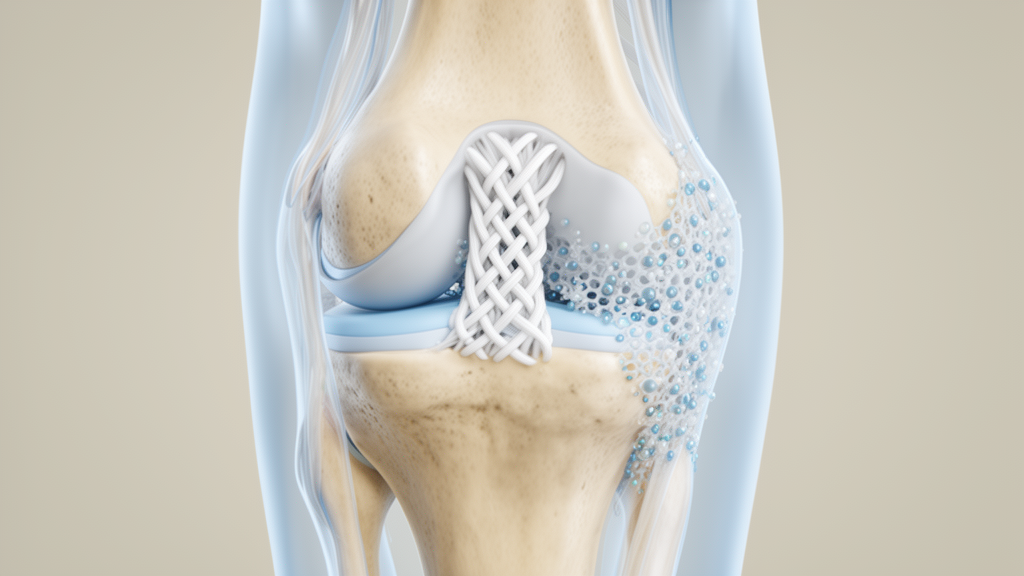
Anterior cruciate ligament tears are among the most feared injuries in sport, and the surgical gold standard for repairing them still relies on harvesting tissue from elsewhere in the patient’s own body. Now a systematic review published in Frontiers in Bioengineering and Biotechnology suggests that a new generation of engineered synthetic ligaments, built from the same polyester fiber used in existing artificial grafts but coated with bioactive materials, may finally be closing the gap between synthetic implants and living tissue. The review, conducted by researchers at Humanitas University and the University of L’Aquila in Italy, analyzed seventeen preclinical studies published since 2010 and found that surface-modified polyethylene terephthalate (PET) scaffolds consistently outperformed their unmodified counterparts in both biological integration and post-implantation mechanical strength.
The problem the researchers set out to address is a fundamental one. Autografts, the tissue harvested from a patient’s own hamstring, quadriceps, or patellar tendon, remain the preferred choice for anterior cruciate ligament reconstruction because they reliably incorporate into the body and produce strong long-term outcomes. But they come with real costs: donor-site morbidity, limited tissue availability, prolonged rehabilitation, and postoperative pain. Allografts, tissue from cadavers, eliminate the donor-site problem but introduce concerns about slower biological incorporation, tissue availability, and potential immunological or infectious complications. Synthetic grafts made from PET, such as the Ligament Advanced Reinforcement System (LARS), were designed to sidestep these issues entirely by providing immediate mechanical stability without requiring any donor tissue at all.
Yet PET has a critical flaw. The material is intrinsically bioinert, meaning its hydrophobic and chemically unreactive surface resists protein adsorption, cellular attachment, and tissue ingrowth. First-generation synthetic ligaments built from PET and similar polymers were largely abandoned after high rates of mechanical failure, wear debris generation, chronic synovitis, and degenerative joint changes. Even the LARS system, which remains the most widely used and clinically investigated PET-based device, has shown encouraging short- to mid-term results but faces persistent questions about long-term biological incorporation. The surface of PET simply does not invite the body’s cells to attach, proliferate, and build new tissue the way a natural ligament does.
The Italian research team, led by Luca Bertolino and colleagues, conducted their systematic review according to the PRISMA 2020 guidelines, searching PubMed, Embase, and Web of Science up to August 20, 2026. They included only original research articles investigating chemically or biologically modified PET grafts for ACL reconstruction that reported in vitro cellular outcomes, in vivo animal model data, and mechanical properties. Two independent reviewers performed screening, full-text assessment, and data extraction. From an initial pool of 83 records, 36 duplicates were removed, 47 articles were screened by title and abstract, 27 underwent full-text inspection, and 17 ultimately met all inclusion criteria.
The functionalization strategies identified across these studies fell into four broad categories. Physical deposition methods, described in three studies, included pulsed laser deposition of bioactive glass nanocoatings and plasma spraying of hydroxyapatite particles onto the PET surface. Chemical surface modifications, the largest category with seven studies, ranged from layer-by-layer electrostatic assembly of hyaluronic acid and cationized gelatin multilayers to ozonation-induced graft polymerization of polystyrene sodium sulfonate, graphene transfer via a poly(methyl methacrylate)-assisted process, collagen coating with simvastatin-loaded microspheres, silk fibroin crosslinking, and polydopamine interlayer formation with subsequent BMP-2 immobilization. Biomimetic mineral coatings, described in five studies, involved hydroxyapatite deposition through alternate soaking, electrodeposited calcium phosphate, and strontium-substituted hydroxyapatite nanoparticles synthesized via microwave-hydrothermal reaction. A single study took a hybrid approach, combining electrospun polycaprolactone nanofibrous membranes loaded with BMP-7 with a PET mesh fabric rolled into a multilayered structure.
Across all seventeen studies, the functionalized PET scaffolds demonstrated improved performance compared with unmodified PET controls. In vitro, the modified surfaces showed enhanced cellular proliferation, upregulation of osteogenic markers including alkaline phosphatase, RUNX2, BMP-2, osteocalcin, osteopontin, and collagen type I, and increased angiogenic activity marked by elevated vascular endothelial growth factor expression. Surface characterization confirmed that the functionalization techniques consistently increased surface roughness and hydrophilicity, with water contact angles dropping from approximately 115 degrees on pristine PET to as low as 30 degrees on some coated scaffolds. These physicochemical changes facilitate protein adsorption and integrin-mediated cell adhesion, which the authors identify as the first critical step in establishing a regenerative microenvironment at the graft-bone interface.
The in vivo evidence, drawn from 726 animals across the included studies, painted a consistent picture of improved graft-bone integration. Micro-computed tomography revealed higher bone volume fraction at the graft-bone interface in functionalized groups, with some studies reporting bone volume fractions more than doubling compared with unmodified PET. Bone tunnel areas were consistently smaller in the functionalized groups, indicating reduced bone resorption around the implant. Histological analysis showed narrower graft-bone interface widths, with some coatings reducing the fibrous tissue layer from over 400 micrometers to under 100 micrometers by twelve weeks post-implantation. One study using a copper-containing bioactive glass coating reported new bone width of 52 micrometers at the interface compared with just 4 micrometers for unmodified PET at the same time point.
Mechanical testing generally favored the functionalized scaffolds as well, though the improvements were measured after implantation rather than before, suggesting that the gains came from enhanced biological fixation rather than from any change in the intrinsic material properties. Ultimate load to failure increased by as much as 2.7-fold in some comparisons, with one study reporting 502 newtons for a hydroxypropylcellulose-coated graft versus 183 newtons for unmodified PET at sixteen weeks in beagle dogs. Stiffness values similarly favored the modified grafts. However, when compared directly with the native anterior cruciate ligament, even the best-performing functionalized PET scaffolds fell short, reaching approximately 70 percent of native ACL strength and 46 percent of native ACL stiffness in the studies that made such comparisons.
The authors emphasize that these findings should be interpreted with significant caution. The SYRCLE risk of bias assessment revealed that all seventeen studies were rated as having an unclear or high risk of bias for most methodological domains, with none reporting adequate blinding of caregivers and investigators. The animal models were predominantly New Zealand rabbits, which accounted for 82 percent of all animals studied, with only limited use of larger species such as goats, sheep, dogs, and pigs that more closely approximate human knee anatomy and loading conditions. Outcome reporting was inconsistent, with key parameters such as ligamentization and angiogenesis assessed in only a small subset of studies using non-standardized methods. The substantial heterogeneity in functionalization techniques, animal models, follow-up durations, and outcome measures prevented any meta-analysis and made it impossible to determine which specific coating strategy was most effective.
Despite these limitations, the review establishes an important proof of concept. Surface biofunctionalization, rather than the base material itself, appears to be the key determinant of scaffold performance in ACL reconstruction. The consistent pattern of improvements across diverse coating strategies suggests that the biological inertness of PET can be effectively addressed regardless of the specific technique employed, since host tissue response is closely tied to surface properties. The authors propose that next-generation synthetic ligaments should be designed as multifunctional systems with spatially controlled functionalization, allowing the bone-facing portion of the scaffold to promote osteointegration while maintaining an appropriate biological environment for ligament tissue formation along the intra-articular portion. Before clinical translation, however, the field will need standardized experimental protocols, harmonized outcome measures, larger animal models with longer follow-up periods, and ultimately well-designed clinical studies to determine whether the biological and biomechanical advantages observed in preclinical models translate into improved patient outcomes.
Subject of Research: Surface functionalization of polyethylene terephthalate scaffolds for anterior cruciate ligament reconstruction
Article Title: Surface engineering strategies for PET-Based ligament scaffolds in anterior cruciate ligament reconstruction: a systematic review of mechanical and biological performances
Article References: Bertolino, L., Picchi, A., Resta, S., Oliva, P., Fidanza, A., & Bonanzinga, T. (2026). Surface engineering strategies for PET-Based ligament scaffolds in anterior cruciate ligament reconstruction: a systematic review of mechanical and biological performances. Frontiers in Bioengineering and Biotechnology, 14, Article 1916072. https://doi.org/10.3389/fbioe.2026.1916072
Image Credits: AI Generated
DOI: 10.3389/fbioe.2026.1916072
Keywords: ACL reconstruction, PET scaffolds, surface functionalization, synthetic ligaments, tissue engineering, hydroxyapatite coating, graft-bone integration, osseointegration, biomaterials, LARS, preclinical studies, ligamentization
Cite Scienmag News
Denise Maddox. (October 16, 2026). Engineered PET Scaffolds Show Promise for Synthetic ACL Reconstruction. Scienmag. https://scienmag.com/engineered-pet-scaffolds-show-promise-for-synthetic-acl-reconstruction/
Denise Maddox. "Engineered PET Scaffolds Show Promise for Synthetic ACL Reconstruction." Scienmag, 16 October 2026, https://scienmag.com/engineered-pet-scaffolds-show-promise-for-synthetic-acl-reconstruction/. Accessed 16 October 2026.
Denise Maddox. "Engineered PET Scaffolds Show Promise for Synthetic ACL Reconstruction." Scienmag. October 16, 2026. https://scienmag.com/engineered-pet-scaffolds-show-promise-for-synthetic-acl-reconstruction/


