


Antibiotics have quietly propped up one of biotechnology’s most fundamental tools for decades. Whenever scientists want a population of bacteria to carry a plasmid—the circular piece of DNA that serves as the blueprint for producing a drug, an enzyme, or an industrial chemical—they have traditionally relied on antibiotic resistance genes to kill off any cell that dares to lose the payload. Now, a team at Gen-H Genetic Engineering Heidelberg GmbH has demonstrated a way to make this selection pressure work without a single molecule of antibiotic, and they have proven the approach works not just in the lab but at a staggering 10,000-liter manufacturing scale.
The method, called inducible complementation, hinges on a deceptively simple genetic trick. The researchers took an essential gene in the production strain—infA, which encodes translation initiation factor 1, a protein so fundamental that the cell cannot survive without it—and replaced its natural promoter with an inducible one controlled by the arabinose system. When arabinose is present, the genomic copy fires and the cell grows happily without any plasmid. When arabinose is absent, the only way the cell can produce this essential factor is if it carries a plasmid bearing a functional infA gene. In other words, the absence of a cheap sugar additive becomes the selection pressure itself, replacing antibiotics entirely.
What makes this approach particularly elegant is the flexibility it preserves. Earlier complementation strategies have existed for years, using essential genes like dapD, glyA, proAB, or leuABCD to force plasmid retention. But these systems come with a cumbersome catch: because the engineered strain cannot survive without the complementing plasmid, generating new strain-plasmid combinations requires either repetitive genome engineering or a helper plasmid, unless the strain can be rescued by adding a specific nutrient to the media. That rescue route, however, opens the door to cross-feeding, where nutrients leak between cells and undermine the selection pressure. The inducible system sidesteps this problem entirely—researchers simply add arabinose when they want to propagate the plasmid-free strain, then remove it when they want selection to kick in.
In the new study, published in Frontiers in Industrial Microbiology, the team extended this technology across a phylogenetically diverse panel of industrially relevant Escherichia coli strains. They engineered strains from the K-12, B, and W phylogenetic groups, as well as the probiotic strain Nissle 1917, which holds GRAS (Generally Recognized As Safe) status and has been used to treat gastrointestinal disorders. E. coli W is particularly notable in industrial settings because it is the only common laboratory strain capable of metabolizing sucrose, a preferred carbon source for large-scale bioprocesses. The researchers also included T7-expression strains like BL21(DE3) and a derivative of HMS174(DE3), workhorses of recombinant protein production.
To test whether the system could hold up under real production conditions, the researchers subjected the engineered strains to a battery of plasmid maintenance assays. They transformed each strain with a model plasmid carrying a constitutively expressed chromoprotein—a fusion of two fluorescent proteins that makes plasmid-bearing cells visibly pigmented—and then grew the cultures in plain LB medium without any antibiotics or arabinose for 24 hours. When they plated the resulting cultures on different media, the unmodified strains showed clear signs of plasmid loss, with white colonies appearing among the pigmented ones. The infA-engineered strains, by contrast, maintained uniform pigmentation across all conditions, indicating tight plasmid retention despite the heavy metabolic burden imposed by the chromoprotein.
The team then pushed the system harder with an extended trial designed to mimic longer fermentations. They grew cultures for 96 hours with passaging every 24 hours, then streaked them to isolate individual colonies. Every single colony from the infA-modified strains contained plasmid. No mutants capable of proliferating without the plasmid were recovered, even in strains where the arabinose promoter might theoretically be prone to leaky expression. The researchers had anticipated this possibility and built in safeguards: during strain construction, they integrated a backup copy of the araC regulator adjacent to the inducible promoter, ensuring tight repression in the uninduced state. They also confirmed by PCR and restriction analysis that the plasmid had not integrated into the genome, ruling out one potential bypass mechanism.
Growth rates and protein production told an equally encouraging story. When the researchers compared the specific growth rates of engineered and unmodified strain pairs using low-copy plasmids that differed only in their selection cassettes, they found no statistically significant differences. The engineered strains grew just as fast as their wild-type counterparts. Protein expression levels, measured with both constitutive and inducible fluorescent reporters, were similarly comparable across all strain pairs. In fact, when the team examined T7-driven expression of a fluorescent protein, they observed something striking: the antibiotic-free cultures actually outperformed the antibiotic-selected ones, maintaining higher plasmid retention and producing more product.
This counterintuitive result makes sense when you consider what happens to antibiotics during a fermentation. The wild-type cultures in the T7 expression experiment were supplemented with chloramphenicol, but the researchers found that plasmid-free cells still emerged and proliferated. The likely culprit is that the antibiotic concentration subsides over time as plasmid-bearing cells acetylate and inactivate the drug, eroding the selection pressure precisely when it is needed most—during the metabolically taxing phase of protein production. The infA-based system, by contrast, requires no media supplementation at all, so the selection pressure remains constant throughout the fermentation regardless of what the cells are doing to their environment.
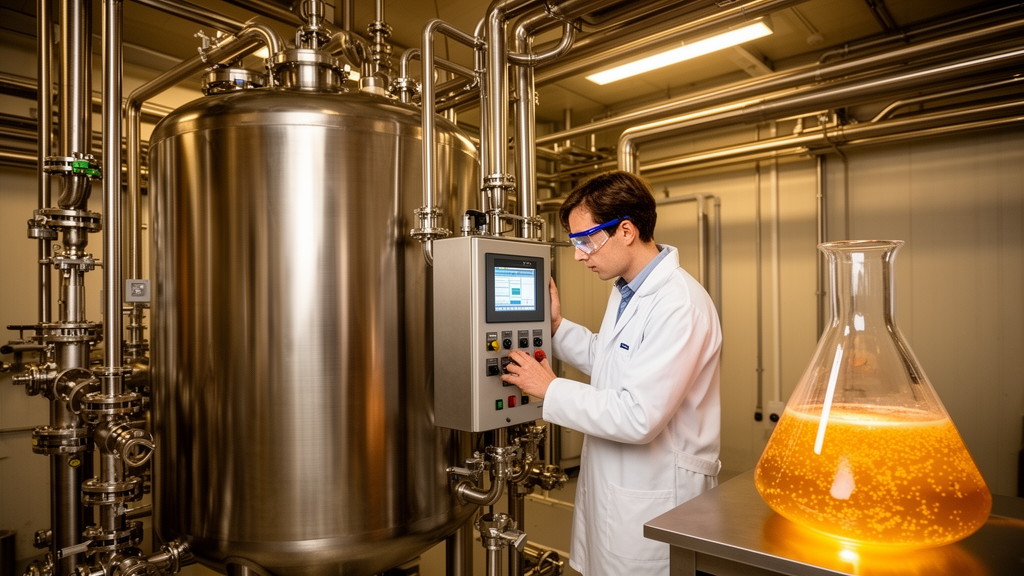
The real test came at manufacturing scale. The team took their engineered BL21(DE3)-infA strain and used it to produce an undisclosed enzyme with application in food, first at 3-liter scale, then scaling up to 750 liters, and finally to 10,000 liters—a volume that places this firmly in commercial production territory. The downstream processing, involving homogenization, centrifugation, ultrafiltration, diafiltration, and bactofiltration, proceeded without modification. Product yields and specific activities were comparable between the antibiotic-free and antibiotic-selected fermentations, with the antibiotic-free process actually showing slightly higher specific activity at the 750-liter scale.
Beyond the technical performance, the regulatory and environmental implications are substantial. The European Medicines Agency has stated that any additional proteins expressed from vectors, including antibiotic resistance factors, should be analyzed and their presence justified in products derived from genetically modified cells. Eliminating antibiotic resistance genes from both the plasmid and the strain simplifies compliance considerably. The modified strains contain no foreign DNA—the integrated regulatory sequence is of E. coli origin—so no new regulatory concerns would be expected to arise. Combined with the elimination of antibiotic costs, purification steps to remove residual drugs, and wastewater pre-treatment to prevent environmental contamination, the technology offers a greener and more cost-efficient path forward for plasmid-based biomanufacturing at a time when antimicrobial resistance is projected to cause up to 10 million annual deaths by 2050 without intervention.
Subject of Research: Antibiotic-free plasmid maintenance in industrial E. coli strains using inducible complementation of the essential gene infA
Article Title: Inducible complementation for antibiotic-free plasmid-based biomanufacturing in industrially relevant strains
Article References: Brechun, K. E., Förschle, M., Schmidt, M., & Kranz, H. (2026). Inducible complementation for antibiotic-free plasmid-based biomanufacturing in industrially relevant strains. Frontiers in Industrial Microbiology, 3, Article 1725733. https://doi.org/10.3389/finmi.2025.1725733
Image Credits: AI Generated
DOI: 10.3389/finmi.2025.1725733
Keywords: antibiotic-free plasmid maintenance, Escherichia coli, inducible complementation, infA, biomanufacturing, fermentation, plasmid stability, genome engineering, antimicrobial resistance, industrial biotechnology, protein expression, scale-up
Cite Scienmag News
Juliet Wilcox. (October 16, 2026). Engineered E. coli Strains Keep Plasmids Without Antibiotics, Scaling to 10,000 Liters. Scienmag. https://scienmag.com/engineered-e-coli-strains-keep-plasmids-without-antibiotics-scaling-to-10000-liters/
Juliet Wilcox. "Engineered E. coli Strains Keep Plasmids Without Antibiotics, Scaling to 10,000 Liters." Scienmag, 16 October 2026, https://scienmag.com/engineered-e-coli-strains-keep-plasmids-without-antibiotics-scaling-to-10000-liters/. Accessed 16 October 2026.
Juliet Wilcox. "Engineered E. coli Strains Keep Plasmids Without Antibiotics, Scaling to 10,000 Liters." Scienmag. October 16, 2026. https://scienmag.com/engineered-e-coli-strains-keep-plasmids-without-antibiotics-scaling-to-10000-liters/


