


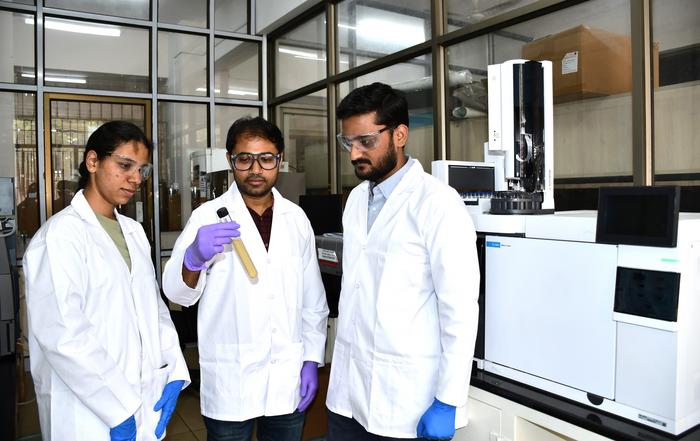
Researchers at the Department of Inorganic and Physical Chemistry (IPC), Indian Institute of Science (IISc), have developed an enzymatic platform that can efficiently transform naturally abundant and inexpensive fatty acids to valuable hydrocarbons called 1-alkenes, which are promising biofuels.

Credit: Jayaprakash K
Researchers at the Department of Inorganic and Physical Chemistry (IPC), Indian Institute of Science (IISc), have developed an enzymatic platform that can efficiently transform naturally abundant and inexpensive fatty acids to valuable hydrocarbons called 1-alkenes, which are promising biofuels.
Given the finite availability and polluting nature of fossil fuels, scientists are increasingly exploring sustainable fuel pathways that involve compounds called hydrocarbons. They show great potential as “drop-in” biofuels, which can be blended and used with existing fuels and infrastructure. These hydrocarbons can potentially be synthesised on a large scale using microorganism “factories”. Enzymes that help mass-produce these hydrocarbons are therefore highly sought after. Hydrocarbons are also widely used in polymer, detergent and lubricant industries.
In a previous study, the IISc team purified and characterised an enzyme called UndB, bound to the membranes of living cells, especially certain bacteria. It can convert fatty acids to 1-alkenes at the fastest rate currently possible. But the team found that the process was not very efficient – the enzyme would become inactivated after just a few cycles. When they investigated further, they realised that H2O2 – a byproduct of the reaction process – was inhibiting UndB.
In the current study published in Science Advances, the team circumvented this challenge by adding another enzyme called catalase to the reaction mix. “The catalase degrades the H2O2 that is produced,” explains Tabish Iqbal, first author of the study and PhD student at IPC. Adding catalase, he says, enhanced the activity of the enzyme 19-fold, from 14 to 265 turnovers (turnover indicates the number of active cycles an enzyme completes before getting inactivated).
Excited by this finding, the team decided to create an artificial fusion protein combining UndB with catalase, by introducing a fused genetic code via carriers called plasmids into E. coli bacteria. Given the right conditions, these E. coli would then act as a “whole cell biocatalyst”, converting fatty acids and churning out alkenes.
However, there were several challenges. Being a membrane protein, UndB is extremely challenging to work with. Beyond a certain concentration, it can be toxic to bacterial cells. Membrane proteins like UndB are also not soluble in water, making it hard to maintain the right conditions for studying them.
To improve the efficiency of their chimeric protein, the team tested the effect of various “redox partner” proteins that help shuttle electrons to UndB during the conversion of fatty acids to alkenes. They found that proteins called ferredoxin and ferredoxin reductase, along with nicotinamide adenine dinucleotide phosphate (NADPH), were able to supply electrons most efficiently. On incorporating these in the genetically modified E. coli and feeding fatty acids, the efficiency of conversion rose up to 95%.
A key advantage of this biocatalyst is that UndB is very specific and does not produce any unwanted side products – pure 1-alkene is the only product, says Debasis Das, Assistant Professor at IPC and corresponding author. “1-alkenes can directly be used as biofuels,” he adds.
The team found that their biocatalyst could convert a wide range of fatty acids containing different types of carbon chains to 1-alkene. They also showed that the biocatalyst can produce styrene, an important commodity in chemical and polymer industries.
The team has applied for a patent for their engineered protein and whole cell biocatalyst. They are also looking for industry collaborators to scale up the platform for mass-production.
“Our platform can be efficiently used to generate a large number of 1-alkenes that are valuable in biotechnology and polymer industries,” says Das.
Journal
Science Advances
Article Title
A Chimeric Membrane Enzyme and an Engineered Whole-cell Biocatalyst for Efficient 1-Alkene Production
Article Publication Date
26-Jun-2024
Cite Scienmag News
Denise Maddox. (June 28, 2024). Engineered biocatalyst for making “drop-in” biofuels. Scienmag. https://scienmag.com/engineered-biocatalyst-for-making-drop-in-biofuels/
Denise Maddox. "Engineered biocatalyst for making “drop-in” biofuels." Scienmag, 28 June 2024, https://scienmag.com/engineered-biocatalyst-for-making-drop-in-biofuels/. Accessed 9 September 2026.
Denise Maddox. "Engineered biocatalyst for making “drop-in” biofuels." Scienmag. June 28, 2024. https://scienmag.com/engineered-biocatalyst-for-making-drop-in-biofuels/

