


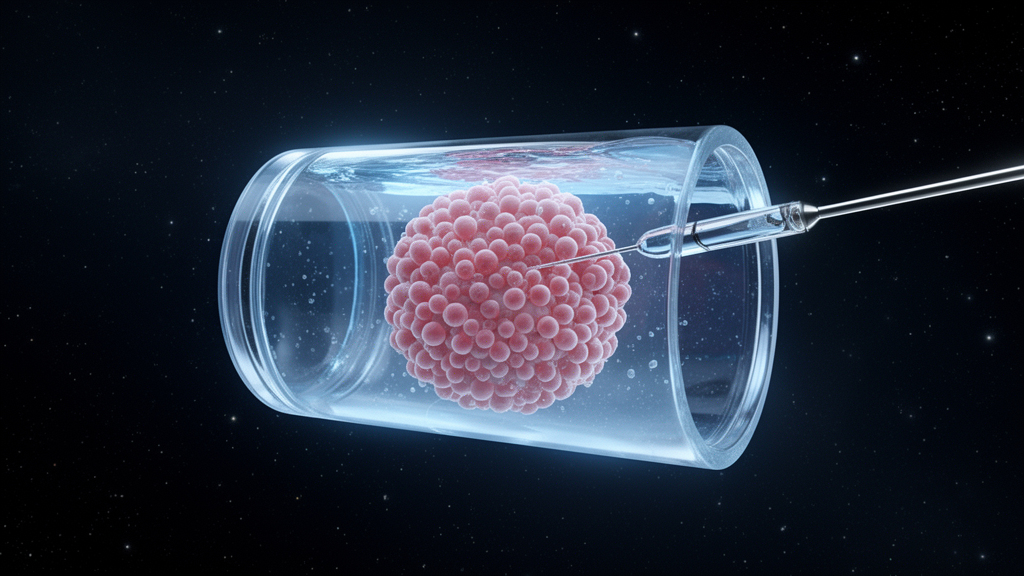
Researchers from the Wake Forest Institute for Regenerative Medicine (WFIRM) have launched a study aboard the International Space Station to investigate how microgravity influences the response of colorectal cancer models to chemotherapy. The project, known as Tumor Avatars in Space (TAVIS), launched on October 13 aboard a NASA mission from Cape Canaveral Space Force Station in Florida. The primary objective of this investigation is to determine whether the space environment alters the effectiveness of standard chemotherapy treatments in tumor models, with the aim of applying these insights to improve cancer patient care on Earth. By studying these biological processes in an environment that cannot be reproduced on Earth, the team hopes to gain new insights into tumor biology and treatment response that may ultimately benefit patients.
The study utilizes tumor organoids, which are small replicas of tumors grown in the laboratory from cancer cells obtained from patients with colorectal cancer. These organoids serve as stand-ins, or avatars, for the patients’ actual tumors. For the TAVIS project, WFIRM scientists built these models to test how chemotherapy drugs affect the tumor cells.
Shay Soker, Ph.D., a WFIRM professor and the principal investigator of the study, explained the rationale behind the experiment. If microgravity makes these tumors more responsive, we can look for the genetic changes behind that and try to induce the same changes here on Earth, Soker said. He noted that the approach is similar in spirit to immunotherapy, which makes tumors more visible to the immune system.
Colorectal cancer is one of the most diagnosed cancers in the United States, and chemotherapy remains a mainstay of treatment. However, how well chemotherapy works varies significantly from person to person. Many patients whose tumors respond poorly to standard doses could potentially benefit from higher doses, but these higher doses are often not possible due to severe side effects.
In the TAVIS experiment, the organoids are being studied by astronaut researchers in space to observe how cancer cells change their response to chemotherapy in microgravity. A matching control group of organoids is being treated on Earth to provide a direct comparison. Once the samples return to Earth later this month, WFIRM researchers will compare how the two groups responded to the chemotherapy treatments.
If the treatment proves effective in microgravity, the team will look for genetic factors, such as changes in cancer cell metabolism, that may be responsible for the difference in response. Researchers would then try to reproduce those changes on Earth by manipulating the same genes and cellular pathways.
If the team identifies genetic changes that make tumors more responsive, the next step would be to identify small-molecule drugs that can induce those genetic changes. The goal is to combine these drugs with chemotherapy to make the treatment more effective at lower, better-tolerated doses.
The TAVIS investigation is one of several WFIRM studies using the International Space Station as a research platform. These projects explore how the space environment influences biological systems and whether those insights can be applied to address challenges in human health.
Anthony Atala, M.D., director of WFIRM and co-principal investigator of the study, emphasized the importance of the space environment for this research. The International Space Station provides a unique research environment that allows us to study biological processes under conditions that cannot be reproduced on Earth, Atala said.
TAVIS is a partnership with BioServe Space Technologies at the University of Colorado Boulder and with Axiom Space. The project is funded by the Center for the Advancement of Science in Space (CASIS), which manages the International Space Station National Laboratory. The project was selected through the space station’s National Lab’s Igniting Innovation collaboration with NASA’s Biological and Physical Sciences Division.
The program supports research that uses the space environment to address challenges in human health. TAVIS was selected for its potential to improve understanding of cancer biology and treatment response through research conducted in the unique environment of space.
Wake Forest Institute for Regenerative Medicine (WFIRM) is recognized as an international leader in scientific discovery and its translation into clinical therapies. The institute has achieved many world firsts, including the development of the first permanently implanted engineered organ in a human. Other firsts include discovering a novel source of highly multipotent stem cells from amniotic fluid and placenta now used clinically, and advancing 3D printing methods to manufacture tissues and organs.
WFIRM researchers have successfully engineered replacement tissues and organs in all four categories, including flat structures, tubular tissues, hollow organs, and solid organs. Additionally, 18 different applications of cell and tissue therapy technologies, such as skin, urethras, cartilage, bladders, muscle, kidney, and vaginal organs, have been successfully used in human patients. The institute, which is part of Wake Forest University School of Medicine, is driven by the urgent needs of patients and is making a global difference in regenerative medicine through collaborations with over 600 entities and institutions worldwide.
The Center for the Advancement of Science in Space, which manages the National Laboratory, selected the project through its Igniting Innovation collaboration with NASA’s Biological and Physical Sciences Division.
The experimental design relies on a direct comparison between the space-based samples and a matching control group treated on Earth. Once the samples return to Earth later this month, researchers will analyze the differences in response between the two groups to determine if microgravity influences chemotherapy effectiveness.
If the data indicates that tumors become more responsive to chemotherapy in microgravity, the research team will investigate the underlying genetic mechanisms. This phase of the study involves looking for specific changes in cancer cell metabolism or other genetic factors that may drive the altered response. The ultimate objective is to identify these genetic changes so that they can be reproduced on Earth through targeted manipulation of genes and cellular pathways.
The long-term goal of the TAVIS project is to develop small-molecule drugs that can induce the same genetic changes observed in space. By combining these potential drugs with standard chemotherapy, the team aims to enhance treatment effectiveness at lower doses. This strategy seeks to address the common clinical challenge where higher chemotherapy doses are limited by severe side effects.
Subject of Research: Microgravity effects on colorectal cancer chemotherapy response in space
Article Title: Wake Forest Institute for Regenerative Medicine research aboard International Space Station examines chemotherapy effectiveness
Article References: Wake Forest Institute for Regenerative Medicine research aboard International Space Station examines chemotherapy effectiveness. Original publication (Bibliographic details unavailable.)
Image Credits: AI Generated
DOI: Not provided
Keywords: International Space Station, colorectal cancer, chemotherapy, microgravity, tumor organoids, Wake Forest Institute for Regenerative Medicine, cancer research, space medicine, treatment response, biological systems, Wake, Forest
Cite Scienmag News
Nathaniel Bowman. (November 9, 2026). Space Station Study Tests Cancer Model Chemotherapy Response. Scienmag. https://scienmag.com/space-station-study-tests-cancer-model-chemotherapy-response/
Nathaniel Bowman. "Space Station Study Tests Cancer Model Chemotherapy Response." Scienmag, 9 November 2026, https://scienmag.com/space-station-study-tests-cancer-model-chemotherapy-response/. Accessed 22 November 2026.
Nathaniel Bowman. "Space Station Study Tests Cancer Model Chemotherapy Response." Scienmag. November 9, 2026. https://scienmag.com/space-station-study-tests-cancer-model-chemotherapy-response/




