


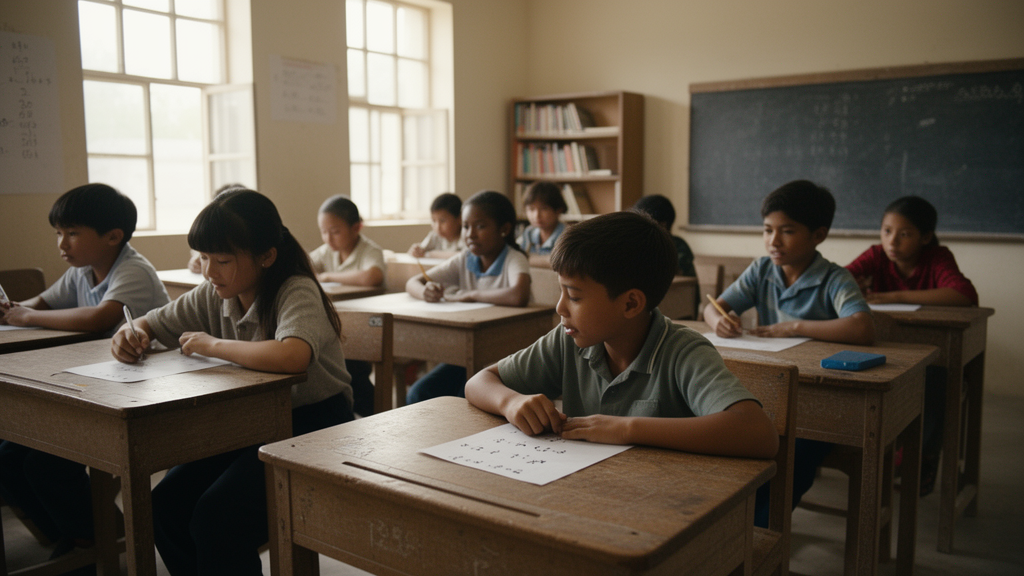
A qualitative case study conducted in rural secondary schools in Yucatán, Mexico, reveals that while male and female students participate in mathematics classes with broadly similar overall frequencies, they experience significantly different types of epistemic access. The research, published in Discover Education, examines how opportunities to engage with mathematical knowledge are distributed by gender within classroom interactions. The findings indicate that gender differentiation is not visible in the aggregate volume of participation but emerges in specific interactional categories, such as how teachers invite students to speak, how they recognize contributions, and how they authorize or disauthorize students as mathematical knowers.
Epistemic access in mathematics education refers to more than physical presence or verbal participation. It encompasses the opportunities students have to contribute to the production, interpretation, and justification of mathematical meaning. The study distinguishes between observable involvement and participation that carries epistemic consequences for the collective activity. A student may answer questions frequently yet have little opportunity to introduce strategies, develop explanations, or influence subsequent mathematical reasoning. Conversely, a single contribution may become epistemically consequential if it is taken up, elaborated, evaluated, or incorporated into the collective work of the classroom.
The study employed a qualitative–interpretive case study design to observe naturally occurring classroom interaction. Researchers analyzed six mathematics classrooms from three public rural secondary schools in Yucatán, Mexico. The participants included over 103 students, comprising 58 males and 45 females, enrolled in grades 7 to 9. The students ranged in age from 12 to 14 years, and the group sizes varied from 13 to 20 students. The six classrooms were taught by six teachers, two women and four men, with teaching experience ranging from 8 to 31 years. The lessons covered diverse mathematical topics, including analysis of tables and graphs, progressions, mean, median, mode, area, perimeter, and equation solving.
Data collection relied on video recordings of entire lessons and structured anecdotal records that documented situated events, student positioning, and contextual conditions. The primary analytic instrument was a theory-informed observational coding framework comprising three analytic areas: Discursive Regulation, Epistemic Positioning, and Organization of Participation. This framework included 16 specific observational categories, such as Invitation, Omission, Recognition, Disauthorization, and Leadership Allocation. The coding scheme was pilot-tested and reviewed by expert judges to ensure conceptual clarity and operational consistency before the final analysis.
For the analysis, three five-minute segments were selected from each video recording to represent the opening, middle, and closing phases of instruction. This sampling strategy allowed for intensive examination of interaction while retaining instructional context. Each segment was coded for interactional events relevant to epistemic access. Because a single event could contain multiple manifestations, each category assignment was treated as a distinct coded manifestation. The analysis included descriptive, comparative, and integrative procedures, calculating frequencies and proportional distributions for the analytic areas and categories. Gender comparisons focused on manifestations involving identifiable female or male students, excluding group interactions or teacher-level events.
At the aggregate level, the distribution of epistemic access manifestations was similar for both genders. Discursive Regulation accounted for the largest proportion of coded manifestations, representing 65.8% of the total, followed by Epistemic Positioning at 22.1% and Organization of Participation at 12.1%. All three areas were observed in every classroom and across all lesson segments. When disaggregated by gender, female students showed a 62.7% distribution in Discursive Regulation, while male students showed 63.4%. Epistemic Positioning represented 25.5% for females and 23.7% for males, and Organization of Participation was 11.8% for females and 13.0% for males. These similar proportions suggest that overall participation volume does not reveal the underlying gendered dynamics of the classroom.
However, clearer gender differences emerged in the duration of direct teacher–student interaction time. Across the six classrooms, 66.2% of the recorded interaction time involved male students, while 33.8% involved female students. Male students accounted for a greater proportion of interaction time in five of the six classrooms, although the magnitude of this difference varied. In one classroom, the pattern was reversed, with a greater proportion of interaction time involving female students. This disparity in interaction time indicates that access to teacher attention is not equally distributed, providing a quantitative basis for examining how participation opportunities are sustained through teacher practices.
Substantial differences also appeared at the level of specific observational categories. Within Discursive Regulation, female students showed a higher proportional presence in Omission, with 23.4% of their manifestations falling into this category, compared to 13.3% for male students. In contrast, Invitation was more prominent among male students, accounting for 13.3% of their manifestations versus 3.1% for female students. Within Epistemic Positioning, the differences were more pronounced. Disauthorization accounted for 50.0% of the manifestations involving female students, compared to 22.6% among male students. Conversely, Recognition represented 29.0% of male epistemic-positioning manifestations but only 3.8% of those involving female students. These findings highlight that female students were more frequently omitted from exchanges or disauthorized as knowers, while male students were more often invited to participate and recognized for their contributions.
In the Organization of Participation area, Restricted Collaboration was proportionally more prominent among female students, representing 41.7% of their manifestations in this area, compared to 23.5% for male students. Leadership Allocation, however, was more prominent among male students, accounting for 64.7% of their manifestations versus 50.0% for female students. This distinction matters because epistemic access depends on the positions students occupy within collective mathematical activity. Restricted collaboration may limit the range of peers and exchanges through which students participate, whereas leadership allocation can position particular students as recurring reference points for advancing the activity.
The study identifies recurrent configurations of gender-differentiated epistemic access that are not visible at the level of the broad analytic areas alone. Categories such as Reinforcement, Student Presence, and Legitimation were recurrent across classrooms but showed similar distributions for both genders, indicating that recurrence alone does not constitute evidence of gender differentiation. In contrast, Omission and Disauthorization combined broad recurrence with greater proportional presence among female students, while Invitation and Leadership Allocation were more prominent among male students. The convergence of these patterns across Discursive Regulation, Epistemic Positioning, and Organization of Participation suggests that gender-differentiated epistemic access is a configuration of interactional opportunities rather than a result of a single practice.
The proposed model of gender-differentiated epistemic access situates these differences at the intersection of the three analytic dimensions. It does not imply a causal or sequential relationship among the dimensions but represents how differences across them may converge in recurrent configurations. The model shifts attention from isolated interactional events to the recurrent configuration of epistemic opportunities across classroom activity. Gender differentiation may remain unobtrusive when participation is considered at an aggregate level but becomes visible when the regulation, recognition, and organization of participation are examined together.
The findings are limited by the specific context of the study, which involved six rural secondary classrooms in Yucatán, Mexico. The researchers emphasize that the rural setting is the empirical context rather than an explanatory variable for the observed gender differentiation. The use of three five-minute segments per lesson provided equivalent observation windows but did not capture every interaction occurring during the complete lesson. The analyses were descriptive and integrative, meaning the resulting configurations should not be interpreted as causal sequences. The study provides evidence of gender-differentiated epistemic access in this specific context, highlighting the need for further research in other educational settings to assess the transferability of these patterns.
Subject of Research: Gender differences in epistemic access in rural secondary mathematics classrooms
Article Title: Gender differences in epistemic access in rural secondary mathematics classrooms
Article References: Gómez Pérez, O. I., & Pinto Sosa, J. E. (2026). Gender differences in epistemic access in rural secondary mathematics classrooms. Discover Education, 5(1), Article 1312. https://doi.org/10.1007/s44217-026-02378-w
Image Credits: AI Generated
DOI: 10.1007/s44217-026-02378-w
Keywords: epistemic access, mathematics education, gender equity, classroom interaction, rural education, qualitative research, teacher-student interaction, mathematics pedagogy, Gender, differences, epistemic, access
Cite Scienmag News
Courtney Benton. (November 9, 2026). Gendered Patterns in Rural Math Classroom Epistemic Access. Scienmag. https://scienmag.com/gendered-patterns-in-rural-math-classroom-epistemic-access/
Courtney Benton. "Gendered Patterns in Rural Math Classroom Epistemic Access." Scienmag, 9 November 2026, https://scienmag.com/gendered-patterns-in-rural-math-classroom-epistemic-access/. Accessed 11 November 2026.
Courtney Benton. "Gendered Patterns in Rural Math Classroom Epistemic Access." Scienmag. November 9, 2026. https://scienmag.com/gendered-patterns-in-rural-math-classroom-epistemic-access/




