


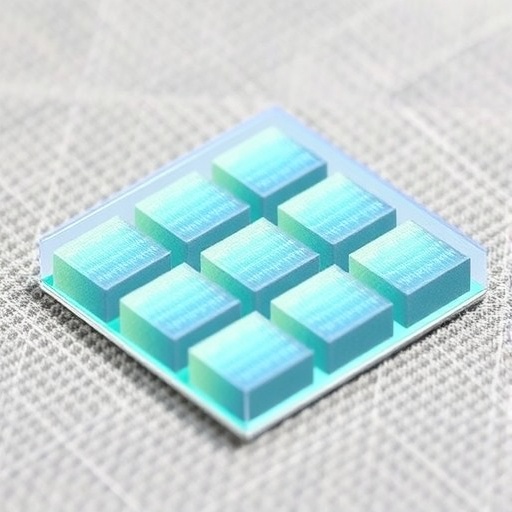
In a groundbreaking advancement poised to redefine wearable technology, a team of researchers led by Kovalska, Routledge, Cancelliere, and colleagues have unveiled multifunctional, energy-autonomous textile sensors enabled by spray-coated two-dimensional (2D) heterostructures. Published in the 2026 edition of npj Flexible Electronics, this work represents a seminal stride toward fully integrated, self-powered smart textiles that can operate independently of external power sources. The implications for fields ranging from health monitoring to environmental sensing are profound, offering a glimpse into a future where clothing itself becomes an intelligent interface with the world.
At the heart of this innovation is the clever exploitation of two-dimensional heterostructures—materials consisting of atomically thin layers stacked or combined to bestow unique electronic, optical, and mechanical properties. 2D materials such as graphene and transition metal dichalcogenides (TMDs) have been a hotbed of research interest over the last decade, thanks to their exceptional conductivity, flexibility, and tunable bandgaps. However, integrating these materials into textiles on a scale and with functionality suitable for everyday use has posed immense challenges.
The researchers addressed these challenges through a novel spray-coating technique that allows uniform deposition of 2D heterostructures directly onto fabric substrates without impairing the cloth’s flexibility or breathability. By carefully optimizing the spray parameters, layer thickness, and post-treatment processes, they achieved a seamless integration of nano-engineered materials into conventional textile fibers. This method not only circumvents the fragility issues typical of 2D materials but also is scalable for industrial production, a critical factor for commercial viability.
Functionality-wise, these sensors are truly multifunctional. They are capable of concurrently monitoring physiological signals such as body temperature, heart rate-related bioelectrical activity, and motion dynamics—all while harvesting energy from ambient sources to power themselves. The energy-autonomy is a game-changer. Eliminating reliance on embedded batteries, which add bulk and raise safety concerns, these textiles embrace energy-harvesting modules derived from the inherent properties of the 2D heterostructures. For instance, they can convert mechanical strain or thermal gradients produced by body movements and temperature differences into electrical energy, thereby powering sensor operations sustainably.
To achieve this sophisticated energy-harvesting capability, the team designed heterostructures that exploit piezoelectric and thermoelectric effects inherent in certain 2D materials. The piezoelectric effect enables the generation of electric charge in response to mechanical deformation, while the thermoelectric effect converts temperature differences directly into voltage. By stacking layers with complementary properties, the sensor fabric harvests multiple forms of ambient energy, significantly extending operational runtime without external charging.
Moreover, the paper highlights the sensors’ outstanding mechanical robustness. The textiles maintain stable sensor performance through repeated stretching, bending, and twisting cycles, preserving the material’s structural integrity and electrical characteristics. This mechanical resilience is critical for wearable applications, where the fabric undergoes continuous deformation during daily activities. The combination of durability with multifunctionality and energy autonomy formulates a benchmark for future smart textile development.
Another remarkable aspect is the high sensitivity and rapid response times exhibited by these sensors. The researchers report that the devices detect subtle physiological fluctuations with accuracy comparable to conventional rigid sensors. This performance is achieved without sacrificing comfort or wearability, underscoring the synergy between advanced material science and pragmatic engineering that the study embodies.
In addition to personal health monitoring, the authors discuss broader applications extending to environmental monitoring and human-machine interfaces. For example, the textile sensors could detect hazardous gases, pollutants, or UV exposure levels, all while operating independently and unobtrusively. Furthermore, incorporation into augmented reality systems could enable garments to seamlessly interact with digital devices, responding in real-time to user gestures or physiological cues.
This research also marks a significant leap toward the realization of the Internet of Things (IoT) in wearable formats. The energy-autonomous textile sensors can continuously collect and transmit data without the need for bulky peripheral devices or frequent recharging. When paired with wireless communication modules, these textiles offer an integrated platform for real-time, pervasive sensing—transforming clothing from passive apparel to active data hubs.
The spray-coating technique itself merits attention. The authors provide detailed characterizations of coating uniformity, adhesion strength, and conductivity mappings, demonstrating scalable manufacturing potential. Unlike more conventional synthesis methods that involve complex lithographic processes or vacuum deposition, spray-coating offers a cost-effective, rapid, and versatile route adaptable to diverse fabric types and sensor architectures.
In terms of future directions, the study opens pathways for integrating additional functionalities such as self-healing capability, color-changing indicators, and biodegradability. By tweaking the heterostructure compositions or combining them with emerging 2D materials, further enhancements in efficiency, sensitivity, and durability are plausible. Additionally, coupling these sensors with artificial intelligence algorithms could unlock sophisticated pattern recognition and predictive diagnostics in wearable healthcare.
One of the more compelling implications is the potential to overcome limitations encountered with battery life and rigidity that have long hindered wearable sensor deployment at scale. The seamless energy autonomy significantly reduces maintenance burdens and enhances user compliance, which are key hurdles in translating wearable sensors from research prototypes to everyday health management tools.
Moreover, the lightweight, flexible, and washable nature of these fabrics ensures practicality. Users can treat smart garments like ordinary clothes—laundering, wearing, and discarding without concerns over damage to sensor integrity. This user-centric design aspect addresses a fundamental usability gap that has impeded prior smart textile technologies.
The multidisciplinary collaboration between materials scientists, electrical engineers, textile experts, and biomedical researchers exemplifies how convergent approaches catalyze innovation. Such integrative efforts are increasingly vital for creating technologies that not only function at the lab scale but also meet real-world demands of comfort, robustness, and accessibility.
In conclusion, the work by Kovalska et al. heralds a new era for smart textiles, marrying the electrical and mechanical virtues of 2D heterostructures with practical manufacturing and operational autonomy. It is a compelling demonstration of how nanotechnology can empower fabrics to sense, think, and sustain themselves, potentially revolutionizing wearable electronics by embedding intelligence invisibly within the very garments we wear.
As this technology advances towards commercial deployment, it promises to reshape industries from personalized medicine to interactive fashion and environmental stewardship. The energy-autonomous, multifunctional textile sensors illuminate the thrilling horizon where science fiction’s dream of smart clothing becomes tangible reality, signaling a paradigm shift in how humans interact not only with technology but also with their own bodies and environment in real time.
Cite Scienmag News
Denise Maddox. (February 27, 2026). Energy-Harvesting Textile Sensors from 2D Coatings. Scienmag. https://scienmag.com/energy-harvesting-textile-sensors-from-2d-coatings/
Denise Maddox. "Energy-Harvesting Textile Sensors from 2D Coatings." Scienmag, 27 February 2026, https://scienmag.com/energy-harvesting-textile-sensors-from-2d-coatings/. Accessed 4 September 2026.
Denise Maddox. "Energy-Harvesting Textile Sensors from 2D Coatings." Scienmag. February 27, 2026. https://scienmag.com/energy-harvesting-textile-sensors-from-2d-coatings/


