


URBANA, Ill. — Elephant conservation is a major priority in southern Africa, but habitat loss and urbanization mean the far-ranging pachyderms are increasingly restricted to protected areas like game reserves. The risk? Contained populations could become genetically isolated over time, making elephants more vulnerable to disease and environmental change.

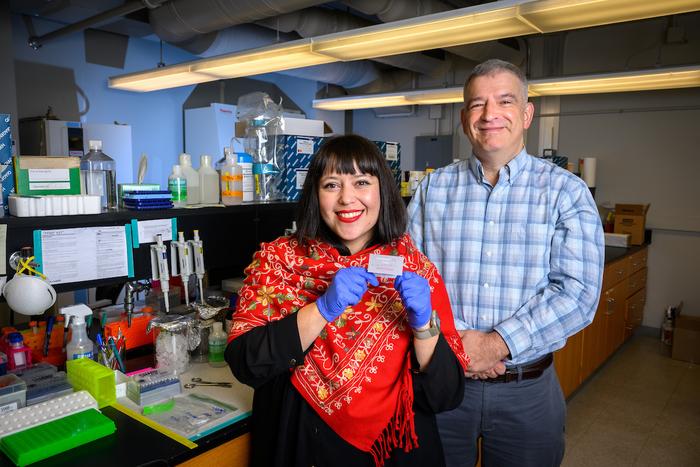
Credit: Fred Zwicky, University of Illinois Urbana-Champaign
URBANA, Ill. — Elephant conservation is a major priority in southern Africa, but habitat loss and urbanization mean the far-ranging pachyderms are increasingly restricted to protected areas like game reserves. The risk? Contained populations could become genetically isolated over time, making elephants more vulnerable to disease and environmental change.
A recent study from the University of Illinois Urbana-Champaign and the University of Pretoria in South Africa demonstrates how African conservation managers could create and optimize elephant movement corridors across a seven-country region. The study offers a map showing landscape connections that would support elephants’ habitat needs and allow for more gene flow among populations.
“Other research groups have integrated genetic and spatial data before, but usually it’s done on a more local scale. Ours was the first to combine both types of data for southern African elephants across such a large geographic area,” said lead author Alida de Flamingh, who completed the study as part of her doctoral program in the Department of Animal Sciences, part of the College of Agricultural, Consumer and Environmental Sciences (ACES) at Illinois. She is now a postdoctoral researcher at the Carl R. Woese Institute for Genomic Biology.
Scale is meaningful because African elephants have very large home ranges — roaming up to 11,000 square kilometers, or more than 2.7 million acres — and they often travel long distances out of their way to avoid unsuitable habitat. Capturing that scale in a single analysis was no easy feat.
“This was a massive effort. We went out with our partners in the Conservation Ecology Research Unit at the University of Pretoria to collect non-invasive DNA samples from elephant dung across the whole range,” de Flamingh said. “CERU also contributed data from GPS trackers on 80 collared elephants across nearly 54,000 locations.”
GPS collar data shows how elephants move across the landscape but can’t indicate whether that movement leads to gene flow. Conversely, DNA data documents gene flow, but can’t show how elephants moved to make that happen. Integrating the two data sets required a landscape genetics approach.
“Landscape genetics adapts some ideas from electrical circuit theory to discuss how animals might move and achieve gene flow. Our approach looks at resistances or costs elephants encounter as they move along multiple pathways through the region, accounting for the possibility of losing or gaining individual paths,” said co-author Nathan Alexander, a postdoctoral researcher at the Illinois Natural History Survey. Alexander worked on the project during his doctoral program in the Department of Natural Resources and Environmental Sciences in ACES.
Costs in this case included steep slopes, barren areas with little to no vegetation, densely populated human settlements, and areas far from water. The researchers combined these environmental challenges with DNA data to explain how elephants might navigate their habitat, identifying key routes to maintain gene flow across protected areas.
“We did not find a simple linear relationship where more suitable habitats are less costly. Instead, we found a pronounced nonlinear pattern where the least suitable habitats have the biggest impact on elephant movement or distribution across the landscape,” de Flamingh said. “Intermediate habitats aren’t necessarily dictating their movements as much as these really, really unsuitable habitats. That’s positive, if you think about it. They’re tolerant of intermediate habitats and can still move through them.”
What qualifies as a “really, really unsuitable” habitat? The researchers identified areas like the vegetation-free Makgadikgadi salt pans in Botswana, as well as densely populated human settlements. Providing connections for elephants that avoid these areas will also reduce human-elephant conflict, a distinct threat to elephants.
De Flamingh said the insights gained from this study can help governmental authorities and NGOs in southern Africa to develop robust conservation initiatives on the ground.
“Southern Africa has the largest number of elephants in all of Africa. So any conservation efforts there, especially those that avoid human-elephant conflict, would protect pretty large populations of elephants,” said senior author Al Roca, an animal sciences professor in ACES. “Our partners at CERU, as well as our funders — the International Fund for Animal Welfare and the African Elephant Conservation Fund of the U.S. Fish and Wildlife Service — are really critical in those efforts.”
The study, “Integrating habitat suitability modeling with gene flow improves delineation of landscape connections among African savanna elephants,” is published in Biodiversity and Conservation [DOI:10.1007/s10531-024-02910-0]. The paper is dedicated to the memory of co-author Rudi van Aarde, who was instrumental in launching the study as head of CERU, and who passed away while the research was ongoing.
Roca is also affiliated with the Carl R. Woese Institute for Genomic Biology, the Illinois Natural History Survey, and the School of Information Sciences at Illinois.
Journal
Biodiversity and Conservation
Cite Scienmag News
Denise Maddox. (August 6, 2024). Elephants on the move: Mapping connections across African landscapes. Scienmag. https://scienmag.com/elephants-on-the-move-mapping-connections-across-african-landscapes/
Denise Maddox. "Elephants on the move: Mapping connections across African landscapes." Scienmag, 6 August 2024, https://scienmag.com/elephants-on-the-move-mapping-connections-across-african-landscapes/. Accessed 6 September 2026.
Denise Maddox. "Elephants on the move: Mapping connections across African landscapes." Scienmag. August 6, 2024. https://scienmag.com/elephants-on-the-move-mapping-connections-across-african-landscapes/

