


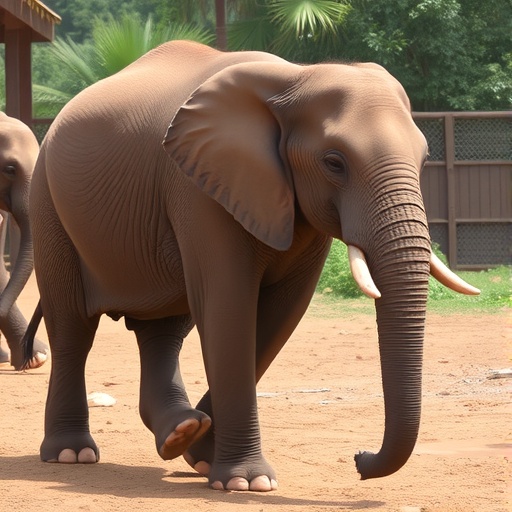
More than 15 years of collaboration between Baylor College of Medicine (BCM) and Houston Zoo has produced the first peer-reviewed evidence that an experimental mRNA vaccine could protect young Asian elephants against elephant endotheliotropic herpesvirus (EEHV), one of the deadliest threats to the species.
The findings are reported in two companion Journal of Virology papers. Together, they describe how the elephant mRNA platform was engineered and tested, and they provide clinical evidence that vaccinated animals can withstand natural EEHV1A exposure without progressing to severe hemorrhagic disease.
The work traces back to 2009, when Houston Zoo began partnering with BCM virologist Dr. Paul Ling after a young zoo elephant succumbed to EEHV. Over time, the partnership advanced diagnostics, treatment strategies, and prevention approaches, establishing a pipeline from viral understanding to translational intervention.
A key milestone occurred on June 18, 2024, when Houston Zoo’s Asian elephant Tess became the first elephant to receive the experimental EEHV mRNA vaccine. Additional study participants included Houston Zoo elephants Winnie and Teddy.
In the immunogenicity study, researchers evaluated a multi-antigen mRNA vaccine in nine Asian elephants across five institutions. The vaccine induced sustained immune responses targeting key viral proteins, supporting the idea that mRNA-encoded antigens can drive protective antiviral immunity in a large mammal with limited prior vaccine data.
A companion study then assessed real-world protection. Two vaccinated juvenile elephants at Cincinnati Zoo later developed natural EEHV1A infection, yet remained clinically healthy, required no medical intervention, and recovered without hemorrhagic disease.
“This is the first published evidence that vaccination can induce protective immune responses against EEHV and may prevent the severe disease associated with primary infection,” said Dr. Paul D. Ling. “While more research is needed, this represents a significant step toward protecting vulnerable elephant calves.”
The authors emphasize that these studies mark the first peer-reviewed report of mRNA vaccine administration in elephants and the first published clinical protection signal linked to an EEHV mRNA vaccine during natural infection.
Next-generation vaccine development is already underway for Asian elephants, alongside efforts to explore approaches for African elephants. If these strategies translate more broadly, they could reshape EEHV prevention and improve survival prospects for calves in zoos and beyond.
News Publication Date: 28-Jul-2026
Web References:
https://journals.asm.org/doi/10.1128/jvi.02186-25
https://journals.asm.org/doi/10.1128/jvi.00388-26
References:
https://journals.asm.org/doi/10.1128/jvi.02186-25
https://journals.asm.org/doi/10.1128/jvi.00388-26
Cite Scienmag News
Kristina Jarvis. (July 28, 2026). Elephant Vaccine Early Results Show Protection Against Deadly Virus. Scienmag. https://scienmag.com/elephant-vaccine-early-results-show-protection-against-deadly-virus/
Kristina Jarvis. "Elephant Vaccine Early Results Show Protection Against Deadly Virus." Scienmag, 28 July 2026, https://scienmag.com/elephant-vaccine-early-results-show-protection-against-deadly-virus/. Accessed 4 September 2026.
Kristina Jarvis. "Elephant Vaccine Early Results Show Protection Against Deadly Virus." Scienmag. July 28, 2026. https://scienmag.com/elephant-vaccine-early-results-show-protection-against-deadly-virus/


