


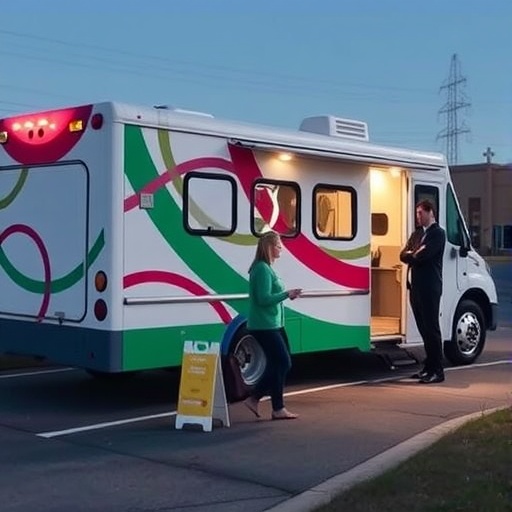
A study co-led by investigators at Mass General Brigham finds that mobile addiction services can be scaled across multiple organizations and communities, delivering addiction treatment, harm reduction, and basic healthcare directly to people who use drugs—particularly those cut off from traditional systems. Published in the International Journal of Environmental Research and Public Health, the work frames mobile clinics as a practical infrastructure for reaching high-risk groups in real-world settings.
Lead researchers highlight adaptability as a core technical advantage. The team reports that street-based mobile addiction services can be operated by different kinds of entities, from academic medical systems to community health centers, without losing core functional components of care. Senior author Elsie M. Taveras, MD, MPH, notes that the model’s performance supported effective deployment across regions.
The program studied—Community Care in Reach®—began in 2018 in Boston as a single mobile clinic. With support from the Massachusetts Department of Public Health and the Kraft Center, it expanded to six programs across Massachusetts, targeting adults who are unhoused or at imminent risk of losing housing. This growth enabled multisite learning about how mobile outreach can be sustained over time.
Across the observation window from January 1, 2022 to June 30, 2024, the investigators quantified service reach and clinical engagement. The teams documented 17,887 harm reduction encounters, designed to reduce the negative health, social, and legal consequences linked to drug use.
In parallel, the mobile units supported 16,117 clinical encounters serving 4,645 individuals. These contacts were not merely informational: the services included initiation of buprenorphine, a medication commonly used for opioid use disorder, which was started in 1,227 people.
A key outcomes signal concerned retention in treatment. Among those who initiated buprenorphine, 15% remained on buprenorphine-based treatment after 180 days. The study interprets this as a meaningful foothold for ongoing care among populations often facing unstable housing and interrupted access.
The analysis also describes operational challenges that varied by program, including differences in local capacity and implementation logistics. Even so, researchers found consistent engagement of hard-to-reach individuals, suggesting that mobile presence can function as a low-barrier “access point” where services can meet people on the street.
Cynthia A. Tschampl, PhD, emphasizes that multisite expansion can serve adults with complex needs. The physical visibility of mobile units appears to lower participation friction and support entry into clinical pathways.
Cite Scienmag News
Phoebe Ingram. (July 28, 2026). Study Finds Effects of Expanding Mobile Clinics for Addiction Treatment. Scienmag. https://scienmag.com/study-finds-effects-of-expanding-mobile-clinics-for-addiction-treatment/
Phoebe Ingram. "Study Finds Effects of Expanding Mobile Clinics for Addiction Treatment." Scienmag, 28 July 2026, https://scienmag.com/study-finds-effects-of-expanding-mobile-clinics-for-addiction-treatment/. Accessed 5 September 2026.
Phoebe Ingram. "Study Finds Effects of Expanding Mobile Clinics for Addiction Treatment." Scienmag. July 28, 2026. https://scienmag.com/study-finds-effects-of-expanding-mobile-clinics-for-addiction-treatment/


