


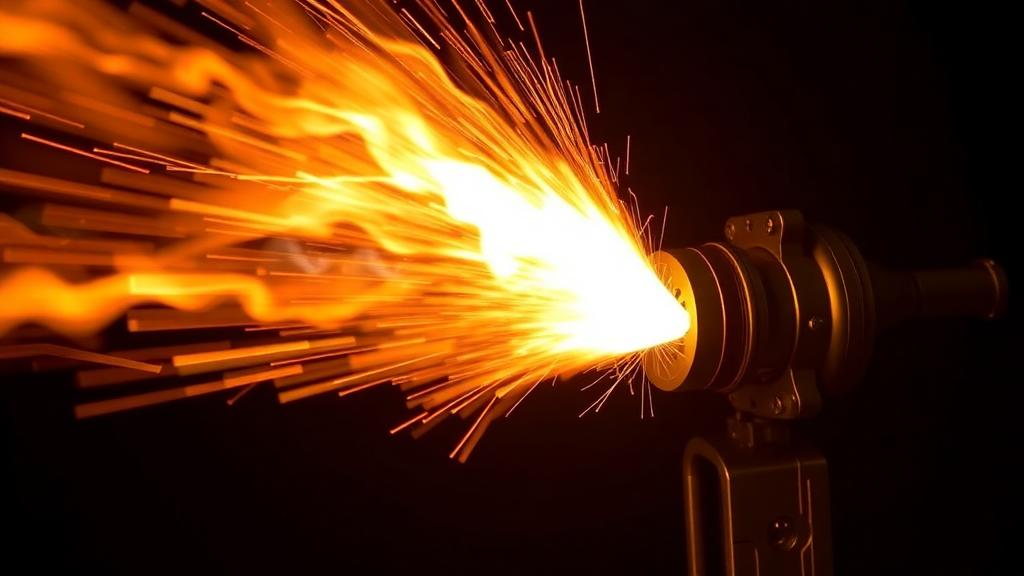
A team of researchers at Beijing Jiaotong University has demonstrated, for the first time at the thruster system level, that ammonium dinitramide-based rocket thrusters can be ignited electrically without any catalyst, eliminating one of the most persistent bottlenecks in green space propulsion. The study, published in Space: Science & Technology, describes a preliminary hot-fire test campaign in which a 5-newton thruster burning an ADN-based liquid propellant achieved cold-start ignition and stable combustion at room temperature using a combined scheme of resistive ignition and arc-assisted combustion. The result marks a significant departure from the catalytic ignition route that every ADN thruster currently flying in engineering applications has been forced to adopt, and it arrives at a moment when demand for non-toxic, high-performance propellants is accelerating across the satellite industry.
To understand why this demonstration matters, it helps to look at the limitations of the technology it seeks to replace. Ammonium dinitramide-based liquid propellants have attracted extensive attention as a new-generation green alternative to hydrazine-based fuels because they are non-toxic, deliver high specific impulse, and exhibit favorable stability. Yet all existing ADN thrusters rely on catalytic ignition, in which highly active catalyst beds decompose the propellant so that it can burn. That approach carries inherent drawbacks. The catalyst cannot withstand temperatures exceeding 1500 kelvin, and the catalytic bed must be preheated to above 623 kelvin before the thruster can start. In the Prisma mission, in-flight preheating lasted between 600 and 720 seconds, with a single-event energy consumption of 25 kilojoules. Worse, insufficient preheating may lead to a hard start or even an explosion, a failure mode that severely constrains the rapid response capability and operational safety of the thruster.
The Beijing Jiaotong University team set out to overcome this technical bottleneck by designing an electric ignition experimental system that requires neither catalyst nor preheating. The system comprises the thruster itself, a propellant supply system, an ignition system, a data acquisition system, and a control system. The thruster’s structural design includes a swirl injector, a decomposition zone, a combustion chamber, honeycomb multi-layer decomposition electrodes, arc electrodes, and a Laval nozzle. The honeycomb electrode structure is the key innovation: it enlarges the contact area between the propellant and the electrodes while suppressing the secondary droplet splashing caused by micro-explosions, a phenomenon that can otherwise disrupt the delicate ignition process. By combining resistive heating with an electric arc, the design aims to enable rapid cold-start while avoiding the hard-start risk entirely.
The researchers conducted systematic hot-fire tests under conditions of 5 newtons of thrust and a propellant mass flow rate of 2.5 grams per second, investigating how ignition voltage, arc loading time, electrode gap, and electrode orifice diameter affect thruster performance. During the hot-fire process, the propellant undergoes a sequence of thermal events: under resistive heating, methanol in the formulation dehydrogenates, water evaporates, and the ammonium dinitramide thermally decomposes, generating strongly oxidizing intermediates. These intermediates subsequently undergo violent oxidation reactions with methanol and its dehydrogenation products inside the combustion chamber, releasing substantial heat. Photographs taken at four stages of the test, from pre-ignition through arc loading, ignition operation, and the end of the run, showed a bright orange glow at the combustion chamber window during arc loading, with light intensity increasing further during ignition operation, indicating that the decomposition products were successfully ignited by the arc and achieved stable combustion.
The headline result came under operating conditions of 80 volts ignition voltage, a 3-millimeter electrode gap, and a 0.8-millimeter electrode orifice diameter. Under these settings, the thruster achieved cold-start ignition at room temperature, something catalytic designs cannot do without lengthy preheating. In a 30-second hot-fire test, the combustion chamber pressure was rapidly established after ignition, reaching an average of 0.93 megapascals. The ignition delay time was 0.64 seconds and the pressure establishment time was 1.02 seconds, figures that stand in stark contrast to the ten-minute preheating sequences required by catalytic systems in orbit. The measured characteristic velocity was 1168.7 meters per second, a value that exceeds the design value of hydrogen peroxide thrusters of comparable thrust level, underscoring the propellant’s performance credentials.
Electrical measurements provided additional insight into the ignition mechanism. The voltage and current curves revealed that the average current in the decomposition zone circuit was 3.3 amperes, corresponding to an average power of approximately 263 watts, and the circuit resistance gradually increased and stabilized as propellant decomposition proceeded. This resistance evolution offers a real-time diagnostic of the decomposition state, since the electrical properties of the decomposition zone change as the propellant transitions from liquid to hot reactive gases. The experiments also revealed periodic oscillations in the combustion chamber pressure, signaling the existence of combustion instability in the thruster, a phenomenon the team then set out to diagnose systematically.
The parametric studies yielded clear design guidance. Increasing the ignition voltage shortened the ignition delay time, falling from 0.93 seconds to 0.47 seconds when the voltage was raised from 60 to 100 volts, with 80 volts identified as the optimal voltage overall when all performance metrics were weighed together. Reducing the electrode gap shortened both the ignition delay time and the pressure establishment time, tightening the thermal coupling between the electrodes and the propellant. The electrode orifice diameter proved equally consequential: when it was increased from 0.3 to 0.8 millimeters, the average chamber pressure rose from 0.70 to 0.94 megapascals and the ignition delay time decreased from 1.70 to 0.59 seconds. However, further increasing the orifice to 1.2 millimeters degraded performance, because the excessively short residence time inhibited the decomposition reactions, a reminder that electrically ignited thrusters obey the same trade-offs between flow residence time and reaction completion as their chemical counterparts.
Perhaps the most scientifically revealing finding concerned the origin of the combustion instability. Fast Fourier transform analysis showed that the pressure oscillation frequencies were predominantly concentrated below 10 hertz, characteristic of low-frequency combustion instability, and the current oscillation frequency closely matched the pressure oscillation frequency with an opposite phase. This correlation demonstrates that unstable propellant decomposition, rather than any downstream aerodynamic effect, is the root cause of the combustion instability. Spray atomization analysis reinforced the conclusion: the dominant frequency of droplet size fluctuations was above 50 hertz, indicating no direct coupling with the pressure oscillations and only an indirect effect on the decomposition process. In practical terms, stabilizing the decomposition zone, whether through electrode design, arc control, or propellant formulation, becomes the central task for taming low-frequency oscillations in electrically ignited ADN thrusters.
The arc itself played a subtler role than the team may have initially expected. Although the arc proved not to be a necessary condition for propellant ignition and combustion, and exerted no significant effect on ignition response characteristics, it could effectively suppress low-frequency pressure oscillations and improve combustion stability. This positions the arc as a stability-control tool rather than an ignition trigger, a distinction that could shape how future thruster architectures allocate electrical power between the resistive decomposition circuit and the arc electrodes. It also suggests a pathway to adaptive operation, in which the arc is engaged only when pressure oscillations are detected, conserving onboard electrical resources during nominal operation.
The study does not pretend the concept is without cost. The energy consumption of approximately 263 watts in the decomposition zone circuit imposes higher demands on the spacecraft power system than a catalytic thruster, which draws no continuous electrical power during steady-state operation. For small satellites with constrained power budgets, this trade-off will need careful engineering attention. Even so, the advantages are compelling: the electrically ignited design overcomes the catalyst activity degradation and the explosion risk from insufficient preheating that are inherent to catalytic ignition, while offering extended lifespan and rapid startup. By providing critical experimental evidence and clear optimization directions, from the 80-volt optimum and the 0.8-millimeter orifice to the decomposition-driven mechanism of instability, the research establishes a credible engineering foundation for catalyst-free ADN thrusters and advances the broader goal of green, high-performance space propulsion systems capable of responding quickly and safely in orbit.
Subject of Research: Electrically ignited, catalyst-free ammonium dinitramide thrusters for green space propulsion
Article Title: Preliminary hot-fire test of ammonium dinitramide-based thrusters basedon electrical ignition
Article References: Preliminary hot-fire test of ammonium dinitramide-based thrusters basedon electrical ignition. (n.d.). Original publication
Image Credits: AI Generated
DOI: Not provided
Keywords: ammonium dinitramide, ADN propellant, green propulsion, electric ignition, resistive ignition, arc-assisted combustion, hot-fire test, combustion instability, hydrazine alternative, spacecraft thruster, catalyst-free ignition, Beijing Jiaotong University
Cite Scienmag News
Grant Pearson. (October 7, 2026). Electric Ignition Powers Green ADN Thruster Through First System-Level Hot-Fire Test. Scienmag. https://scienmag.com/electric-ignition-powers-green-adn-thruster-through-first-system-level-hot-fire-test/
Grant Pearson. "Electric Ignition Powers Green ADN Thruster Through First System-Level Hot-Fire Test." Scienmag, 7 October 2026, https://scienmag.com/electric-ignition-powers-green-adn-thruster-through-first-system-level-hot-fire-test/. Accessed 7 October 2026.
Grant Pearson. "Electric Ignition Powers Green ADN Thruster Through First System-Level Hot-Fire Test." Scienmag. October 7, 2026. https://scienmag.com/electric-ignition-powers-green-adn-thruster-through-first-system-level-hot-fire-test/


