


Space stations are no longer brief orbital outposts but long-duration laboratories whose hulls, trusses, and external payloads demand continuous attention. As extravehicular hardware ages, operators on the ground and crews inside pressurized modules increasingly rely on robotic arms to carry cameras along the station’s exterior, inspecting surfaces for micrometeoroid strikes, thermal coating degradation, and fatigue cracks. That shift in mission profile has exposed a stubborn gap in robotic autonomy: planning the motion of a highly articulated space manipulator so that it reaches its viewing positions quickly, smoothly, and safely remains a genuinely hard computational problem. A research team led by Zhu Zhanxia of the Unmanned Systems Research Institute at Northwestern Polytechnical University has now published a hierarchical motion planning method in the journal Space: Science & Technology that aims to close this gap by combining two historically separate families of planning algorithms into a single pipeline.
The difficulty stems from the sheer density of constraints that a space manipulator must respect simultaneously. A redundant arm, such as the seven-degree-of-freedom system studied by the team, has more joints than the minimum needed to position its end effector, which gives it the dexterity to reorient its shoulder and elbow around obstacles. That redundancy, however, turns every planning query into a high-dimensional search. The planner must satisfy kinematic limits on joint angles, velocities, and accelerations; dynamic limits on the torques each joint motor can deliver; collision-avoidance requirements as the arm sweeps through the space around the station; and, critically for inspection work, a line-of-sight constraint that keeps the camera mounted on the end effector pointed at the target within a fixed field of view. The researchers characterize the combined problem as a nonlinear, non-convex optimal control problem, a class in which standard solvers can stall in poor local solutions or fail to converge at all.
Existing approaches each capture only part of the picture. Sampling-based planners, including the widely used Rapidly-exploring Random Tree family, explore high-dimensional configuration spaces by randomly extending tree branches toward unexplored regions. They excel at rapidly finding collision-free paths even among complicated geometry, but the paths they return are typically jagged, dynamically infeasible, and of low quality, and their performance degrades badly once tight task constraints such as camera line-of-sight are added. Optimization-based methods take the opposite tack: they formulate trajectory generation as a mathematical program and, when they converge, produce smooth, dynamically feasible, high-quality trajectories. Their weakness is sensitivity to the initial guess. Without a good warm start, a nonlinear solver may diverge or settle into an unusable local minimum, and no general mechanism exists to supply that starting point automatically.
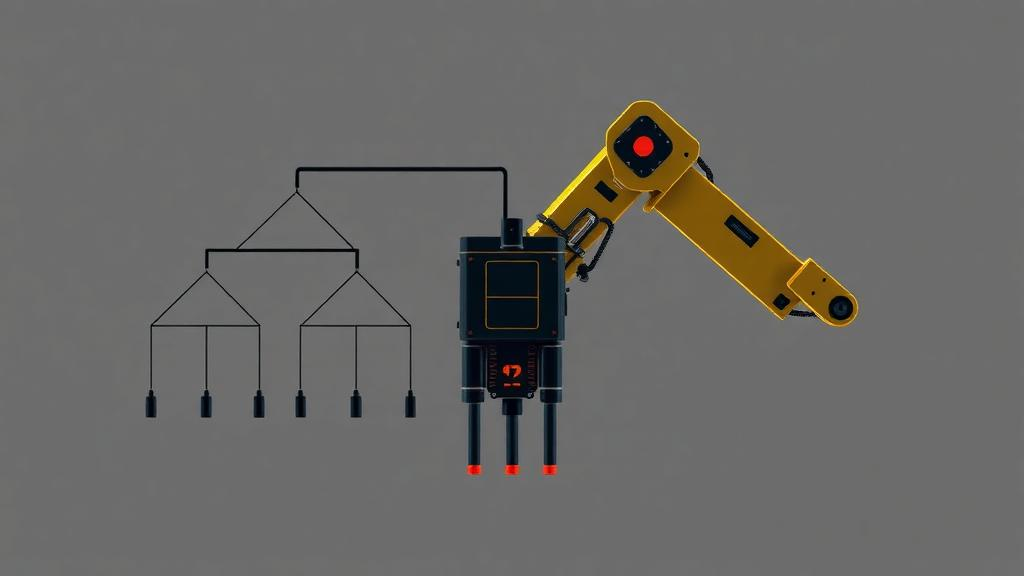
The insight behind the new method is that these two weaknesses are complementary. A sampling-based planner can find a rough but collision-free route quickly, and that route is exactly the kind of warm start an optimization-based solver needs. The team therefore built a two-level architecture. At the kinematic level, they designed a goal-biased RRT algorithm that steers random sampling toward the goal rather than exploring uniformly, accelerating convergence toward a feasible path. Collision checking uses axis-aligned bounding boxes together with the Separating Axis Theorem, a standard geometric test for determining whether two oriented volumes intersect. Once a path is found, a greedy pruning strategy eliminates redundant waypoints, and cubic spline interpolation converts the pruned waypoint sequence into a smooth, continuous reference trajectory in joint space, providing the high-quality initial guess for the second stage.
At the dynamic level, the method converts the full nonlinear problem into a sequence of convex programs that can be solved reliably and iteratively. The transformation is the technical heart of the work. Obstacle-avoidance constraints, which are inherently nonlinear because they describe distances between moving links and obstacles, are recast as linear inequalities on joint angular velocities using a velocity damping method, effectively forbidding joint rates that would carry any link into a forbidden region. The line-of-sight constraint, which ties the orientation of the end-effector camera to the direction of the target, is linearized through quaternion differentiation, representing rotations in a form amenable to first-order approximation. The manipulator’s dynamic equations, which couple joint accelerations to torques through configuration-dependent inertia terms, are linearized with a first-order Taylor expansion around the current trajectory iterate.
Because each linearization is only locally accurate, the researchers embed two safeguards that make the sequential scheme trustworthy. Successive linearization repeats the approximation at every iteration, so errors inherited from an early guess are corrected as the trajectory evolves. Trust-region constraints limit how far each new iterate may deviate from the trajectory around which the linearization was performed, preventing the solver from leaping to a point where the convex approximation no longer resembles the true nonlinear problem. Together, these mechanisms convert the original nonlinear, non-convex optimal control problem into an iteratively solved convex optimization problem, inheriting the reliability and speed of convex solvers while retaining, in the limit, the fidelity of the full nonlinear formulation.
To evaluate the framework, the team simulated a seven-degree-of-freedom space redundant manipulator in two monitoring scenarios: one in which the inspection target is static and one in which the target moves. In the static scenario, the manipulator must swing around an obstacle positioned directly on its mandatory path while keeping its end-effector camera trained on the target. The optimization converged to the optimum in 17 iterations, and the results show the end-effector line-of-sight angle remaining consistently within the 30-degree field of view throughout the motion, confirming that the camera constraint was enforced at every instant along the trajectory rather than merely at the endpoints.
The dynamic scenario imposed the additional challenge of tracking a moving target, which forces the planner to continuously reconcile the line-of-sight requirement with the arm’s dynamic limits. The algorithm converged in 18 iterations, and the resulting trajectory satisfied the end-effector line-of-sight constraint effectively even though the driving torque of joint 3 briefly saturated at certain instants, a detail the authors report transparently. Solution times were 112.7 seconds for the static scenario and 122.9 seconds for the dynamic one. The team also compared their goal-biased RRT against a standard RRT across 100 path planning experiments, finding that the biased variant achieved higher computational efficiency and could supply a warm-start reference to the convex stage more rapidly, validating the design of the kinematic layer as well as the dynamic one.
The broader significance of the work lies in how it restructures a notoriously difficult problem rather than attacking it with brute force. By delegating global feasibility to a fast stochastic search and local quality to disciplined convex optimization, the hierarchical method sidesteps the poor scalability of sampling-based planners under dense constraints and the initialization fragility of pure optimization approaches. For mission designers, that means inspection trajectories for redundant space arms can be generated autonomously, smoothly, and with verifiable satisfaction of torque, collision, and camera-pointing limits, capabilities that will matter as orbital stations grow and their upkeep depends increasingly on robotic labor. The authors position the method as a feasible technical solution for autonomous motion planning of space manipulators under end-effector task constraints such as extravehicular visual monitoring, and it arrives at a moment when the demand for such autonomy is rising sharply.
There are, of course, caveats that separate a convincing simulation from flight heritage. The reported solution times of roughly two minutes per scenario are practical for pre-planned inspection sorties but would need assessment against real-time replanning requirements if a target moved unpredictably or an obstacle changed position. The brief torque saturation of joint 3 in the dynamic scenario likewise illustrates how tightly constrained these motions are, and how future refinements might trade trajectory duration against actuator margins. Still, the study offers a concrete, validated recipe for merging two algorithmic traditions that the robotics community has long treated as alternatives, and it demonstrates on a realistic seven-degree-of-freedom system that the combination can deliver executable, constraint-respecting trajectories for one of the most demanding routine tasks in orbital operations.
Subject of Research: Hierarchical motion planning for space redundant manipulators under end-effector line-of-sight and obstacle constraints
Article Title: Hierarchical motion planning method for space redundant manipulators with end-task constraint
Article References: Hierarchical motion planning method for space redundant manipulators with end-task constraint. (n.d.). Original publication
Image Credits: AI Generated
DOI: Not provided
Keywords: space manipulator, motion planning, redundant manipulator, RRT, sequential convex programming, line-of-sight constraint, obstacle avoidance, trajectory optimization, on-orbit inspection, nonlinear optimal control, warm start, space robotics
Cite Scienmag News
Grant Pearson. (October 7, 2026). Hierarchical Planner Blends Random Tree Search and Convex Optimization for Space Manipulator Control. Scienmag. https://scienmag.com/hierarchical-planner-blends-random-tree-search-and-convex-optimization-for-space-manipulator-control/
Grant Pearson. "Hierarchical Planner Blends Random Tree Search and Convex Optimization for Space Manipulator Control." Scienmag, 7 October 2026, https://scienmag.com/hierarchical-planner-blends-random-tree-search-and-convex-optimization-for-space-manipulator-control/. Accessed 7 October 2026.
Grant Pearson. "Hierarchical Planner Blends Random Tree Search and Convex Optimization for Space Manipulator Control." Scienmag. October 7, 2026. https://scienmag.com/hierarchical-planner-blends-random-tree-search-and-convex-optimization-for-space-manipulator-control/


